

of electrons in the lowest unoccupied orbital of Ag, the Fermi energy level of Ag
nanoparticle will be lifted. Afterward, the superfluous electrons will migrate into the
CB of the neighboring AgCl. Simultaneously, the photo-generated electrons in CB
of semiconductor Y will transfer to Ag nanoparticle and combine with the holes in
the highest occupied orbital of Ag, while the photo-generated holes in VB of
semiconductor Y can participate in the photocatalytic reaction. Beneficial from
this special mechanism for separating photo-generated carriers, Z-scheme structured
AgX-Ag-Y photocatalytic material exhibit superior photocatalytic activity for
organic compound degradation [114–122]. For example, Wu et al. designed a
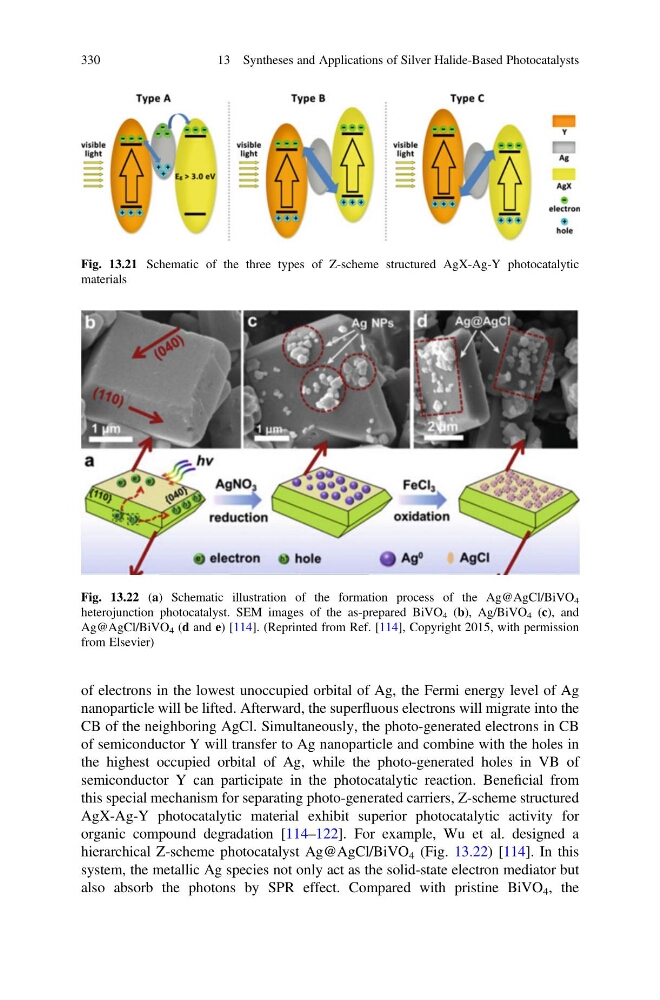
hierarchical Z-scheme photocatalyst Ag@AgCl/BiVO 4 (Fig. 13.22) [114]. In this
system, the metallic Ag species not only act as the solid-state electron mediator but
also absorb the photons by SPR effect. Compared with pristine BiVO 4 , the
Fig. 13.21 Schematic of the three types of Z-scheme structured AgX-Ag-Y photocatalytic
materials
Fig. 13.22 (a) Schematic illustration of the formation process of the Ag@AgCl/BiVO 4
heterojunction photocatalyst. SEM images of the as-prepared BiVO 4 (b), Ag/BiVO 4 (c), and
Ag@AgCl/BiVO 4 (d and e) [114]. (Reprinted from Ref. [114], Copyright 2015, with permission
from Elsevier)
330
13 Syntheses and Applications of Silver Halide-Based Photocatalysts
nanoparticle will be lifted. Afterward, the superfluous electrons will migrate into the
CB of the neighboring AgCl. Simultaneously, the photo-generated electrons in CB
of semiconductor Y will transfer to Ag nanoparticle and combine with the holes in
the highest occupied orbital of Ag, while the photo-generated holes in VB of
semiconductor Y can participate in the photocatalytic reaction. Beneficial from
this special mechanism for separating photo-generated carriers, Z-scheme structured
AgX-Ag-Y photocatalytic material exhibit superior photocatalytic activity for
organic compound degradation [114–122]. For example, Wu et al. designed a
hierarchical Z-scheme photocatalyst Ag@AgCl/BiVO 4 (Fig. 13.22) [114]. In this
system, the metallic Ag species not only act as the solid-state electron mediator but
also absorb the photons by SPR effect. Compared with pristine BiVO 4 , the
Fig. 13.21 Schematic of the three types of Z-scheme structured AgX-Ag-Y photocatalytic
materials
Fig. 13.22 (a) Schematic illustration of the formation process of the Ag@AgCl/BiVO 4
heterojunction photocatalyst. SEM images of the as-prepared BiVO 4 (b), Ag/BiVO 4 (c), and
Ag@AgCl/BiVO 4 (d and e) [114]. (Reprinted from Ref. [114], Copyright 2015, with permission
from Elsevier)
330
13 Syntheses and Applications of Silver Halide-Based Photocatalysts