

1. Type A
In type A, the Z-scheme AgX-Ag-Y photocatalytic material is composed of AgCl
(E g ¼ 3.2 eV) and another semiconductor Y with narrower band gap (E g < 3.0 eV).
As a result, under visible light irradiation, semiconductor Y can adsorb photons and
generate electron–hole pairs, while AgCl cannot. Furthermore, to meet the requirement of Z-scheme structure, the CB of semiconductor Y should be lower than that of
AgCl (E CB, AgCl ¼ À0.05 eV). In this case, the Ag nanoparticles simultaneously
serve as the electron mediator and photosensitizer, differing from the role of noble
metal nanoparticles in common Z-scheme structured photocatalytic materials.
As illustrated in Fig. 13.21, Ag nanoparticles can produce photo-generated
electrons and holes via SPR effect under visible light irradiation. Due to the store
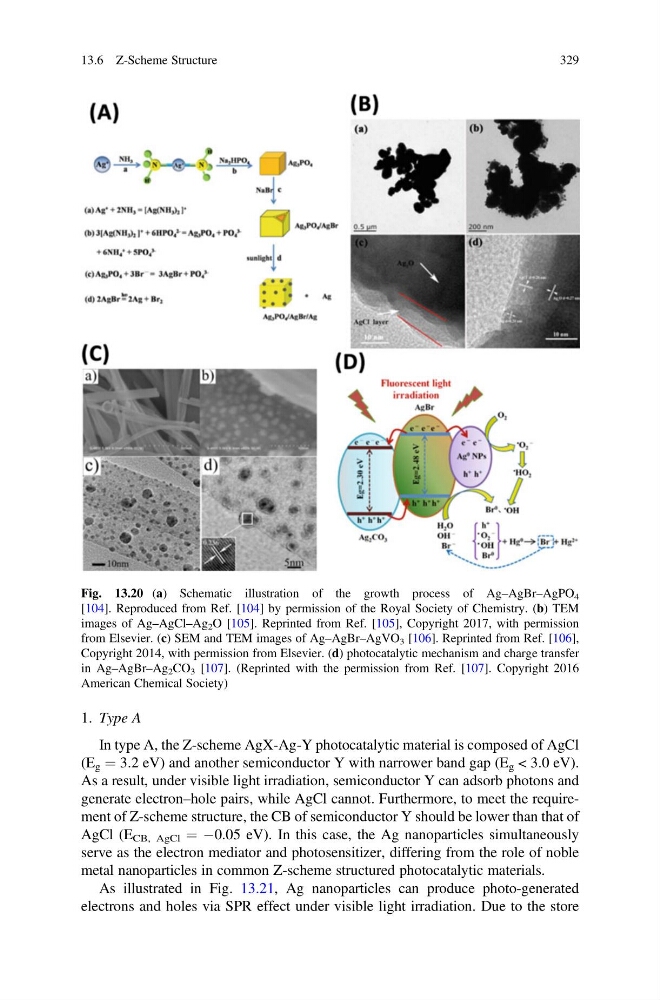
Fig. 13.20 (a) Schematic illustration of the growth process of Ag–AgBr–AgPO 4
[104]. Reproduced from Ref. [104] by permission of the Royal Society of Chemistry. (b) TEM
images of Ag–AgCl–Ag 2 O [105]. Reprinted from Ref. [105], Copyright 2017, with permission
from Elsevier. (c) SEM and TEM images of Ag–AgBr–AgVO 3 [106]. Reprinted from Ref. [106],
Copyright 2014, with permission from Elsevier. (d) photocatalytic mechanism and charge transfer
in Ag–AgBr–Ag 2 CO 3 [107]. (Reprinted with the permission from Ref. [107]. Copyright 2016
American Chemical Society)
13.6 Z-Scheme Structure
329
In type A, the Z-scheme AgX-Ag-Y photocatalytic material is composed of AgCl
(E g ¼ 3.2 eV) and another semiconductor Y with narrower band gap (E g < 3.0 eV).
As a result, under visible light irradiation, semiconductor Y can adsorb photons and
generate electron–hole pairs, while AgCl cannot. Furthermore, to meet the requirement of Z-scheme structure, the CB of semiconductor Y should be lower than that of
AgCl (E CB, AgCl ¼ À0.05 eV). In this case, the Ag nanoparticles simultaneously
serve as the electron mediator and photosensitizer, differing from the role of noble
metal nanoparticles in common Z-scheme structured photocatalytic materials.
As illustrated in Fig. 13.21, Ag nanoparticles can produce photo-generated
electrons and holes via SPR effect under visible light irradiation. Due to the store
Fig. 13.20 (a) Schematic illustration of the growth process of Ag–AgBr–AgPO 4
[104]. Reproduced from Ref. [104] by permission of the Royal Society of Chemistry. (b) TEM
images of Ag–AgCl–Ag 2 O [105]. Reprinted from Ref. [105], Copyright 2017, with permission
from Elsevier. (c) SEM and TEM images of Ag–AgBr–AgVO 3 [106]. Reprinted from Ref. [106],
Copyright 2014, with permission from Elsevier. (d) photocatalytic mechanism and charge transfer
in Ag–AgBr–Ag 2 CO 3 [107]. (Reprinted with the permission from Ref. [107]. Copyright 2016
American Chemical Society)
13.6 Z-Scheme Structure
329