

situ ion exchange approach to prepared AgI/AgVO 3 nanocomposites with β-AgVO 3
nanoribbons as the Ag source and support to immobilize AgI (Fig. 13.23b)
[124]. The as-prepared composites can serve as highly efficient visible light-driven
photocatalysts toward selective oxidation of benzylic amine to imine and reduction
of toxic Cr (VI) ions. It also found that the considerable improvement in the
photocatalytic redox properties of AgI/AgVO 3 is mainly ascribed to the efficient
separation of photoinduced electrons/holes via a Z-scheme bridge mechanism of
formed Ag/AgI/AgVO 3 , in which Ag nanoparticles serve as the charge migration
bridge.
3. Type C
Similar to Type B, the Z-scheme structured AgX-Ag-Y photocatalytic material in
Type C is also composed of AgX and semiconductor Y, in which both of them can
absorb visible light. However, as shown in Fig. 13.21c, the CB and VB of semiconductor Y is higher than that of AgX. Consequently, after the recombination process,
the photo-generated electrons with higher reduction ability in CB of semiconductor
Y and holes with better oxidation property in VB of AgX will be reserved. For
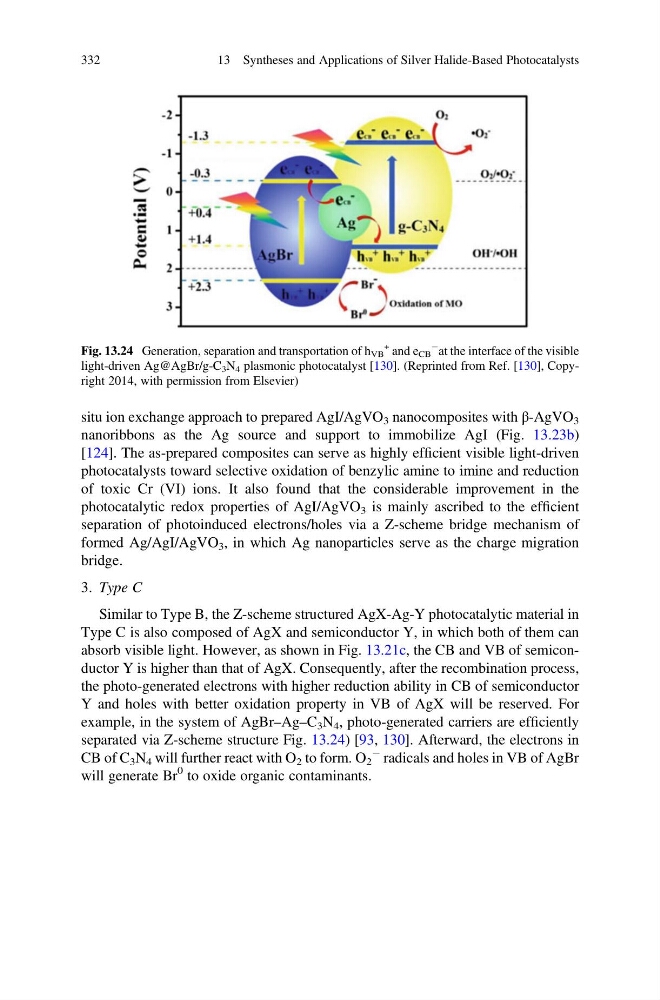
example, in the system of AgBr–Ag–C 3 N 4 , photo-generated carriers are efficiently
separated via Z-scheme structure Fig. 13.24) [93, 130]. Afterward, the electrons in
CB of C 3 N 4 will further react with O 2 to form. O 2
À radicals and holes in VB of AgBr
will generate Br
0 to oxide organic contaminants.
Fig. 13.24 Generation, separation and transportation of h VB
+ and e CB
À at the interface of the visible
light-driven Ag@AgBr/g-C 3 N 4 plasmonic photocatalyst [130]. (Reprinted from Ref. [130], Copyright 2014, with permission from Elsevier)
332
13 Syntheses and Applications of Silver Halide-Based Photocatalysts
nanoribbons as the Ag source and support to immobilize AgI (Fig. 13.23b)
[124]. The as-prepared composites can serve as highly efficient visible light-driven
photocatalysts toward selective oxidation of benzylic amine to imine and reduction
of toxic Cr (VI) ions. It also found that the considerable improvement in the
photocatalytic redox properties of AgI/AgVO 3 is mainly ascribed to the efficient
separation of photoinduced electrons/holes via a Z-scheme bridge mechanism of
formed Ag/AgI/AgVO 3 , in which Ag nanoparticles serve as the charge migration
bridge.
3. Type C
Similar to Type B, the Z-scheme structured AgX-Ag-Y photocatalytic material in
Type C is also composed of AgX and semiconductor Y, in which both of them can
absorb visible light. However, as shown in Fig. 13.21c, the CB and VB of semiconductor Y is higher than that of AgX. Consequently, after the recombination process,
the photo-generated electrons with higher reduction ability in CB of semiconductor
Y and holes with better oxidation property in VB of AgX will be reserved. For
example, in the system of AgBr–Ag–C 3 N 4 , photo-generated carriers are efficiently
separated via Z-scheme structure Fig. 13.24) [93, 130]. Afterward, the electrons in
CB of C 3 N 4 will further react with O 2 to form. O 2
À radicals and holes in VB of AgBr
will generate Br
0 to oxide organic contaminants.
Fig. 13.24 Generation, separation and transportation of h VB
+ and e CB
À at the interface of the visible
light-driven Ag@AgBr/g-C 3 N 4 plasmonic photocatalyst [130]. (Reprinted from Ref. [130], Copyright 2014, with permission from Elsevier)
332
13 Syntheses and Applications of Silver Halide-Based Photocatalysts