

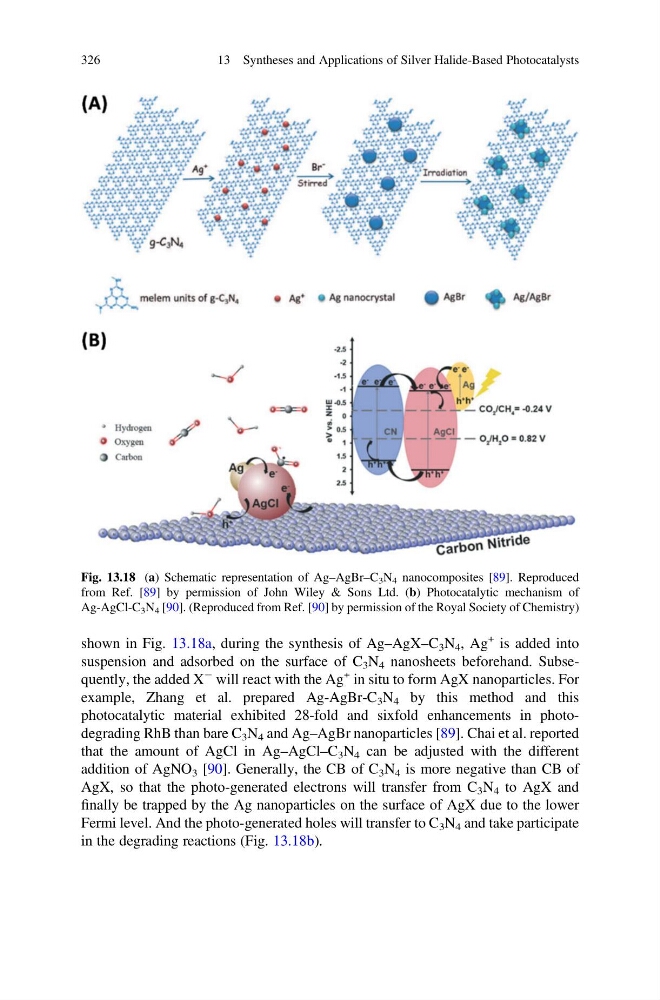
shown in Fig. 13.18a, during the synthesis of Ag–AgX–C 3 N 4 , Ag
+ is added into
suspension and adsorbed on the surface of C 3 N 4 nanosheets beforehand. Subsequently, the added X
À will react with the Ag
+ in situ to form AgX nanoparticles. For
example, Zhang et al. prepared Ag-AgBr-C 3 N 4 by this method and this
photocatalytic material exhibited 28-fold and sixfold enhancements in photodegrading RhB than bare C 3 N 4 and Ag–AgBr nanoparticles [89]. Chai et al. reported
that the amount of AgCl in Ag–AgCl–C 3 N 4 can be adjusted with the different
addition of AgNO 3 [90]. Generally, the CB of C 3 N 4 is more negative than CB of
AgX, so that the photo-generated electrons will transfer from C 3 N 4 to AgX and
finally be trapped by the Ag nanoparticles on the surface of AgX due to the lower
Fermi level. And the photo-generated holes will transfer to C 3 N 4 and take participate
in the degrading reactions (Fig. 13.18b).
Fig. 13.18 (a) Schematic representation of Ag–AgBr–C 3 N 4 nanocomposites [89]. Reproduced
from Ref. [89] by permission of John Wiley & Sons Ltd. (b) Photocatalytic mechanism of
Ag-AgCl-C 3 N 4 [90]. (Reproduced from Ref. [90] by permission of the Royal Society of Chemistry)
326
13 Syntheses and Applications of Silver Halide-Based Photocatalysts
+ is added into
suspension and adsorbed on the surface of C 3 N 4 nanosheets beforehand. Subsequently, the added X
À will react with the Ag
+ in situ to form AgX nanoparticles. For
example, Zhang et al. prepared Ag-AgBr-C 3 N 4 by this method and this
photocatalytic material exhibited 28-fold and sixfold enhancements in photodegrading RhB than bare C 3 N 4 and Ag–AgBr nanoparticles [89]. Chai et al. reported
that the amount of AgCl in Ag–AgCl–C 3 N 4 can be adjusted with the different
addition of AgNO 3 [90]. Generally, the CB of C 3 N 4 is more negative than CB of
AgX, so that the photo-generated electrons will transfer from C 3 N 4 to AgX and
finally be trapped by the Ag nanoparticles on the surface of AgX due to the lower
Fermi level. And the photo-generated holes will transfer to C 3 N 4 and take participate
in the degrading reactions (Fig. 13.18b).
Fig. 13.18 (a) Schematic representation of Ag–AgBr–C 3 N 4 nanocomposites [89]. Reproduced
from Ref. [89] by permission of John Wiley & Sons Ltd. (b) Photocatalytic mechanism of
Ag-AgCl-C 3 N 4 [90]. (Reproduced from Ref. [90] by permission of the Royal Society of Chemistry)
326
13 Syntheses and Applications of Silver Halide-Based Photocatalysts