

13.5.2.3 Ag–AgX–BiOX
Bismuth oxyhalides BiOX (X ¼ Cl, Br, I) have been paid close attention for their
outstanding optical and photocatalytic properties [95–97]. From the literatures, we
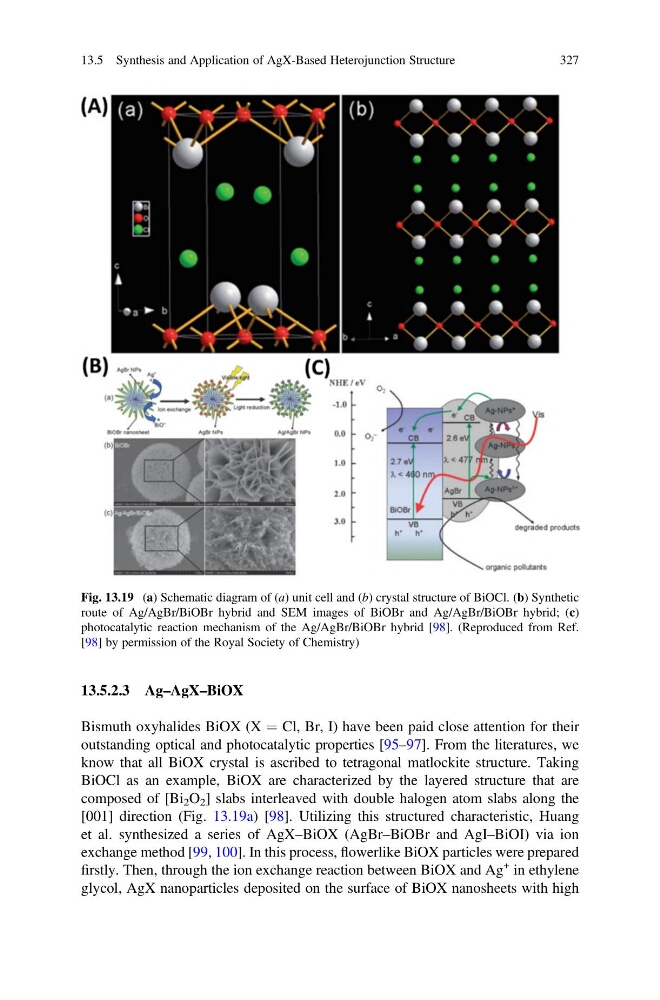
know that all BiOX crystal is ascribed to tetragonal matlockite structure. Taking
BiOCl as an example, BiOX are characterized by the layered structure that are
composed of [Bi 2 O 2 ] slabs interleaved with double halogen atom slabs along the
[001] direction (Fig. 13.19a) [98]. Utilizing this structured characteristic, Huang
et al. synthesized a series of AgX–BiOX (AgBr–BiOBr and AgI–BiOI) via ion
exchange method [99, 100]. In this process, flowerlike BiOX particles were prepared
firstly. Then, through the ion exchange reaction between BiOX and Ag
+ in ethylene
glycol, AgX nanoparticles deposited on the surface of BiOX nanosheets with high
Fig. 13.19 (a) Schematic diagram of (a) unit cell and (b) crystal structure of BiOCl. (b) Synthetic
route of Ag/AgBr/BiOBr hybrid and SEM images of BiOBr and Ag/AgBr/BiOBr hybrid; (c)
photocatalytic reaction mechanism of the Ag/AgBr/BiOBr hybrid [98]. (Reproduced from Ref.
[98] by permission of the Royal Society of Chemistry)
13.5 Synthesis and Application of AgX-Based Heterojunction Structure
327
Bismuth oxyhalides BiOX (X ¼ Cl, Br, I) have been paid close attention for their
outstanding optical and photocatalytic properties [95–97]. From the literatures, we
know that all BiOX crystal is ascribed to tetragonal matlockite structure. Taking
BiOCl as an example, BiOX are characterized by the layered structure that are
composed of [Bi 2 O 2 ] slabs interleaved with double halogen atom slabs along the
[001] direction (Fig. 13.19a) [98]. Utilizing this structured characteristic, Huang
et al. synthesized a series of AgX–BiOX (AgBr–BiOBr and AgI–BiOI) via ion
exchange method [99, 100]. In this process, flowerlike BiOX particles were prepared
firstly. Then, through the ion exchange reaction between BiOX and Ag
+ in ethylene
glycol, AgX nanoparticles deposited on the surface of BiOX nanosheets with high
Fig. 13.19 (a) Schematic diagram of (a) unit cell and (b) crystal structure of BiOCl. (b) Synthetic
route of Ag/AgBr/BiOBr hybrid and SEM images of BiOBr and Ag/AgBr/BiOBr hybrid; (c)
photocatalytic reaction mechanism of the Ag/AgBr/BiOBr hybrid [98]. (Reproduced from Ref.
[98] by permission of the Royal Society of Chemistry)
13.5 Synthesis and Application of AgX-Based Heterojunction Structure
327