

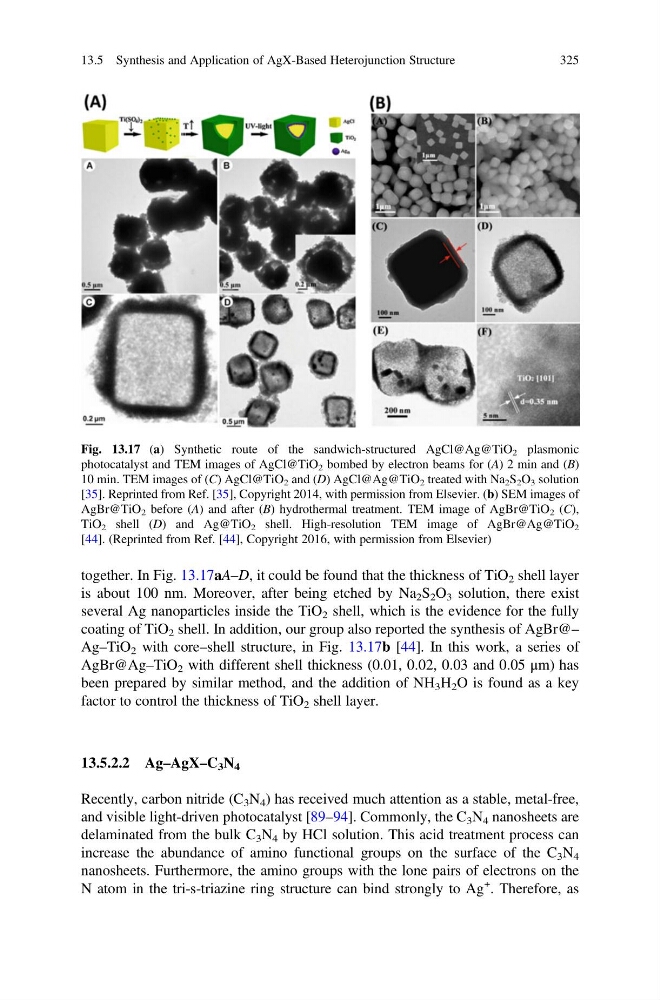
together. In Fig. 13.17aA–D, it could be found that the thickness of TiO 2 shell layer
is about 100 nm. Moreover, after being etched by Na 2 S 2 O 3 solution, there exist
several Ag nanoparticles inside the TiO 2 shell, which is the evidence for the fully
coating of TiO 2 shell. In addition, our group also reported the synthesis of AgBr@–
Ag–TiO 2 with core–shell structure, in Fig. 13.17b [44]. In this work, a series of
AgBr@Ag–TiO 2 with different shell thickness (0.01, 0.02, 0.03 and 0.05 μm) has
been prepared by similar method, and the addition of NH 3 H 2 O is found as a key
factor to control the thickness of TiO 2 shell layer.
13.5.2.2 Ag–AgX–C 3 N 4
Recently, carbon nitride (C 3 N 4 ) has received much attention as a stable, metal-free,
and visible light-driven photocatalyst [89–94]. Commonly, the C 3 N 4 nanosheets are
delaminated from the bulk C 3 N 4 by HCl solution. This acid treatment process can
increase the abundance of amino functional groups on the surface of the C 3 N 4
nanosheets. Furthermore, the amino groups with the lone pairs of electrons on the
N atom in the tri-s-triazine ring structure can bind strongly to Ag
+
. Therefore, as
Fig. 13.17 (a) Synthetic route of the sandwich-structured AgCl@Ag@TiO 2 plasmonic
photocatalyst and TEM images of AgCl@TiO 2 bombed by electron beams for (A) 2 min and (B)
10 min. TEM images of (C) AgCl@TiO 2 and (D) AgCl@Ag@TiO 2 treated with Na 2 S 2 O 3 solution
[35]. Reprinted from Ref. [35], Copyright 2014, with permission from Elsevier. (b) SEM images of
AgBr@TiO 2 before (A) and after (B) hydrothermal treatment. TEM image of AgBr@TiO 2 (C),
TiO 2 shell (D) and Ag@TiO 2 shell. High-resolution TEM image of AgBr@Ag@TiO 2
[44]. (Reprinted from Ref. [44], Copyright 2016, with permission from Elsevier)
13.5 Synthesis and Application of AgX-Based Heterojunction Structure
325
is about 100 nm. Moreover, after being etched by Na 2 S 2 O 3 solution, there exist
several Ag nanoparticles inside the TiO 2 shell, which is the evidence for the fully
coating of TiO 2 shell. In addition, our group also reported the synthesis of AgBr@–
Ag–TiO 2 with core–shell structure, in Fig. 13.17b [44]. In this work, a series of
AgBr@Ag–TiO 2 with different shell thickness (0.01, 0.02, 0.03 and 0.05 μm) has
been prepared by similar method, and the addition of NH 3 H 2 O is found as a key
factor to control the thickness of TiO 2 shell layer.
13.5.2.2 Ag–AgX–C 3 N 4
Recently, carbon nitride (C 3 N 4 ) has received much attention as a stable, metal-free,
and visible light-driven photocatalyst [89–94]. Commonly, the C 3 N 4 nanosheets are
delaminated from the bulk C 3 N 4 by HCl solution. This acid treatment process can
increase the abundance of amino functional groups on the surface of the C 3 N 4
nanosheets. Furthermore, the amino groups with the lone pairs of electrons on the
N atom in the tri-s-triazine ring structure can bind strongly to Ag
+
. Therefore, as
Fig. 13.17 (a) Synthetic route of the sandwich-structured AgCl@Ag@TiO 2 plasmonic
photocatalyst and TEM images of AgCl@TiO 2 bombed by electron beams for (A) 2 min and (B)
10 min. TEM images of (C) AgCl@TiO 2 and (D) AgCl@Ag@TiO 2 treated with Na 2 S 2 O 3 solution
[35]. Reprinted from Ref. [35], Copyright 2014, with permission from Elsevier. (b) SEM images of
AgBr@TiO 2 before (A) and after (B) hydrothermal treatment. TEM image of AgBr@TiO 2 (C),
TiO 2 shell (D) and Ag@TiO 2 shell. High-resolution TEM image of AgBr@Ag@TiO 2
[44]. (Reprinted from Ref. [44], Copyright 2016, with permission from Elsevier)
13.5 Synthesis and Application of AgX-Based Heterojunction Structure
325