

13.5.2.1 Ag–AgX–TiO 2
Titanium dioxide (TiO 2 ) has been widely researched as a kind of traditional
photocatalytic material with the advantages of low cost and high stability. Generally,
Ag–AgX–TiO 2 is synthesized by cation surfactant adsorption and photoreduction
technique [84–88]. In detail, a layer of cetyltrimethylammonium chloride (CTAC) or
cetyltrimethylammonium bromide (CTAB) is absorbed on the surface of TiO 2 .
Subsequently, Ag
+ ions are added and react with halogen ions on the surface of
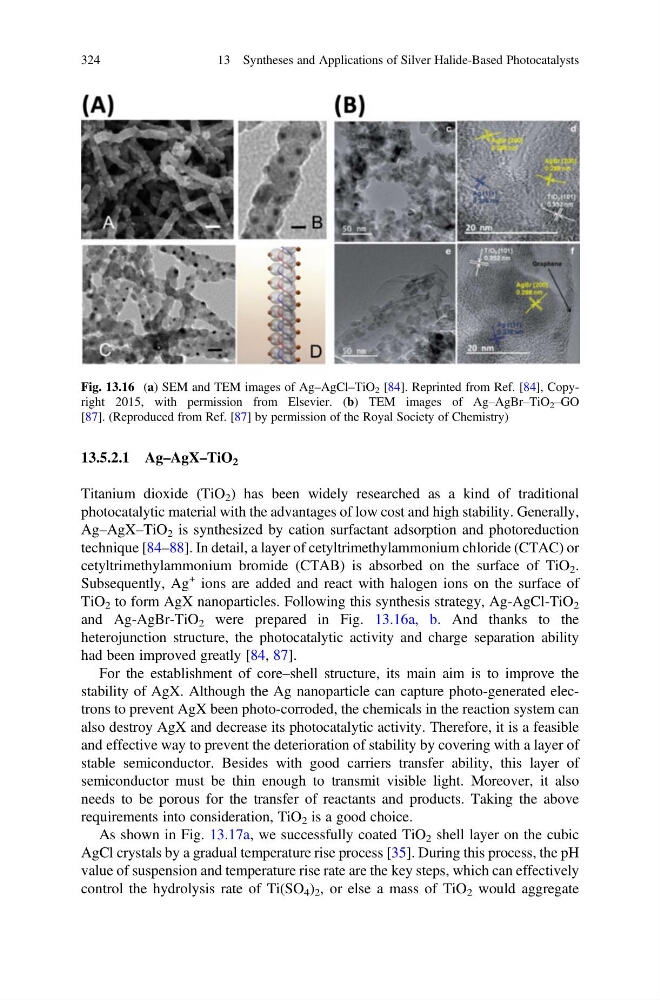
TiO 2 to form AgX nanoparticles. Following this synthesis strategy, Ag-AgCl-TiO 2
and Ag-AgBr-TiO 2 were prepared in Fig. 13.16a, b. And thanks to the
heterojunction structure, the photocatalytic activity and charge separation ability
had been improved greatly [84, 87].
For the establishment of core–shell structure, its main aim is to improve the
stability of AgX. Although the Ag nanoparticle can capture photo-generated electrons to prevent AgX been photo-corroded, the chemicals in the reaction system can
also destroy AgX and decrease its photocatalytic activity. Therefore, it is a feasible
and effective way to prevent the deterioration of stability by covering with a layer of
stable semiconductor. Besides with good carriers transfer ability, this layer of
semiconductor must be thin enough to transmit visible light. Moreover, it also
needs to be porous for the transfer of reactants and products. Taking the above
requirements into consideration, TiO 2 is a good choice.
As shown in Fig. 13.17a, we successfully coated TiO 2 shell layer on the cubic
AgCl crystals by a gradual temperature rise process [35]. During this process, the pH
value of suspension and temperature rise rate are the key steps, which can effectively
control the hydrolysis rate of Ti(SO 4 ) 2 , or else a mass of TiO 2 would aggregate
Fig. 13.16 (a) SEM and TEM images of Ag–AgCl–TiO 2 [84]. Reprinted from Ref. [84], Copyright 2015, with permission from Elsevier. (b) TEM images of Ag–AgBr–TiO 2 –GO
[87]. (Reproduced from Ref. [87] by permission of the Royal Society of Chemistry)
324
13 Syntheses and Applications of Silver Halide-Based Photocatalysts
Titanium dioxide (TiO 2 ) has been widely researched as a kind of traditional
photocatalytic material with the advantages of low cost and high stability. Generally,
Ag–AgX–TiO 2 is synthesized by cation surfactant adsorption and photoreduction
technique [84–88]. In detail, a layer of cetyltrimethylammonium chloride (CTAC) or
cetyltrimethylammonium bromide (CTAB) is absorbed on the surface of TiO 2 .
Subsequently, Ag
+ ions are added and react with halogen ions on the surface of
TiO 2 to form AgX nanoparticles. Following this synthesis strategy, Ag-AgCl-TiO 2
and Ag-AgBr-TiO 2 were prepared in Fig. 13.16a, b. And thanks to the
heterojunction structure, the photocatalytic activity and charge separation ability
had been improved greatly [84, 87].
For the establishment of core–shell structure, its main aim is to improve the
stability of AgX. Although the Ag nanoparticle can capture photo-generated electrons to prevent AgX been photo-corroded, the chemicals in the reaction system can
also destroy AgX and decrease its photocatalytic activity. Therefore, it is a feasible
and effective way to prevent the deterioration of stability by covering with a layer of
stable semiconductor. Besides with good carriers transfer ability, this layer of
semiconductor must be thin enough to transmit visible light. Moreover, it also
needs to be porous for the transfer of reactants and products. Taking the above
requirements into consideration, TiO 2 is a good choice.
As shown in Fig. 13.17a, we successfully coated TiO 2 shell layer on the cubic
AgCl crystals by a gradual temperature rise process [35]. During this process, the pH
value of suspension and temperature rise rate are the key steps, which can effectively
control the hydrolysis rate of Ti(SO 4 ) 2 , or else a mass of TiO 2 would aggregate
Fig. 13.16 (a) SEM and TEM images of Ag–AgCl–TiO 2 [84]. Reprinted from Ref. [84], Copyright 2015, with permission from Elsevier. (b) TEM images of Ag–AgBr–TiO 2 –GO
[87]. (Reproduced from Ref. [87] by permission of the Royal Society of Chemistry)
324
13 Syntheses and Applications of Silver Halide-Based Photocatalysts