

Normally, it is hard to control the morphology and exposed facets of AgX due to
the high reaction rate between Ag
+ ions and X
À ions [65–71]. Therefore, it is
necessary to slow down the reaction speed between Ag
+ ions and X
À ions to obtain
AgBr crystals with regular morphology and specific exposed facets. By precisely
controlling the injection speed of Ag
+ ions and X
À ions using the double-jet
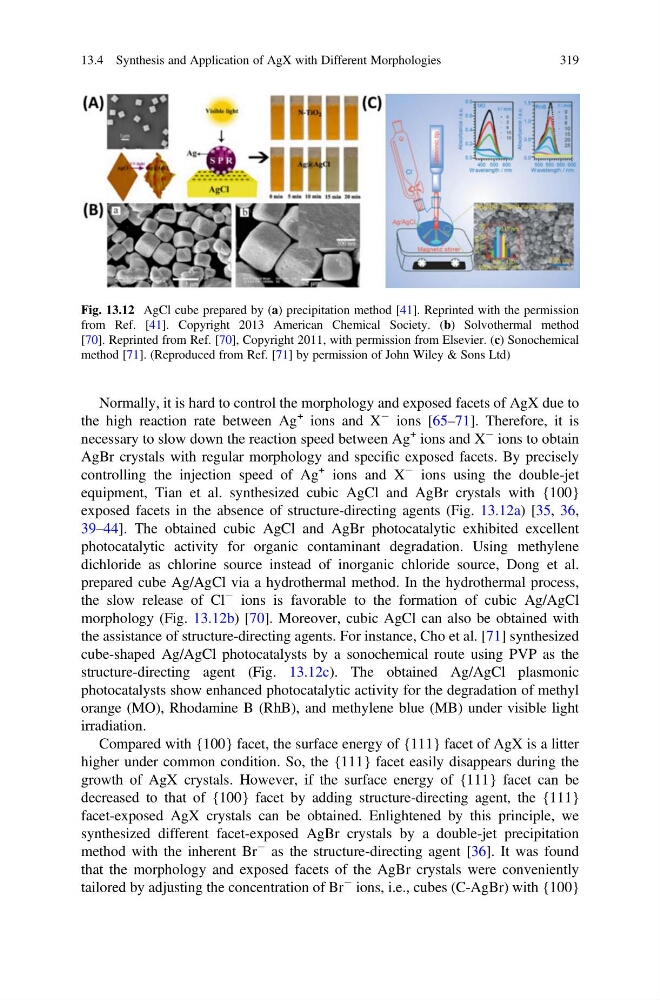
equipment, Tian et al. synthesized cubic AgCl and AgBr crystals with {100}
exposed facets in the absence of structure-directing agents (Fig. 13.12a) [35, 36,
39–44]. The obtained cubic AgCl and AgBr photocatalytic exhibited excellent
photocatalytic activity for organic contaminant degradation. Using methylene
dichloride as chlorine source instead of inorganic chloride source, Dong et al.
prepared cube Ag/AgCl via a hydrothermal method. In the hydrothermal process,
the slow release of Cl
À ions is favorable to the formation of cubic Ag/AgCl
morphology (Fig. 13.12b) [70]. Moreover, cubic AgCl can also be obtained with
the assistance of structure-directing agents. For instance, Cho et al. [71] synthesized
cube-shaped Ag/AgCl photocatalysts by a sonochemical route using PVP as the
structure-directing agent (Fig. 13.12c). The obtained Ag/AgCl plasmonic
photocatalysts show enhanced photocatalytic activity for the degradation of methyl
orange (MO), Rhodamine B (RhB), and methylene blue (MB) under visible light
irradiation.
Compared with {100} facet, the surface energy of {111} facet of AgX is a litter
higher under common condition. So, the {111} facet easily disappears during the
growth of AgX crystals. However, if the surface energy of {111} facet can be
decreased to that of {100} facet by adding structure-directing agent, the {111}
facet-exposed AgX crystals can be obtained. Enlightened by this principle, we
synthesized different facet-exposed AgBr crystals by a double-jet precipitation
method with the inherent Br
À as the structure-directing agent [36]. It was found
that the morphology and exposed facets of the AgBr crystals were conveniently
tailored by adjusting the concentration of Br
À ions, i.e., cubes (C-AgBr) with {100}
Fig. 13.12 AgCl cube prepared by (a) precipitation method [41]. Reprinted with the permission
from Ref. [41]. Copyright 2013 American Chemical Society. (b) Solvothermal method
[70]. Reprinted from Ref. [70], Copyright 2011, with permission from Elsevier. (c) Sonochemical
method [71]. (Reproduced from Ref. [71] by permission of John Wiley & Sons Ltd)
13.4 Synthesis and Application of AgX with Different Morphologies
319
the high reaction rate between Ag
+ ions and X
À ions [65–71]. Therefore, it is
necessary to slow down the reaction speed between Ag
+ ions and X
À ions to obtain
AgBr crystals with regular morphology and specific exposed facets. By precisely
controlling the injection speed of Ag
+ ions and X
À ions using the double-jet
equipment, Tian et al. synthesized cubic AgCl and AgBr crystals with {100}
exposed facets in the absence of structure-directing agents (Fig. 13.12a) [35, 36,
39–44]. The obtained cubic AgCl and AgBr photocatalytic exhibited excellent
photocatalytic activity for organic contaminant degradation. Using methylene
dichloride as chlorine source instead of inorganic chloride source, Dong et al.
prepared cube Ag/AgCl via a hydrothermal method. In the hydrothermal process,
the slow release of Cl
À ions is favorable to the formation of cubic Ag/AgCl
morphology (Fig. 13.12b) [70]. Moreover, cubic AgCl can also be obtained with
the assistance of structure-directing agents. For instance, Cho et al. [71] synthesized
cube-shaped Ag/AgCl photocatalysts by a sonochemical route using PVP as the
structure-directing agent (Fig. 13.12c). The obtained Ag/AgCl plasmonic
photocatalysts show enhanced photocatalytic activity for the degradation of methyl
orange (MO), Rhodamine B (RhB), and methylene blue (MB) under visible light
irradiation.
Compared with {100} facet, the surface energy of {111} facet of AgX is a litter
higher under common condition. So, the {111} facet easily disappears during the
growth of AgX crystals. However, if the surface energy of {111} facet can be
decreased to that of {100} facet by adding structure-directing agent, the {111}
facet-exposed AgX crystals can be obtained. Enlightened by this principle, we
synthesized different facet-exposed AgBr crystals by a double-jet precipitation
method with the inherent Br
À as the structure-directing agent [36]. It was found
that the morphology and exposed facets of the AgBr crystals were conveniently
tailored by adjusting the concentration of Br
À ions, i.e., cubes (C-AgBr) with {100}
Fig. 13.12 AgCl cube prepared by (a) precipitation method [41]. Reprinted with the permission
from Ref. [41]. Copyright 2013 American Chemical Society. (b) Solvothermal method
[70]. Reprinted from Ref. [70], Copyright 2011, with permission from Elsevier. (c) Sonochemical
method [71]. (Reproduced from Ref. [71] by permission of John Wiley & Sons Ltd)
13.4 Synthesis and Application of AgX with Different Morphologies
319