

shown in Fig. 13.10b-a and b-c, the AgCl–KCl eutectic infilled and solidified in
colloidal crystal template. After removing template and KCl, a rather complex
porous AgCl mesostructure containing features with characteristic dimensions of
100–200 nm is observed (Fig. 13.10b-d). Another feasible way to prepare 3D AgX
material is one-pot growing method. Shen et al. synthesized a cuboidal AgCl hollow
nanostructure by a simple one-pot reaction using AgNO 3 and CCl 4 as precursors
(Fig. 13.10c) [64]. The key process in this strategy is dissolution–precipitation
process. During this process, the Ag atoms in the core of the cubes gradually diffuse
outward and react with CCl 4 on the surface, where Ag atoms could be oxidized by
CCl 4 to form AgCl and deposited on the surface of each cube as a shell. In this case,
Ag cations or atoms have a higher diffuse speed compared with the incoming Cl
species, which causes a void space inside the cube and the formation of a hollow
structure (Fig. 13.10d).
13.4.3 Facet Exposed
The crystal structure of AgX is a face-centered cubic belonging to the space group
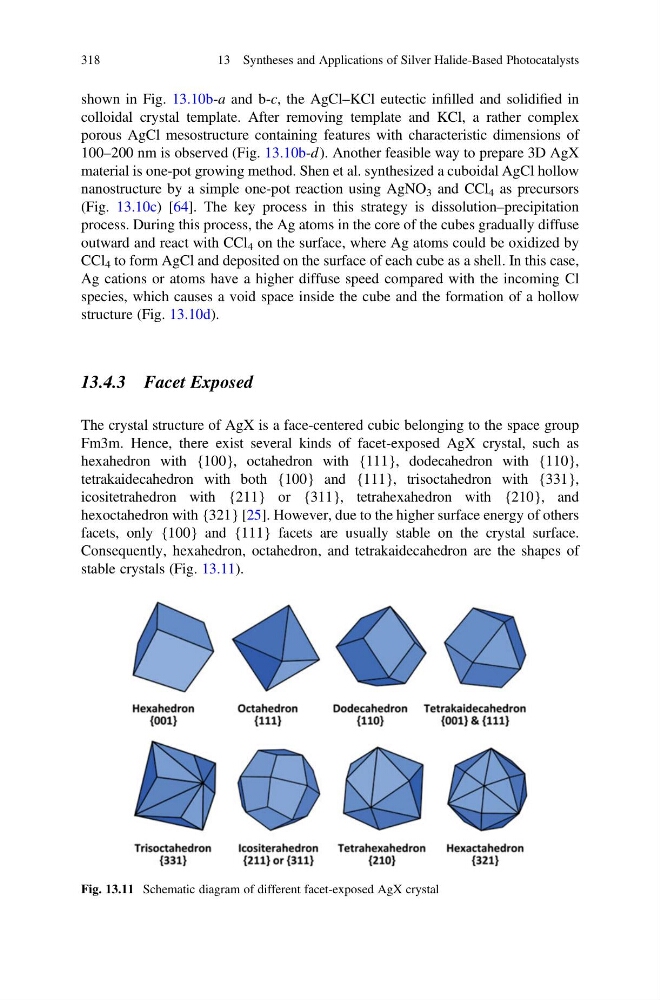
Fm3m. Hence, there exist several kinds of facet-exposed AgX crystal, such as
hexahedron with {100}, octahedron with {111}, dodecahedron with {110},
tetrakaidecahedron with both {100} and {111}, trisoctahedron with {331},
icositetrahedron with {211} or {311}, tetrahexahedron with {210}, and
hexoctahedron with {321} [25]. However, due to the higher surface energy of others
facets, only {100} and {111} facets are usually stable on the crystal surface.
Consequently, hexahedron, octahedron, and tetrakaidecahedron are the shapes of
stable crystals (Fig. 13.11).
Fig. 13.11 Schematic diagram of different facet-exposed AgX crystal
318
13 Syntheses and Applications of Silver Halide-Based Photocatalysts
colloidal crystal template. After removing template and KCl, a rather complex
porous AgCl mesostructure containing features with characteristic dimensions of
100–200 nm is observed (Fig. 13.10b-d). Another feasible way to prepare 3D AgX
material is one-pot growing method. Shen et al. synthesized a cuboidal AgCl hollow
nanostructure by a simple one-pot reaction using AgNO 3 and CCl 4 as precursors
(Fig. 13.10c) [64]. The key process in this strategy is dissolution–precipitation
process. During this process, the Ag atoms in the core of the cubes gradually diffuse
outward and react with CCl 4 on the surface, where Ag atoms could be oxidized by
CCl 4 to form AgCl and deposited on the surface of each cube as a shell. In this case,
Ag cations or atoms have a higher diffuse speed compared with the incoming Cl
species, which causes a void space inside the cube and the formation of a hollow
structure (Fig. 13.10d).
13.4.3 Facet Exposed
The crystal structure of AgX is a face-centered cubic belonging to the space group
Fm3m. Hence, there exist several kinds of facet-exposed AgX crystal, such as
hexahedron with {100}, octahedron with {111}, dodecahedron with {110},
tetrakaidecahedron with both {100} and {111}, trisoctahedron with {331},
icositetrahedron with {211} or {311}, tetrahexahedron with {210}, and
hexoctahedron with {321} [25]. However, due to the higher surface energy of others
facets, only {100} and {111} facets are usually stable on the crystal surface.
Consequently, hexahedron, octahedron, and tetrakaidecahedron are the shapes of
stable crystals (Fig. 13.11).
Fig. 13.11 Schematic diagram of different facet-exposed AgX crystal
318
13 Syntheses and Applications of Silver Halide-Based Photocatalysts