

agent (Fig. 13.9a, b). Detailedly, AgNO 3 was added into the prepared cubic NaCl
suspension, along with the assistance of surfactant PVP to prevent the aggregation of
AgCl particle. Ion exchange diffusion reaction between NaCl and Ag
+ in the solution
led to the heterogeneous nucleation and continued growth of AgCl on the surface of
the NaCl template. Finally, NaCl template would be removed by water washing and
the AgCl cubic cages would be obtained. Similarly, AgCl nanoframe, AgBr cubic
cage, and porous AgBr microsphere can also be synthesized via similar experimental
steps [59–62].
3. Other Methods
Besides ion exchange method, there still exist other ways to prepare 3D AgX
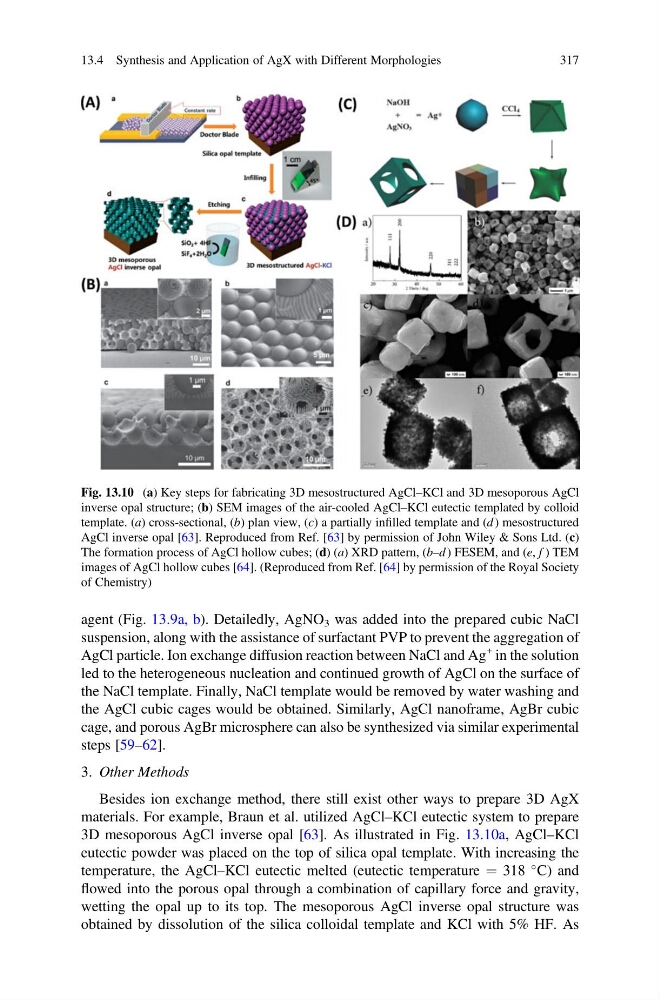
materials. For example, Braun et al. utilized AgCl–KCl eutectic system to prepare
3D mesoporous AgCl inverse opal [63]. As illustrated in Fig. 13.10a, AgCl–KCl
eutectic powder was placed on the top of silica opal template. With increasing the
temperature, the AgCl–KCl eutectic melted (eutectic temperature ¼ 318
C) and
flowed into the porous opal through a combination of capillary force and gravity,
wetting the opal up to its top. The mesoporous AgCl inverse opal structure was
obtained by dissolution of the silica colloidal template and KCl with 5% HF. As
Fig. 13.10 (a) Key steps for fabricating 3D mesostructured AgCl–KCl and 3D mesoporous AgCl
inverse opal structure; (b) SEM images of the air-cooled AgCl–KCl eutectic templated by colloid
template. (a) cross-sectional, (b) plan view, (c) a partially infilled template and (d ) mesostructured
AgCl inverse opal [63]. Reproduced from Ref. [63] by permission of John Wiley & Sons Ltd. (c)
The formation process of AgCl hollow cubes; (d) (a) XRD pattern, (b–d ) FESEM, and (e, f ) TEM
images of AgCl hollow cubes [64]. (Reproduced from Ref. [64] by permission of the Royal Society
of Chemistry)
13.4 Synthesis and Application of AgX with Different Morphologies
317
suspension, along with the assistance of surfactant PVP to prevent the aggregation of
AgCl particle. Ion exchange diffusion reaction between NaCl and Ag
+ in the solution
led to the heterogeneous nucleation and continued growth of AgCl on the surface of
the NaCl template. Finally, NaCl template would be removed by water washing and
the AgCl cubic cages would be obtained. Similarly, AgCl nanoframe, AgBr cubic
cage, and porous AgBr microsphere can also be synthesized via similar experimental
steps [59–62].
3. Other Methods
Besides ion exchange method, there still exist other ways to prepare 3D AgX
materials. For example, Braun et al. utilized AgCl–KCl eutectic system to prepare
3D mesoporous AgCl inverse opal [63]. As illustrated in Fig. 13.10a, AgCl–KCl
eutectic powder was placed on the top of silica opal template. With increasing the
temperature, the AgCl–KCl eutectic melted (eutectic temperature ¼ 318
C) and
flowed into the porous opal through a combination of capillary force and gravity,
wetting the opal up to its top. The mesoporous AgCl inverse opal structure was
obtained by dissolution of the silica colloidal template and KCl with 5% HF. As
Fig. 13.10 (a) Key steps for fabricating 3D mesostructured AgCl–KCl and 3D mesoporous AgCl
inverse opal structure; (b) SEM images of the air-cooled AgCl–KCl eutectic templated by colloid
template. (a) cross-sectional, (b) plan view, (c) a partially infilled template and (d ) mesostructured
AgCl inverse opal [63]. Reproduced from Ref. [63] by permission of John Wiley & Sons Ltd. (c)
The formation process of AgCl hollow cubes; (d) (a) XRD pattern, (b–d ) FESEM, and (e, f ) TEM
images of AgCl hollow cubes [64]. (Reproduced from Ref. [64] by permission of the Royal Society
of Chemistry)
13.4 Synthesis and Application of AgX with Different Morphologies
317