

(RhB, MO, and MB) and alcohols (methanol and isopropanol) under visible light.
[56] Similarly, Jiang et al. prepared AgCl@Ag hollow architectures by employing
NH 4 Cl as a reactive acidic etching agent to etch Ag 2 CO 3 particles (Fig. 13.8b).[57]
During the etching process, the surface of Ag 2 CO 3 would be chlorinated and the
poles would be created. Finally, the hierarchical porous AgCl@Ag hollow architectures were formed (Fig. 13.8c). The obtained hierarchical porous structure not only
increases the adsorption of contaminants but also enhances the harvesting efficiency
of light.
2. Cation Exchange Method
Similar to anion exchange method, the difference of solubility between AgX and
MX (M means other metal element) is also used in cation exchange method.
Different to the former method, the MX used in cation exchange method is usually
with uniform morphology, such as cube and sphere. Consequently, the morphology
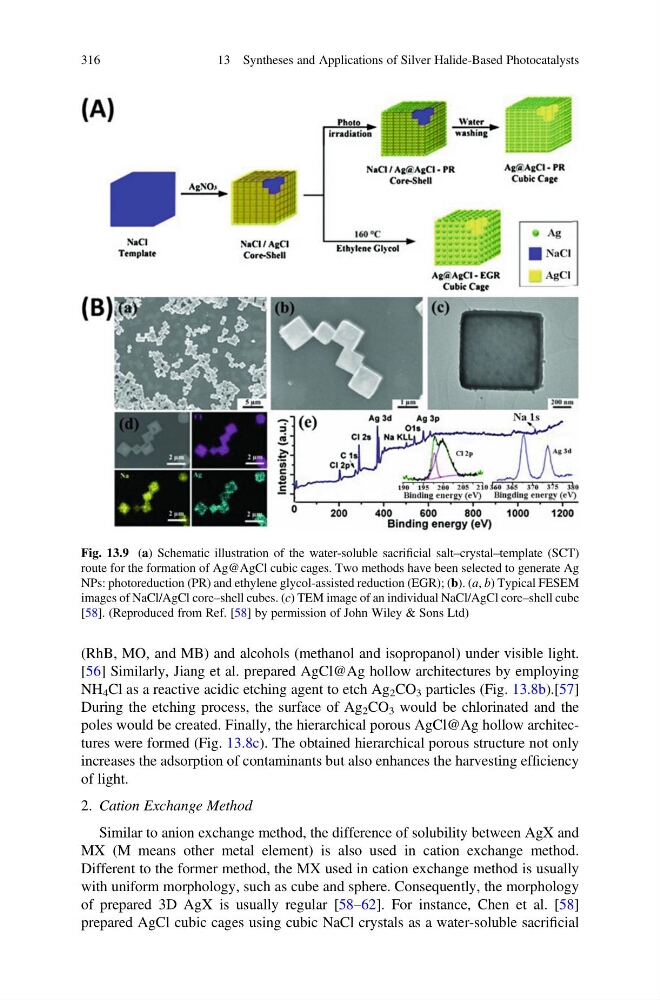
of prepared 3D AgX is usually regular [58–62]. For instance, Chen et al. [58]
prepared AgCl cubic cages using cubic NaCl crystals as a water-soluble sacrificial
Fig. 13.9 (a) Schematic illustration of the water-soluble sacrificial salt–crystal–template (SCT)
route for the formation of Ag@AgCl cubic cages. Two methods have been selected to generate Ag
NPs: photoreduction (PR) and ethylene glycol-assisted reduction (EGR); (b). (a, b) Typical FESEM
images of NaCl/AgCl core–shell cubes. (c) TEM image of an individual NaCl/AgCl core–shell cube
[58]. (Reproduced from Ref. [58] by permission of John Wiley & Sons Ltd)
316
13 Syntheses and Applications of Silver Halide-Based Photocatalysts
[56] Similarly, Jiang et al. prepared AgCl@Ag hollow architectures by employing
NH 4 Cl as a reactive acidic etching agent to etch Ag 2 CO 3 particles (Fig. 13.8b).[57]
During the etching process, the surface of Ag 2 CO 3 would be chlorinated and the
poles would be created. Finally, the hierarchical porous AgCl@Ag hollow architectures were formed (Fig. 13.8c). The obtained hierarchical porous structure not only
increases the adsorption of contaminants but also enhances the harvesting efficiency
of light.
2. Cation Exchange Method
Similar to anion exchange method, the difference of solubility between AgX and
MX (M means other metal element) is also used in cation exchange method.
Different to the former method, the MX used in cation exchange method is usually
with uniform morphology, such as cube and sphere. Consequently, the morphology
of prepared 3D AgX is usually regular [58–62]. For instance, Chen et al. [58]
prepared AgCl cubic cages using cubic NaCl crystals as a water-soluble sacrificial
Fig. 13.9 (a) Schematic illustration of the water-soluble sacrificial salt–crystal–template (SCT)
route for the formation of Ag@AgCl cubic cages. Two methods have been selected to generate Ag
NPs: photoreduction (PR) and ethylene glycol-assisted reduction (EGR); (b). (a, b) Typical FESEM
images of NaCl/AgCl core–shell cubes. (c) TEM image of an individual NaCl/AgCl core–shell cube
[58]. (Reproduced from Ref. [58] by permission of John Wiley & Sons Ltd)
316
13 Syntheses and Applications of Silver Halide-Based Photocatalysts