

13.4.2 3D Structure
Different to the 1D structured AgX, 3D structured AgX have more complex framework. This framework can not only increase the surface area to provide more active
sites but also promote the transfer of reactants from outside to inside. So far, the
strategies for synthesizing AgX 3D structure can be classified into three types:
1. Anion Exchange Method
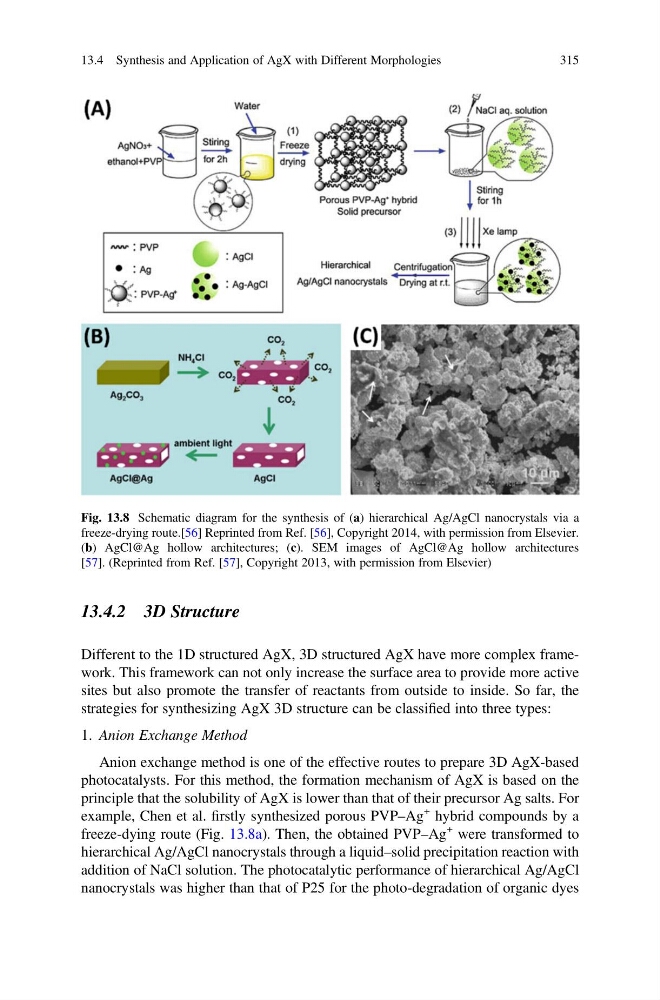
Anion exchange method is one of the effective routes to prepare 3D AgX-based
photocatalysts. For this method, the formation mechanism of AgX is based on the
principle that the solubility of AgX is lower than that of their precursor Ag salts. For
example, Chen et al. firstly synthesized porous PVP–Ag
+ hybrid compounds by a
freeze-dying route (Fig. 13.8a). Then, the obtained PVP–Ag
+ were transformed to
hierarchical Ag/AgCl nanocrystals through a liquid–solid precipitation reaction with
addition of NaCl solution. The photocatalytic performance of hierarchical Ag/AgCl
nanocrystals was higher than that of P25 for the photo-degradation of organic dyes
Fig. 13.8 Schematic diagram for the synthesis of (a) hierarchical Ag/AgCl nanocrystals via a
freeze-drying route.[56] Reprinted from Ref. [56], Copyright 2014, with permission from Elsevier.
(b) AgCl@Ag hollow architectures; (c). SEM images of AgCl@Ag hollow architectures
[57]. (Reprinted from Ref. [57], Copyright 2013, with permission from Elsevier)
13.4 Synthesis and Application of AgX with Different Morphologies
315
Different to the 1D structured AgX, 3D structured AgX have more complex framework. This framework can not only increase the surface area to provide more active
sites but also promote the transfer of reactants from outside to inside. So far, the
strategies for synthesizing AgX 3D structure can be classified into three types:
1. Anion Exchange Method
Anion exchange method is one of the effective routes to prepare 3D AgX-based
photocatalysts. For this method, the formation mechanism of AgX is based on the
principle that the solubility of AgX is lower than that of their precursor Ag salts. For
example, Chen et al. firstly synthesized porous PVP–Ag
+ hybrid compounds by a
freeze-dying route (Fig. 13.8a). Then, the obtained PVP–Ag
+ were transformed to
hierarchical Ag/AgCl nanocrystals through a liquid–solid precipitation reaction with
addition of NaCl solution. The photocatalytic performance of hierarchical Ag/AgCl
nanocrystals was higher than that of P25 for the photo-degradation of organic dyes
Fig. 13.8 Schematic diagram for the synthesis of (a) hierarchical Ag/AgCl nanocrystals via a
freeze-drying route.[56] Reprinted from Ref. [56], Copyright 2014, with permission from Elsevier.
(b) AgCl@Ag hollow architectures; (c). SEM images of AgCl@Ag hollow architectures
[57]. (Reprinted from Ref. [57], Copyright 2013, with permission from Elsevier)
13.4 Synthesis and Application of AgX with Different Morphologies
315