

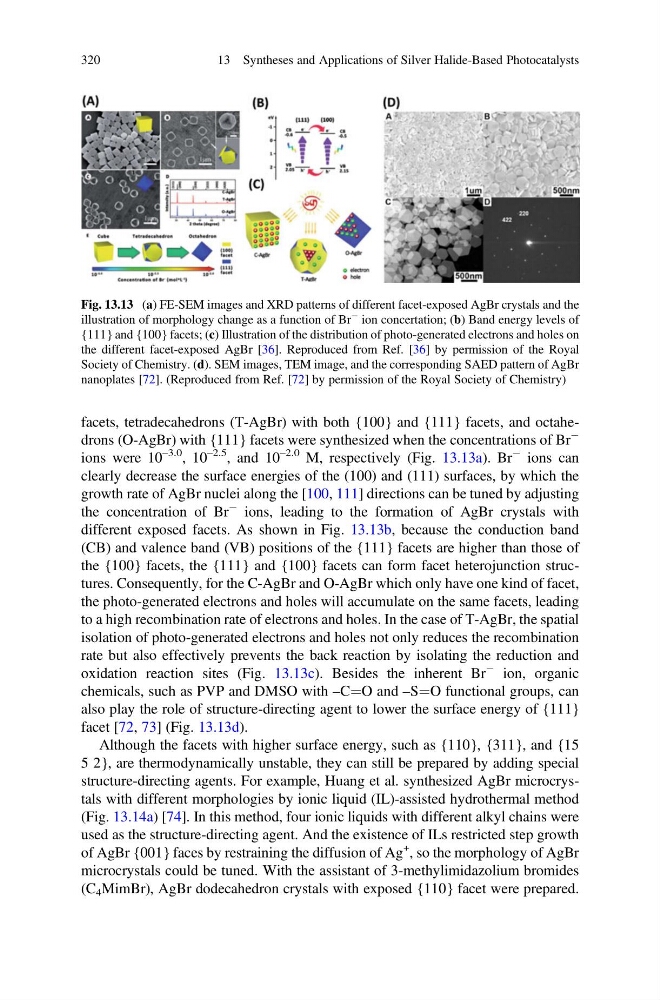
facets, tetradecahedrons (T-AgBr) with both {100} and {111} facets, and octahedrons (O-AgBr) with {111} facets were synthesized when the concentrations of Br
À
ions were 10
–3.0 , 10
–2.5 , and 10
–2.0 M, respectively (Fig. 13.13a). Br
À ions can
clearly decrease the surface energies of the (100) and (111) surfaces, by which the
growth rate of AgBr nuclei along the [100, 111] directions can be tuned by adjusting
the concentration of Br
À ions, leading to the formation of AgBr crystals with
different exposed facets. As shown in Fig. 13.13b, because the conduction band
(CB) and valence band (VB) positions of the {111} facets are higher than those of
the {100} facets, the {111} and {100} facets can form facet heterojunction structures. Consequently, for the C-AgBr and O-AgBr which only have one kind of facet,
the photo-generated electrons and holes will accumulate on the same facets, leading
to a high recombination rate of electrons and holes. In the case of T-AgBr, the spatial
isolation of photo-generated electrons and holes not only reduces the recombination
rate but also effectively prevents the back reaction by isolating the reduction and
oxidation reaction sites (Fig. 13.13c). Besides the inherent Br
À ion, organic
chemicals, such as PVP and DMSO with –C¼O and –S¼O functional groups, can
also play the role of structure-directing agent to lower the surface energy of {111}
facet [72, 73] (Fig. 13.13d).
Although the facets with higher surface energy, such as {110}, {311}, and {15
5 2}, are thermodynamically unstable, they can still be prepared by adding special
structure-directing agents. For example, Huang et al. synthesized AgBr microcrystals with different morphologies by ionic liquid (IL)-assisted hydrothermal method
(Fig. 13.14a) [74]. In this method, four ionic liquids with different alkyl chains were
used as the structure-directing agent. And the existence of ILs restricted step growth
of AgBr {001} faces by restraining the diffusion of Ag
+
, so the morphology of AgBr
microcrystals could be tuned. With the assistant of 3-methylimidazolium bromides
(C 4 MimBr), AgBr dodecahedron crystals with exposed {110} facet were prepared.
Fig. 13.13 (a) FE-SEM images and XRD patterns of different facet-exposed AgBr crystals and the
illustration of morphology change as a function of Br
À ion concertation; (b) Band energy levels of
{111} and {100} facets; (c) Illustration of the distribution of photo-generated electrons and holes on
the different facet-exposed AgBr [36]. Reproduced from Ref. [36] by permission of the Royal
Society of Chemistry. (d). SEM images, TEM image, and the corresponding SAED pattern of AgBr
nanoplates [72]. (Reproduced from Ref. [72] by permission of the Royal Society of Chemistry)
320
13 Syntheses and Applications of Silver Halide-Based Photocatalysts
À
ions were 10
–3.0 , 10
–2.5 , and 10
–2.0 M, respectively (Fig. 13.13a). Br
À ions can
clearly decrease the surface energies of the (100) and (111) surfaces, by which the
growth rate of AgBr nuclei along the [100, 111] directions can be tuned by adjusting
the concentration of Br
À ions, leading to the formation of AgBr crystals with
different exposed facets. As shown in Fig. 13.13b, because the conduction band
(CB) and valence band (VB) positions of the {111} facets are higher than those of
the {100} facets, the {111} and {100} facets can form facet heterojunction structures. Consequently, for the C-AgBr and O-AgBr which only have one kind of facet,
the photo-generated electrons and holes will accumulate on the same facets, leading
to a high recombination rate of electrons and holes. In the case of T-AgBr, the spatial
isolation of photo-generated electrons and holes not only reduces the recombination
rate but also effectively prevents the back reaction by isolating the reduction and
oxidation reaction sites (Fig. 13.13c). Besides the inherent Br
À ion, organic
chemicals, such as PVP and DMSO with –C¼O and –S¼O functional groups, can
also play the role of structure-directing agent to lower the surface energy of {111}
facet [72, 73] (Fig. 13.13d).
Although the facets with higher surface energy, such as {110}, {311}, and {15
5 2}, are thermodynamically unstable, they can still be prepared by adding special
structure-directing agents. For example, Huang et al. synthesized AgBr microcrystals with different morphologies by ionic liquid (IL)-assisted hydrothermal method
(Fig. 13.14a) [74]. In this method, four ionic liquids with different alkyl chains were
used as the structure-directing agent. And the existence of ILs restricted step growth
of AgBr {001} faces by restraining the diffusion of Ag
+
, so the morphology of AgBr
microcrystals could be tuned. With the assistant of 3-methylimidazolium bromides
(C 4 MimBr), AgBr dodecahedron crystals with exposed {110} facet were prepared.
Fig. 13.13 (a) FE-SEM images and XRD patterns of different facet-exposed AgBr crystals and the
illustration of morphology change as a function of Br
À ion concertation; (b) Band energy levels of
{111} and {100} facets; (c) Illustration of the distribution of photo-generated electrons and holes on
the different facet-exposed AgBr [36]. Reproduced from Ref. [36] by permission of the Royal
Society of Chemistry. (d). SEM images, TEM image, and the corresponding SAED pattern of AgBr
nanoplates [72]. (Reproduced from Ref. [72] by permission of the Royal Society of Chemistry)
320
13 Syntheses and Applications of Silver Halide-Based Photocatalysts