

Facet-Selective Photocatalytic Reaction The differences in surface energy levels
of the conduction and valence bands, surface structures, and adsorption energies of
substrates on the exposed crystal faces may result in face-selective photocatalytic
reaction. Fluorescence at the single-molecule and single-particle level has recently
evolved as an important tool for studying selective photocatalytic reactions on
different facets because of its high sensitivity, simplicity of data collection, and
high spatial resolution in microscopic imaging techniques. Several organic dye
probes have been successfully employed to detect the generated ROS and identify
the active sites on individual TiO 2 nanoparticles by utilizing single-molecule fluorescence spectroscopy. A typical example is from boron dipyrromethene (BODIPY),
which has a high extinction coefficient, high fluorescence quantum yield, and good
chemical and photostability. It has evolved into versatile fluorescent sensors for
biological and chemical detection. On the other hand, the reduction of aromatic nitro
compounds to the corresponding hydroxylamines or amines has been widely used as
a model system to investigate photocatalytic reduction reactions with semiconductor
or metal nanoparticles. The major drawback for the development of a fluorogenic
probe based on the reduction of a nitro-substituted benzene moiety for monitoring
electron transfer (ET) process lies in the strong quenching effect of nitrobenzene and
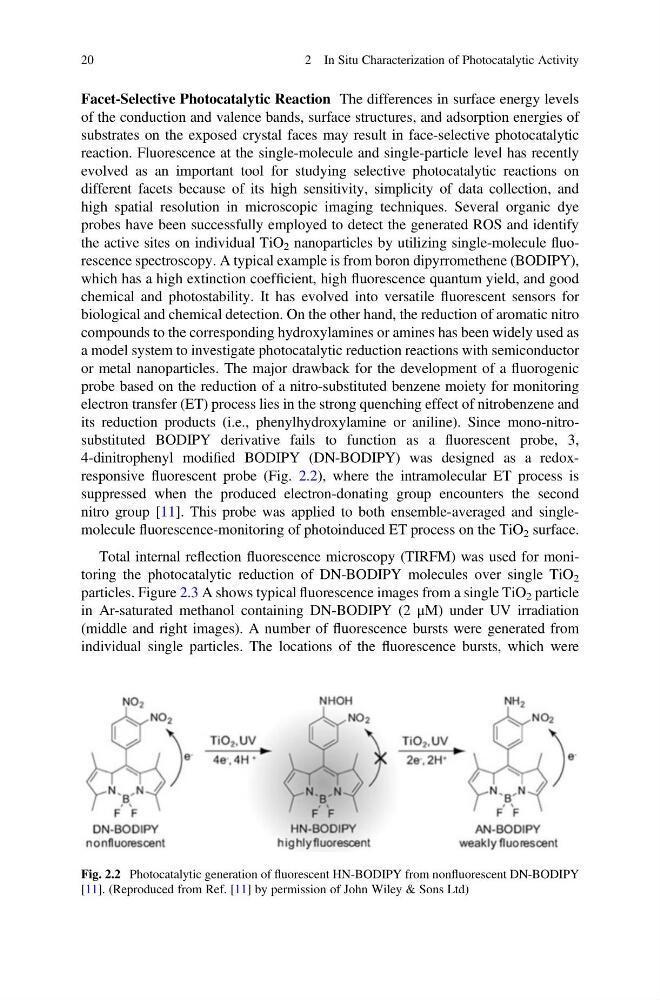
its reduction products (i.e., phenylhydroxylamine or aniline). Since mono-nitrosubstituted BODIPY derivative fails to function as a fluorescent probe, 3,
4-dinitrophenyl modified BODIPY (DN-BODIPY) was designed as a redoxresponsive fluorescent probe (Fig. 2.2), where the intramolecular ET process is
suppressed when the produced electron-donating group encounters the second
nitro group [11]. This probe was applied to both ensemble-averaged and singlemolecule fluorescence-monitoring of photoinduced ET process on the TiO 2 surface.
Total internal reflection fluorescence microscopy (TIRFM) was used for monitoring the photocatalytic reduction of DN-BODIPY molecules over single TiO 2
particles. Figure 2.3 A shows typical fluorescence images from a single TiO 2 particle
in Ar-saturated methanol containing DN-BODIPY (2 μM) under UV irradiation
(middle and right images). A number of fluorescence bursts were generated from
individual single particles. The locations of the fluorescence bursts, which were
Fig. 2.2 Photocatalytic generation of fluorescent HN-BODIPY from nonfluorescent DN-BODIPY
[11]. (Reproduced from Ref. [11] by permission of John Wiley & Sons Ltd)
20
2 In Situ Characterization of Photocatalytic Activity
of the conduction and valence bands, surface structures, and adsorption energies of
substrates on the exposed crystal faces may result in face-selective photocatalytic
reaction. Fluorescence at the single-molecule and single-particle level has recently
evolved as an important tool for studying selective photocatalytic reactions on
different facets because of its high sensitivity, simplicity of data collection, and
high spatial resolution in microscopic imaging techniques. Several organic dye
probes have been successfully employed to detect the generated ROS and identify
the active sites on individual TiO 2 nanoparticles by utilizing single-molecule fluorescence spectroscopy. A typical example is from boron dipyrromethene (BODIPY),
which has a high extinction coefficient, high fluorescence quantum yield, and good
chemical and photostability. It has evolved into versatile fluorescent sensors for
biological and chemical detection. On the other hand, the reduction of aromatic nitro
compounds to the corresponding hydroxylamines or amines has been widely used as
a model system to investigate photocatalytic reduction reactions with semiconductor
or metal nanoparticles. The major drawback for the development of a fluorogenic
probe based on the reduction of a nitro-substituted benzene moiety for monitoring
electron transfer (ET) process lies in the strong quenching effect of nitrobenzene and
its reduction products (i.e., phenylhydroxylamine or aniline). Since mono-nitrosubstituted BODIPY derivative fails to function as a fluorescent probe, 3,
4-dinitrophenyl modified BODIPY (DN-BODIPY) was designed as a redoxresponsive fluorescent probe (Fig. 2.2), where the intramolecular ET process is
suppressed when the produced electron-donating group encounters the second
nitro group [11]. This probe was applied to both ensemble-averaged and singlemolecule fluorescence-monitoring of photoinduced ET process on the TiO 2 surface.
Total internal reflection fluorescence microscopy (TIRFM) was used for monitoring the photocatalytic reduction of DN-BODIPY molecules over single TiO 2
particles. Figure 2.3 A shows typical fluorescence images from a single TiO 2 particle
in Ar-saturated methanol containing DN-BODIPY (2 μM) under UV irradiation
(middle and right images). A number of fluorescence bursts were generated from
individual single particles. The locations of the fluorescence bursts, which were
Fig. 2.2 Photocatalytic generation of fluorescent HN-BODIPY from nonfluorescent DN-BODIPY
[11]. (Reproduced from Ref. [11] by permission of John Wiley & Sons Ltd)
20
2 In Situ Characterization of Photocatalytic Activity