

after the reaction, the photocatalyst powders were removed from the suspension to
improve the precision of the fluorescence spectrophotometry.
2.1.2 Single-Molecule Spectroscopy
Traditional fluorescent spectroscopy provides spectra regarding the intensity, lifetime, and polarization by averaging the emission from trillions of molecules. By
contrast, single-molecule fluorescence spectroscopy rests upon the removal of
ensemble average, thus allowing the detection of the heterogeneity of the local
environment.
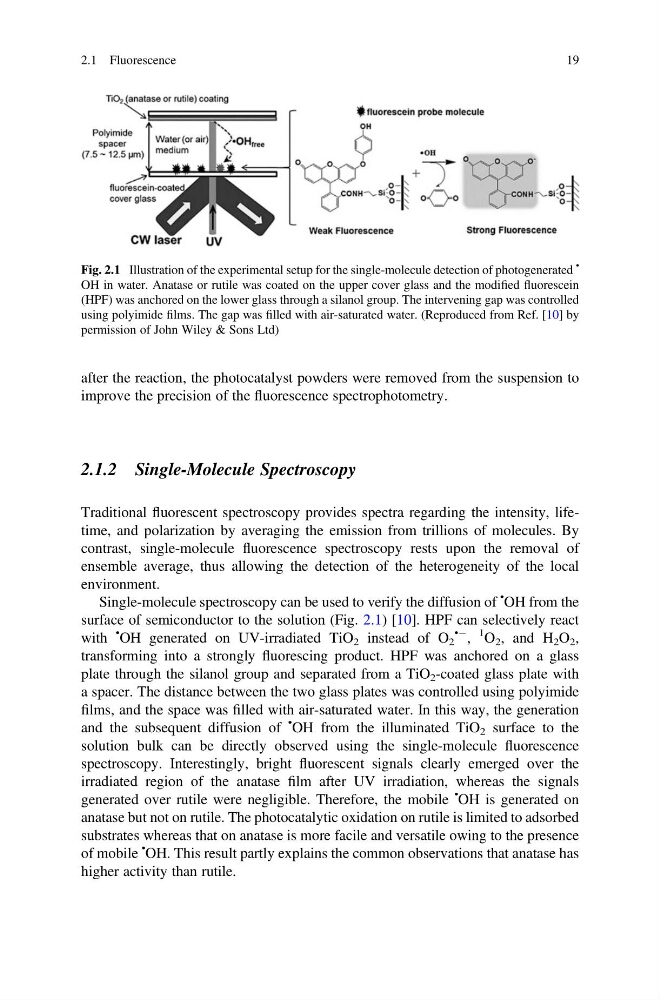
Single-molecule spectroscopy can be used to verify the diffusion of
• OH from the
surface of semiconductor to the solution (Fig. 2.1) [10]. HPF can selectively react
with
• OH generated on UV-irradiated TiO 2 instead of O 2
•À ,
1 O 2 , and H 2 O 2 ,
transforming into a strongly fluorescing product. HPF was anchored on a glass
plate through the silanol group and separated from a TiO 2 -coated glass plate with
a spacer. The distance between the two glass plates was controlled using polyimide
films, and the space was filled with air-saturated water. In this way, the generation
and the subsequent diffusion of
• OH from the illuminated TiO 2 surface to the
solution bulk can be directly observed using the single-molecule fluorescence
spectroscopy. Interestingly, bright fluorescent signals clearly emerged over the
irradiated region of the anatase film after UV irradiation, whereas the signals
generated over rutile were negligible. Therefore, the mobile
•
OH is generated on
anatase but not on rutile. The photocatalytic oxidation on rutile is limited to adsorbed
substrates whereas that on anatase is more facile and versatile owing to the presence
of mobile
•
OH. This result partly explains the common observations that anatase has
higher activity than rutile.
Fig. 2.1 Illustration of the experimental setup for the single-molecule detection of photogenerated
•
OH in water. Anatase or rutile was coated on the upper cover glass and the modified fluorescein
(HPF) was anchored on the lower glass through a silanol group. The intervening gap was controlled
using polyimide films. The gap was filled with air-saturated water. (Reproduced from Ref. [10] by
permission of John Wiley & Sons Ltd)
2.1 Fluorescence
19
improve the precision of the fluorescence spectrophotometry.
2.1.2 Single-Molecule Spectroscopy
Traditional fluorescent spectroscopy provides spectra regarding the intensity, lifetime, and polarization by averaging the emission from trillions of molecules. By
contrast, single-molecule fluorescence spectroscopy rests upon the removal of
ensemble average, thus allowing the detection of the heterogeneity of the local
environment.
Single-molecule spectroscopy can be used to verify the diffusion of
• OH from the
surface of semiconductor to the solution (Fig. 2.1) [10]. HPF can selectively react
with
• OH generated on UV-irradiated TiO 2 instead of O 2
•À ,
1 O 2 , and H 2 O 2 ,
transforming into a strongly fluorescing product. HPF was anchored on a glass
plate through the silanol group and separated from a TiO 2 -coated glass plate with
a spacer. The distance between the two glass plates was controlled using polyimide
films, and the space was filled with air-saturated water. In this way, the generation
and the subsequent diffusion of
• OH from the illuminated TiO 2 surface to the
solution bulk can be directly observed using the single-molecule fluorescence
spectroscopy. Interestingly, bright fluorescent signals clearly emerged over the
irradiated region of the anatase film after UV irradiation, whereas the signals
generated over rutile were negligible. Therefore, the mobile
•
OH is generated on
anatase but not on rutile. The photocatalytic oxidation on rutile is limited to adsorbed
substrates whereas that on anatase is more facile and versatile owing to the presence
of mobile
•
OH. This result partly explains the common observations that anatase has
higher activity than rutile.
Fig. 2.1 Illustration of the experimental setup for the single-molecule detection of photogenerated
•
OH in water. Anatase or rutile was coated on the upper cover glass and the modified fluorescein
(HPF) was anchored on the lower glass through a silanol group. The intervening gap was controlled
using polyimide films. The gap was filled with air-saturated water. (Reproduced from Ref. [10] by
permission of John Wiley & Sons Ltd)
2.1 Fluorescence
19