

core to a desired size via controlling the growth of the inside metal. For the size
manipulation, HAuCl 4 was first introduced into the vacant space of the nanoreactor,
and the HAuCl 4 -soaked Au/TiO 2 nanoreactors were then placed in a solution of
cetyltrimethylammonium bromide (CTAB) and ascorbic acid. It is believed that a
slow interdiffusion between the HAuCl 4 inside the nanoreactor and the CTAB/
ascorbic acid solution outside the nanoreactor would ensure a slow growth of Au
cores while preventing TiO 2 shells from direct metal deposition. The size of Au core
can be tuned in the range of 150–250 nm (Figs. 9.6 and 9.7).
Li et al. reported a facile “hydrothermal etching assisted crystallization” route to
synthesize Fe 3 O 4 @titanate yolk–shell microspheres with ultrathin nanosheetsassembled double-shell structure [12]. The as-prepared microspheres possess a
uniform size, tailored shell structure (Fig. 9.8), good structural stability, versatile
ion-exchange capability, high surface area, and large magnetization and exhibit a
remarkable photocatalytic performance.
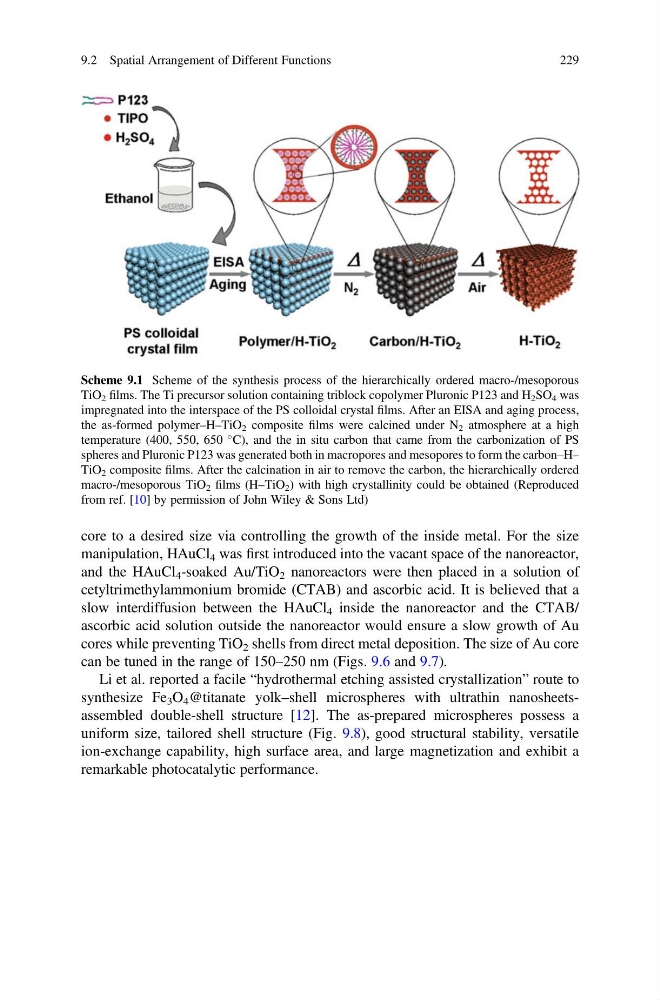
Scheme 9.1 Scheme of the synthesis process of the hierarchically ordered macro-/mesoporous
TiO 2 films. The Ti precursor solution containing triblock copolymer Pluronic P123 and H 2 SO 4 was
impregnated into the interspace of the PS colloidal crystal films. After an EISA and aging process,
the as-formed polymer–H–TiO 2 composite films were calcined under N 2 atmosphere at a high
temperature (400, 550, 650
C), and the in situ carbon that came from the carbonization of PS
spheres and Pluronic P123 was generated both in macropores and mesopores to form the carbon–H–
TiO 2 composite films. After the calcination in air to remove the carbon, the hierarchically ordered
macro-/mesoporous TiO 2 films (H–TiO 2 ) with high crystallinity could be obtained (Reproduced
from ref. [10] by permission of John Wiley & Sons Ltd)
9.2 Spatial Arrangement of Different Functions
229
manipulation, HAuCl 4 was first introduced into the vacant space of the nanoreactor,
and the HAuCl 4 -soaked Au/TiO 2 nanoreactors were then placed in a solution of
cetyltrimethylammonium bromide (CTAB) and ascorbic acid. It is believed that a
slow interdiffusion between the HAuCl 4 inside the nanoreactor and the CTAB/
ascorbic acid solution outside the nanoreactor would ensure a slow growth of Au
cores while preventing TiO 2 shells from direct metal deposition. The size of Au core
can be tuned in the range of 150–250 nm (Figs. 9.6 and 9.7).
Li et al. reported a facile “hydrothermal etching assisted crystallization” route to
synthesize Fe 3 O 4 @titanate yolk–shell microspheres with ultrathin nanosheetsassembled double-shell structure [12]. The as-prepared microspheres possess a
uniform size, tailored shell structure (Fig. 9.8), good structural stability, versatile
ion-exchange capability, high surface area, and large magnetization and exhibit a
remarkable photocatalytic performance.
Scheme 9.1 Scheme of the synthesis process of the hierarchically ordered macro-/mesoporous
TiO 2 films. The Ti precursor solution containing triblock copolymer Pluronic P123 and H 2 SO 4 was
impregnated into the interspace of the PS colloidal crystal films. After an EISA and aging process,
the as-formed polymer–H–TiO 2 composite films were calcined under N 2 atmosphere at a high
temperature (400, 550, 650
C), and the in situ carbon that came from the carbonization of PS
spheres and Pluronic P123 was generated both in macropores and mesopores to form the carbon–H–
TiO 2 composite films. After the calcination in air to remove the carbon, the hierarchically ordered
macro-/mesoporous TiO 2 films (H–TiO 2 ) with high crystallinity could be obtained (Reproduced
from ref. [10] by permission of John Wiley & Sons Ltd)
9.2 Spatial Arrangement of Different Functions
229