

are the commonly used hard templates, which can be removed through acid–base
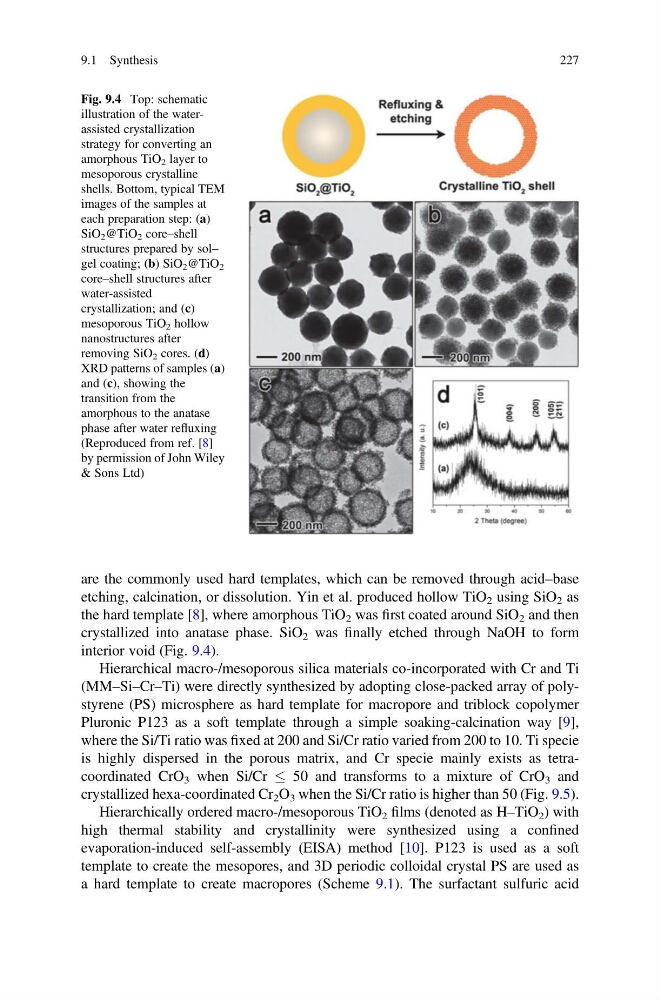
etching, calcination, or dissolution. Yin et al. produced hollow TiO 2 using SiO 2 as
the hard template [8], where amorphous TiO 2 was first coated around SiO 2 and then
crystallized into anatase phase. SiO 2 was finally etched through NaOH to form
interior void (Fig. 9.4).
Hierarchical macro-/mesoporous silica materials co-incorporated with Cr and Ti
(MM–Si–Cr–Ti) were directly synthesized by adopting close-packed array of polystyrene (PS) microsphere as hard template for macropore and triblock copolymer
Pluronic P123 as a soft template through a simple soaking-calcination way [9],
where the Si/Ti ratio was fixed at 200 and Si/Cr ratio varied from 200 to 10. Ti specie
is highly dispersed in the porous matrix, and Cr specie mainly exists as tetracoordinated CrO 3 when Si/Cr
50 and transforms to a mixture of CrO 3 and
crystallized hexa-coordinated Cr 2 O 3 when the Si/Cr ratio is higher than 50 (Fig. 9.5).
Hierarchically ordered macro-/mesoporous TiO 2 films (denoted as H–TiO 2 ) with
high thermal stability and crystallinity were synthesized using a confined
evaporation-induced self-assembly (EISA) method [10]. P123 is used as a soft
template to create the mesopores, and 3D periodic colloidal crystal PS are used as
a hard template to create macropores (Scheme 9.1). The surfactant sulfuric acid
Fig. 9.4 Top: schematic
illustration of the waterassisted crystallization
strategy for converting an
amorphous TiO 2 layer to
mesoporous crystalline
shells. Bottom, typical TEM
images of the samples at
each preparation step: (a)
SiO 2 @TiO 2 core–shell
structures prepared by sol–
gel coating; (b) SiO 2 @TiO 2
core–shell structures after
water-assisted
crystallization; and (c)
mesoporous TiO 2 hollow
nanostructures after
removing SiO 2 cores. (d)
XRD patterns of samples (a)
and (c), showing the
transition from the
amorphous to the anatase
phase after water refluxing
(Reproduced from ref. [8]
by permission of John Wiley
& Sons Ltd)
9.1 Synthesis
227
etching, calcination, or dissolution. Yin et al. produced hollow TiO 2 using SiO 2 as
the hard template [8], where amorphous TiO 2 was first coated around SiO 2 and then
crystallized into anatase phase. SiO 2 was finally etched through NaOH to form
interior void (Fig. 9.4).
Hierarchical macro-/mesoporous silica materials co-incorporated with Cr and Ti
(MM–Si–Cr–Ti) were directly synthesized by adopting close-packed array of polystyrene (PS) microsphere as hard template for macropore and triblock copolymer
Pluronic P123 as a soft template through a simple soaking-calcination way [9],
where the Si/Ti ratio was fixed at 200 and Si/Cr ratio varied from 200 to 10. Ti specie
is highly dispersed in the porous matrix, and Cr specie mainly exists as tetracoordinated CrO 3 when Si/Cr
50 and transforms to a mixture of CrO 3 and
crystallized hexa-coordinated Cr 2 O 3 when the Si/Cr ratio is higher than 50 (Fig. 9.5).
Hierarchically ordered macro-/mesoporous TiO 2 films (denoted as H–TiO 2 ) with
high thermal stability and crystallinity were synthesized using a confined
evaporation-induced self-assembly (EISA) method [10]. P123 is used as a soft
template to create the mesopores, and 3D periodic colloidal crystal PS are used as
a hard template to create macropores (Scheme 9.1). The surfactant sulfuric acid
Fig. 9.4 Top: schematic
illustration of the waterassisted crystallization
strategy for converting an
amorphous TiO 2 layer to
mesoporous crystalline
shells. Bottom, typical TEM
images of the samples at
each preparation step: (a)
SiO 2 @TiO 2 core–shell
structures prepared by sol–
gel coating; (b) SiO 2 @TiO 2
core–shell structures after
water-assisted
crystallization; and (c)
mesoporous TiO 2 hollow
nanostructures after
removing SiO 2 cores. (d)
XRD patterns of samples (a)
and (c), showing the
transition from the
amorphous to the anatase
phase after water refluxing
(Reproduced from ref. [8]
by permission of John Wiley
& Sons Ltd)
9.1 Synthesis
227