

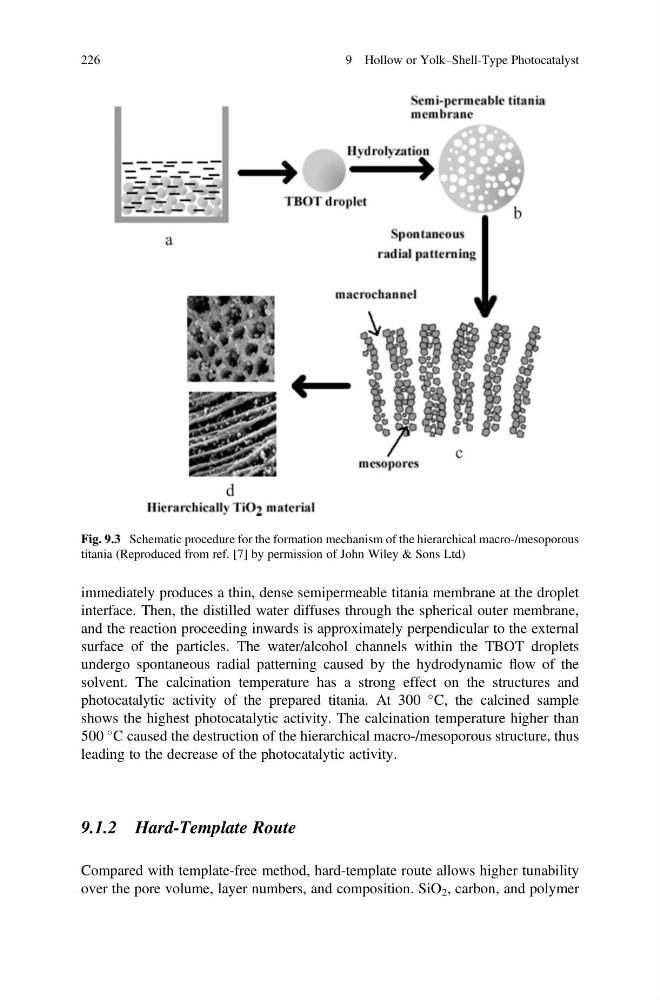
immediately produces a thin, dense semipermeable titania membrane at the droplet
interface. Then, the distilled water diffuses through the spherical outer membrane,
and the reaction proceeding inwards is approximately perpendicular to the external
surface of the particles. The water/alcohol channels within the TBOT droplets
undergo spontaneous radial patterning caused by the hydrodynamic flow of the
solvent. The calcination temperature has a strong effect on the structures and
photocatalytic activity of the prepared titania. At 300
C, the calcined sample
shows the highest photocatalytic activity. The calcination temperature higher than
500
C caused the destruction of the hierarchical macro-/mesoporous structure, thus
leading to the decrease of the photocatalytic activity.
9.1.2 Hard-Template Route
Compared with template-free method, hard-template route allows higher tunability
over the pore volume, layer numbers, and composition. SiO 2 , carbon, and polymer
Fig. 9.3 Schematic procedure for the formation mechanism of the hierarchical macro-/mesoporous
titania (Reproduced from ref. [7] by permission of John Wiley & Sons Ltd)
226
9 Hollow or Yolk–Shell-Type Photocatalyst
interface. Then, the distilled water diffuses through the spherical outer membrane,
and the reaction proceeding inwards is approximately perpendicular to the external
surface of the particles. The water/alcohol channels within the TBOT droplets
undergo spontaneous radial patterning caused by the hydrodynamic flow of the
solvent. The calcination temperature has a strong effect on the structures and
photocatalytic activity of the prepared titania. At 300
C, the calcined sample
shows the highest photocatalytic activity. The calcination temperature higher than
500
C caused the destruction of the hierarchical macro-/mesoporous structure, thus
leading to the decrease of the photocatalytic activity.
9.1.2 Hard-Template Route
Compared with template-free method, hard-template route allows higher tunability
over the pore volume, layer numbers, and composition. SiO 2 , carbon, and polymer
Fig. 9.3 Schematic procedure for the formation mechanism of the hierarchical macro-/mesoporous
titania (Reproduced from ref. [7] by permission of John Wiley & Sons Ltd)
226
9 Hollow or Yolk–Shell-Type Photocatalyst