

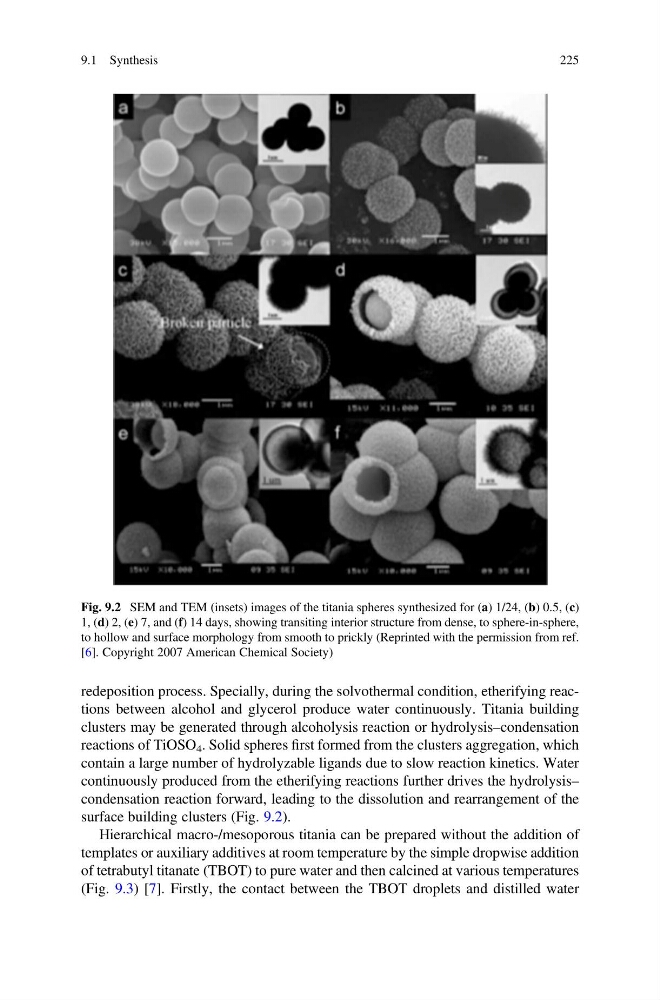
redeposition process. Specially, during the solvothermal condition, etherifying reactions between alcohol and glycerol produce water continuously. Titania building
clusters may be generated through alcoholysis reaction or hydrolysis–condensation
reactions of TiOSO 4 . Solid spheres first formed from the clusters aggregation, which
contain a large number of hydrolyzable ligands due to slow reaction kinetics. Water
continuously produced from the etherifying reactions further drives the hydrolysis–
condensation reaction forward, leading to the dissolution and rearrangement of the
surface building clusters (Fig. 9.2).
Hierarchical macro-/mesoporous titania can be prepared without the addition of
templates or auxiliary additives at room temperature by the simple dropwise addition
of tetrabutyl titanate (TBOT) to pure water and then calcined at various temperatures
(Fig. 9.3) [7]. Firstly, the contact between the TBOT droplets and distilled water
Fig. 9.2 SEM and TEM (insets) images of the titania spheres synthesized for (a) 1/24, (b) 0.5, (c)
1, (d) 2, (e) 7, and (f) 14 days, showing transiting interior structure from dense, to sphere-in-sphere,
to hollow and surface morphology from smooth to prickly (Reprinted with the permission from ref.
[6]. Copyright 2007 American Chemical Society)
9.1 Synthesis
225
clusters may be generated through alcoholysis reaction or hydrolysis–condensation
reactions of TiOSO 4 . Solid spheres first formed from the clusters aggregation, which
contain a large number of hydrolyzable ligands due to slow reaction kinetics. Water
continuously produced from the etherifying reactions further drives the hydrolysis–
condensation reaction forward, leading to the dissolution and rearrangement of the
surface building clusters (Fig. 9.2).
Hierarchical macro-/mesoporous titania can be prepared without the addition of
templates or auxiliary additives at room temperature by the simple dropwise addition
of tetrabutyl titanate (TBOT) to pure water and then calcined at various temperatures
(Fig. 9.3) [7]. Firstly, the contact between the TBOT droplets and distilled water
Fig. 9.2 SEM and TEM (insets) images of the titania spheres synthesized for (a) 1/24, (b) 0.5, (c)
1, (d) 2, (e) 7, and (f) 14 days, showing transiting interior structure from dense, to sphere-in-sphere,
to hollow and surface morphology from smooth to prickly (Reprinted with the permission from ref.
[6]. Copyright 2007 American Chemical Society)
9.1 Synthesis
225