

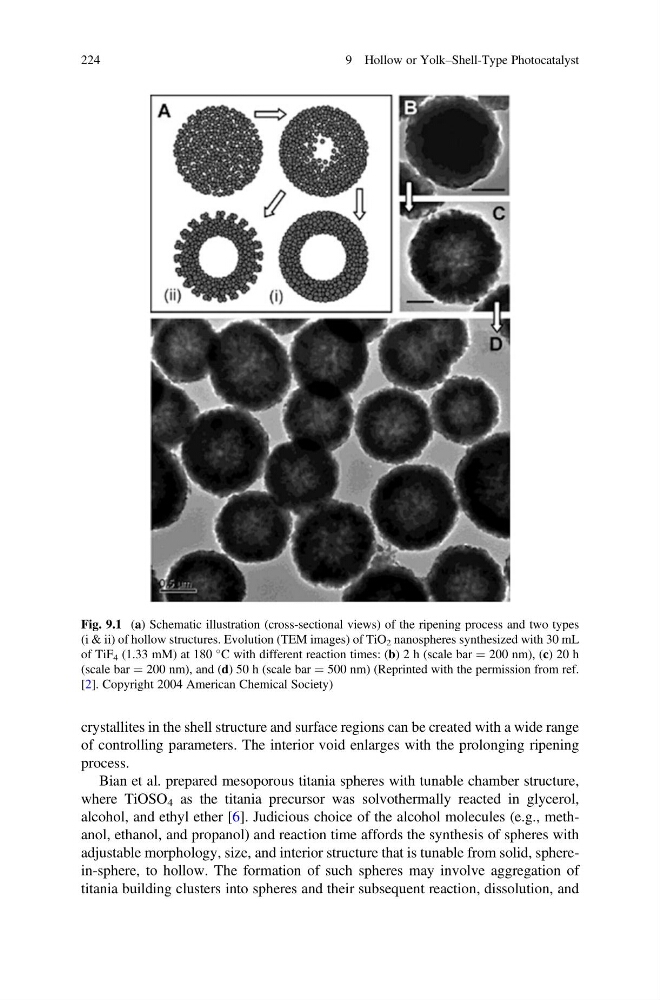
crystallites in the shell structure and surface regions can be created with a wide range
of controlling parameters. The interior void enlarges with the prolonging ripening
process.
Bian et al. prepared mesoporous titania spheres with tunable chamber structure,
where TiOSO 4 as the titania precursor was solvothermally reacted in glycerol,
alcohol, and ethyl ether [6]. Judicious choice of the alcohol molecules (e.g., methanol, ethanol, and propanol) and reaction time affords the synthesis of spheres with
adjustable morphology, size, and interior structure that is tunable from solid, spherein-sphere, to hollow. The formation of such spheres may involve aggregation of
titania building clusters into spheres and their subsequent reaction, dissolution, and
Fig. 9.1 (a) Schematic illustration (cross-sectional views) of the ripening process and two types
(i & ii) of hollow structures. Evolution (TEM images) of TiO 2 nanospheres synthesized with 30 mL
of TiF 4 (1.33 mM) at 180
C with different reaction times: (b) 2 h (scale bar ¼ 200 nm), (c) 20 h
(scale bar ¼ 200 nm), and (d) 50 h (scale bar ¼ 500 nm) (Reprinted with the permission from ref.
[2]. Copyright 2004 American Chemical Society)
224
9 Hollow or Yolk–Shell-Type Photocatalyst
of controlling parameters. The interior void enlarges with the prolonging ripening
process.
Bian et al. prepared mesoporous titania spheres with tunable chamber structure,
where TiOSO 4 as the titania precursor was solvothermally reacted in glycerol,
alcohol, and ethyl ether [6]. Judicious choice of the alcohol molecules (e.g., methanol, ethanol, and propanol) and reaction time affords the synthesis of spheres with
adjustable morphology, size, and interior structure that is tunable from solid, spherein-sphere, to hollow. The formation of such spheres may involve aggregation of
titania building clusters into spheres and their subsequent reaction, dissolution, and
Fig. 9.1 (a) Schematic illustration (cross-sectional views) of the ripening process and two types
(i & ii) of hollow structures. Evolution (TEM images) of TiO 2 nanospheres synthesized with 30 mL
of TiF 4 (1.33 mM) at 180
C with different reaction times: (b) 2 h (scale bar ¼ 200 nm), (c) 20 h
(scale bar ¼ 200 nm), and (d) 50 h (scale bar ¼ 500 nm) (Reprinted with the permission from ref.
[2]. Copyright 2004 American Chemical Society)
224
9 Hollow or Yolk–Shell-Type Photocatalyst