

synergistic effect of C and La is the reason for the high visible light photocatalytic
activity of the co-doped TiO 2 .
However, in addition to the abovementioned synergistic effect, there are also
some other forms of synergistic effects between metal and nonmetal, such as the
increase of the surface active species including the hydroxyl groups and hydrogen
peroxide in TiO 2 . The role of surface hydroxyl groups and hydrogen peroxide is
mainly including two aspects: one is involving in the reaction with the photo-formed
holes to generate the hydroxyl radicals; another function is changing the adsorption
forms of reactant and acting as the active center to influence the photocatalytic
reaction of the reactant molecules. Wei and coworkers found that the content of
hydroxyl groups on the surface of sulfur and iron co-doped TiO 2 was increasing, as
can be seen in the XPS characterization [154], which is beneficial to its visible light
photocatalytic activity. The difference of surface –OH between pure TiO 2 and
single-doped TiO 2 is very small, while the amount of surface –OH on Fe and S
co-doped TiO 2 is much higher than single-doped catalyst, resulting from the synergistic effect between Fe and S. The increase of surface –OH is in favor of the
enhancing of the photoactivity. Gomathi Devi et al. [155] prepared the Ag and
nitrogen co-doped TiO 2 by grinding sol–gel titania with urea followed by a photoreduction process. The as-prepared Ag–TiO 2 – x N x exhibited much higher visible
light photocatalytic activity than the single nitrogen doped TiO 2 , which can be
accounted to the synergistic effect of Ag loading with N doping. Strongly interacting
electron accepting species of hydrogen peroxide at the catalyst surface are acting as
the surface states enabling inelastic transfer of electrons from the CB to the oxidizing
species. Additionally, the synergistic effect also can be shown as the electrons
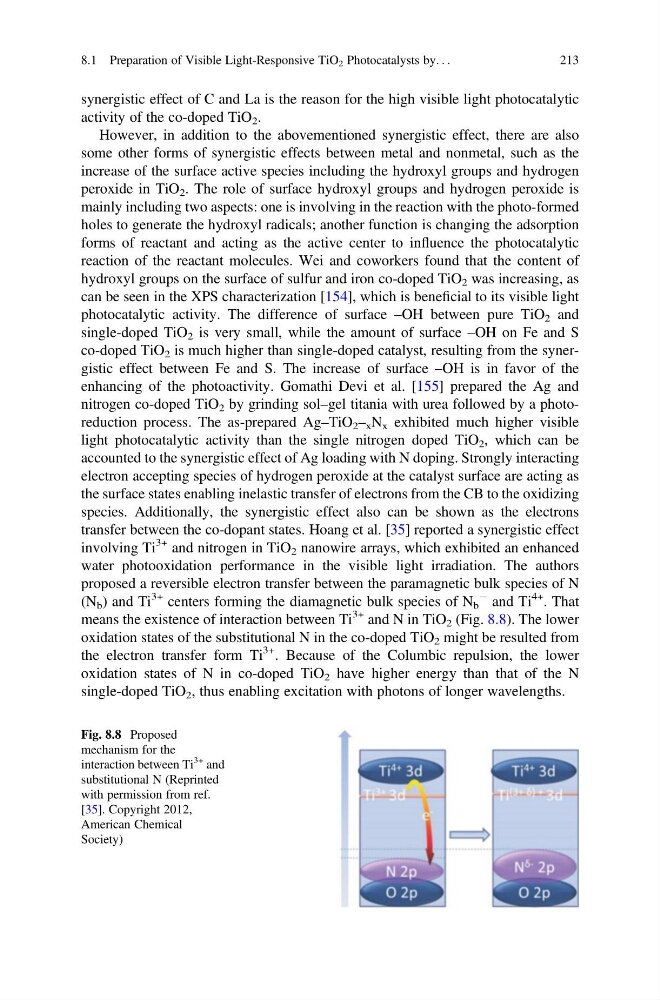
transfer between the co-dopant states. Hoang et al. [35] reported a synergistic effect
involving Ti
3+ and nitrogen in TiO 2 nanowire arrays, which exhibited an enhanced
water photooxidation performance in the visible light irradiation. The authors
proposed a reversible electron transfer between the paramagnetic bulk species of N
(N b ) and Ti
3+ centers forming the diamagnetic bulk species of N b
À and Ti
4+ . That
means the existence of interaction between Ti
3+ and N in TiO 2 (Fig. 8.8). The lower
oxidation states of the substitutional N in the co-doped TiO 2 might be resulted from
the electron transfer form Ti
3+ . Because of the Columbic repulsion, the lower
oxidation states of N in co-doped TiO 2 have higher energy than that of the N
single-doped TiO 2 , thus enabling excitation with photons of longer wavelengths.
Fig. 8.8 Proposed
mechanism for the
interaction between Ti
3+ and
substitutional N (Reprinted
with permission from ref.
[35]. Copyright 2012,
American Chemical
Society)
8.1 Preparation of Visible Light-Responsive TiO 2 Photocatalysts by. . .
213
activity of the co-doped TiO 2 .
However, in addition to the abovementioned synergistic effect, there are also
some other forms of synergistic effects between metal and nonmetal, such as the
increase of the surface active species including the hydroxyl groups and hydrogen
peroxide in TiO 2 . The role of surface hydroxyl groups and hydrogen peroxide is
mainly including two aspects: one is involving in the reaction with the photo-formed
holes to generate the hydroxyl radicals; another function is changing the adsorption
forms of reactant and acting as the active center to influence the photocatalytic
reaction of the reactant molecules. Wei and coworkers found that the content of
hydroxyl groups on the surface of sulfur and iron co-doped TiO 2 was increasing, as
can be seen in the XPS characterization [154], which is beneficial to its visible light
photocatalytic activity. The difference of surface –OH between pure TiO 2 and
single-doped TiO 2 is very small, while the amount of surface –OH on Fe and S
co-doped TiO 2 is much higher than single-doped catalyst, resulting from the synergistic effect between Fe and S. The increase of surface –OH is in favor of the
enhancing of the photoactivity. Gomathi Devi et al. [155] prepared the Ag and
nitrogen co-doped TiO 2 by grinding sol–gel titania with urea followed by a photoreduction process. The as-prepared Ag–TiO 2 – x N x exhibited much higher visible
light photocatalytic activity than the single nitrogen doped TiO 2 , which can be
accounted to the synergistic effect of Ag loading with N doping. Strongly interacting
electron accepting species of hydrogen peroxide at the catalyst surface are acting as
the surface states enabling inelastic transfer of electrons from the CB to the oxidizing
species. Additionally, the synergistic effect also can be shown as the electrons
transfer between the co-dopant states. Hoang et al. [35] reported a synergistic effect
involving Ti
3+ and nitrogen in TiO 2 nanowire arrays, which exhibited an enhanced
water photooxidation performance in the visible light irradiation. The authors
proposed a reversible electron transfer between the paramagnetic bulk species of N
(N b ) and Ti
3+ centers forming the diamagnetic bulk species of N b
À and Ti
4+ . That
means the existence of interaction between Ti
3+ and N in TiO 2 (Fig. 8.8). The lower
oxidation states of the substitutional N in the co-doped TiO 2 might be resulted from
the electron transfer form Ti
3+ . Because of the Columbic repulsion, the lower
oxidation states of N in co-doped TiO 2 have higher energy than that of the N
single-doped TiO 2 , thus enabling excitation with photons of longer wavelengths.
Fig. 8.8 Proposed
mechanism for the
interaction between Ti
3+ and
substitutional N (Reprinted
with permission from ref.
[35]. Copyright 2012,
American Chemical
Society)
8.1 Preparation of Visible Light-Responsive TiO 2 Photocatalysts by. . .
213