

1.4.4 Effect of Temperature
Another factor that has a significant contribution in the photocatalytic degradation of
organic dyes and compounds is temperature. The temperature effect is not profound
if the reaction under observation has a little fluctuation; however, if the temperature
will be excessively higher or lower, it might change the course of degradation
reaction. Dissolved oxygen is one of the key elements that drive the photocatalysis,
as it helps in scavenging CB electrons and leads to the formation of hydroxyl
radicals. The higher or lower temperature causes the change in the percentage of
the dissolved oxygen in the samples and hence changes the degradation rate of the
reaction. Furthermore, the higher temperatures cause desorption of organic compounds from the photocatalyst surface. Because of the fact that the photocatalytic
degradation of the compounds is a surface-based phenomenon, desorption of the
pollutant before the reaction with the electrons or holes due to the high temperature
results in a decrease of the reaction rate.
1.4.5 Effect of Contaminant Concentration
Another factor which can affect the degradation rate of the dyes and hazardous
chemicals is concentration in the reaction mixture. Most of the pollutants for the
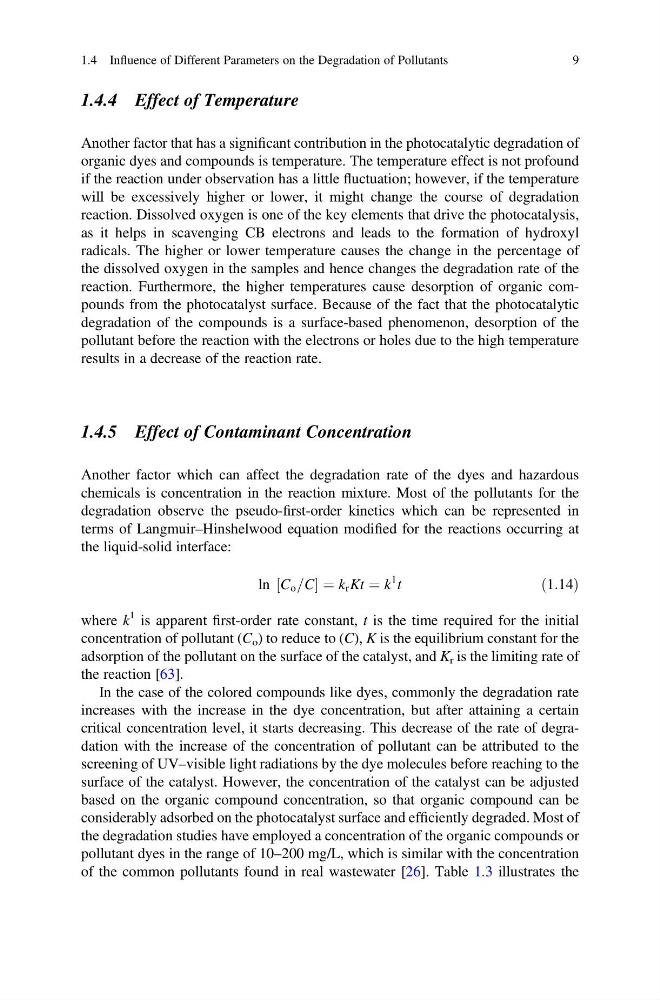
degradation observe the pseudo-first-order kinetics which can be represented in
terms of Langmuir–Hinshelwood equation modified for the reactions occurring at
the liquid-solid interface:
ln C o =C
½
¼k r Kt ¼ k
1
t
ð1:14Þ
where k
1 is apparent first-order rate constant, t is the time required for the initial
concentration of pollutant (C o ) to reduce to (C), K is the equilibrium constant for the
adsorption of the pollutant on the surface of the catalyst, and K r is the limiting rate of
the reaction [63].
In the case of the colored compounds like dyes, commonly the degradation rate
increases with the increase in the dye concentration, but after attaining a certain
critical concentration level, it starts decreasing. This decrease of the rate of degradation with the increase of the concentration of pollutant can be attributed to the
screening of UV–visible light radiations by the dye molecules before reaching to the
surface of the catalyst. However, the concentration of the catalyst can be adjusted
based on the organic compound concentration, so that organic compound can be
considerably adsorbed on the photocatalyst surface and efficiently degraded. Most of
the degradation studies have employed a concentration of the organic compounds or
pollutant dyes in the range of 10–200 mg/L, which is similar with the concentration
of the common pollutants found in real wastewater [26]. Table 1.3 illustrates the
1.4 Influence of Different Parameters on the Degradation of Pollutants
9
Another factor that has a significant contribution in the photocatalytic degradation of
organic dyes and compounds is temperature. The temperature effect is not profound
if the reaction under observation has a little fluctuation; however, if the temperature
will be excessively higher or lower, it might change the course of degradation
reaction. Dissolved oxygen is one of the key elements that drive the photocatalysis,
as it helps in scavenging CB electrons and leads to the formation of hydroxyl
radicals. The higher or lower temperature causes the change in the percentage of
the dissolved oxygen in the samples and hence changes the degradation rate of the
reaction. Furthermore, the higher temperatures cause desorption of organic compounds from the photocatalyst surface. Because of the fact that the photocatalytic
degradation of the compounds is a surface-based phenomenon, desorption of the
pollutant before the reaction with the electrons or holes due to the high temperature
results in a decrease of the reaction rate.
1.4.5 Effect of Contaminant Concentration
Another factor which can affect the degradation rate of the dyes and hazardous
chemicals is concentration in the reaction mixture. Most of the pollutants for the
degradation observe the pseudo-first-order kinetics which can be represented in
terms of Langmuir–Hinshelwood equation modified for the reactions occurring at
the liquid-solid interface:
ln C o =C
½
¼k r Kt ¼ k
1
t
ð1:14Þ
where k
1 is apparent first-order rate constant, t is the time required for the initial
concentration of pollutant (C o ) to reduce to (C), K is the equilibrium constant for the
adsorption of the pollutant on the surface of the catalyst, and K r is the limiting rate of
the reaction [63].
In the case of the colored compounds like dyes, commonly the degradation rate
increases with the increase in the dye concentration, but after attaining a certain
critical concentration level, it starts decreasing. This decrease of the rate of degradation with the increase of the concentration of pollutant can be attributed to the
screening of UV–visible light radiations by the dye molecules before reaching to the
surface of the catalyst. However, the concentration of the catalyst can be adjusted
based on the organic compound concentration, so that organic compound can be
considerably adsorbed on the photocatalyst surface and efficiently degraded. Most of
the degradation studies have employed a concentration of the organic compounds or
pollutant dyes in the range of 10–200 mg/L, which is similar with the concentration
of the common pollutants found in real wastewater [26]. Table 1.3 illustrates the
1.4 Influence of Different Parameters on the Degradation of Pollutants
9