

and tuned the catalyst activity from inert for the nanoflowers and nanospindles to the
highly active nanosheets by the control of the morphology of the samples. Zuo et al.
[61] prepared prism-shaped active faceted rutile Ti (III)-doped TiO 2 with the control
of the morphology under acidic condition and hydrothermal treatment at 200
C for
12 h. They proved that facet effect is an important factor for heterogeneous
photocatalysts due to the surface atom arrangement and coordination which intrinsically determine the reactant adsorption on the surface of molecules, surface
distribution between photoexcited electrons and reactant molecules, as well as the
desorption of product molecules. Li et al. [62] prepared twist-like helix tungsten
nitrogen co-doped TiO 2 for the enhanced degradation of phenol under visible light
irradiation and attributed the enhancement of the photoactivity to the large surface
area, special twist-like helix morphology, large pore size and better crystallinity of
the anatase.
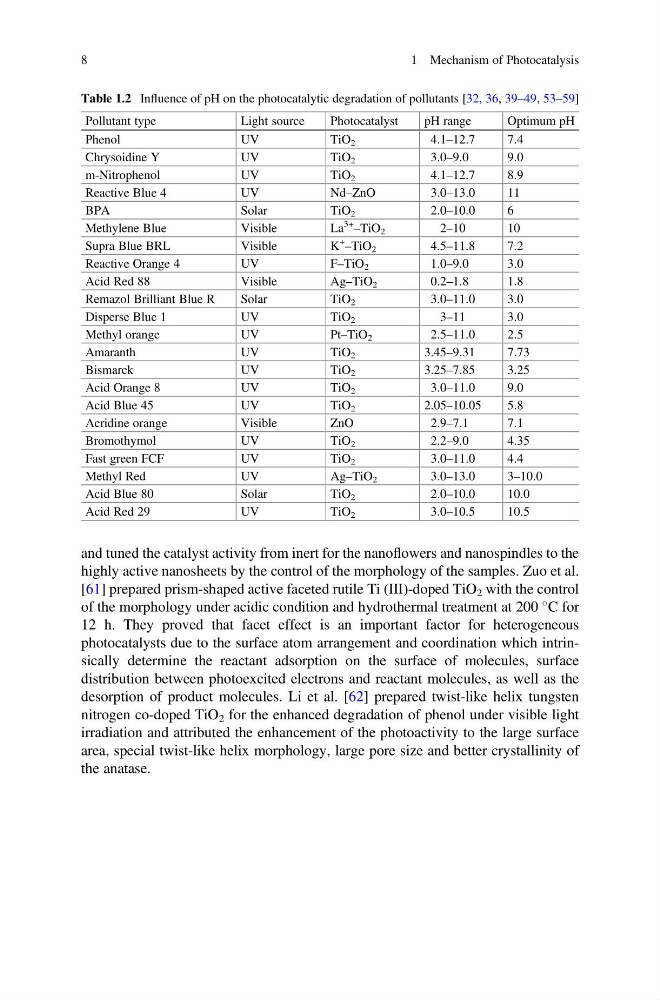
Table 1.2 Influence of pH on the photocatalytic degradation of pollutants [32, 36, 39–49, 53–59]
Pollutant type
Light source
Photocatalyst
pH range
Optimum pH
Phenol
UV
TiO 2
4.1–12.7
7.4
Chrysoidine Y
UV
TiO 2
3.0–9.0
9.0
m-Nitrophenol
UV
TiO 2
4.1–12.7
8.9
Reactive Blue 4
UV
Nd–ZnO
3.0–13.0
11
BPA
Solar
TiO 2
2.0–10.0
6
Methylene Blue
Visible
La
3+ –TiO 2
2–10
10
Supra Blue BRL
Visible
K
+ –TiO 2
4.5–11.8
7.2
Reactive Orange 4
UV
F–TiO 2
1.0–9.0
3.0
Acid Red 88
Visible
Ag–TiO 2
0.2–1.8
1.8
Remazol Brilliant Blue R
Solar
TiO 2
3.0–11.0
3.0
Disperse Blue 1
UV
TiO 2
3–11
3.0
Methyl orange
UV
Pt–TiO 2
2.5–11.0
2.5
Amaranth
UV
TiO 2
3.45–9.31
7.73
Bismarck
UV
TiO 2
3.25–7.85
3.25
Acid Orange 8
UV
TiO 2
3.0–11.0
9.0
Acid Blue 45
UV
TiO 2
2.05–10.05
5.8
Acridine orange
Visible
ZnO
2.9–7.1
7.1
Bromothymol
UV
TiO 2
2.2–9.0
4.35
Fast green FCF
UV
TiO 2
3.0–11.0
4.4
Methyl Red
UV
Ag–TiO 2
3.0–13.0
3–10.0
Acid Blue 80
Solar
TiO 2
2.0–10.0
10.0
Acid Red 29
UV
TiO 2
3.0–10.5
10.5
8
1 Mechanism of Photocatalysis
highly active nanosheets by the control of the morphology of the samples. Zuo et al.
[61] prepared prism-shaped active faceted rutile Ti (III)-doped TiO 2 with the control
of the morphology under acidic condition and hydrothermal treatment at 200
C for
12 h. They proved that facet effect is an important factor for heterogeneous
photocatalysts due to the surface atom arrangement and coordination which intrinsically determine the reactant adsorption on the surface of molecules, surface
distribution between photoexcited electrons and reactant molecules, as well as the
desorption of product molecules. Li et al. [62] prepared twist-like helix tungsten
nitrogen co-doped TiO 2 for the enhanced degradation of phenol under visible light
irradiation and attributed the enhancement of the photoactivity to the large surface
area, special twist-like helix morphology, large pore size and better crystallinity of
the anatase.
Table 1.2 Influence of pH on the photocatalytic degradation of pollutants [32, 36, 39–49, 53–59]
Pollutant type
Light source
Photocatalyst
pH range
Optimum pH
Phenol
UV
TiO 2
4.1–12.7
7.4
Chrysoidine Y
UV
TiO 2
3.0–9.0
9.0
m-Nitrophenol
UV
TiO 2
4.1–12.7
8.9
Reactive Blue 4
UV
Nd–ZnO
3.0–13.0
11
BPA
Solar
TiO 2
2.0–10.0
6
Methylene Blue
Visible
La
3+ –TiO 2
2–10
10
Supra Blue BRL
Visible
K
+ –TiO 2
4.5–11.8
7.2
Reactive Orange 4
UV
F–TiO 2
1.0–9.0
3.0
Acid Red 88
Visible
Ag–TiO 2
0.2–1.8
1.8
Remazol Brilliant Blue R
Solar
TiO 2
3.0–11.0
3.0
Disperse Blue 1
UV
TiO 2
3–11
3.0
Methyl orange
UV
Pt–TiO 2
2.5–11.0
2.5
Amaranth
UV
TiO 2
3.45–9.31
7.73
Bismarck
UV
TiO 2
3.25–7.85
3.25
Acid Orange 8
UV
TiO 2
3.0–11.0
9.0
Acid Blue 45
UV
TiO 2
2.05–10.05
5.8
Acridine orange
Visible
ZnO
2.9–7.1
7.1
Bromothymol
UV
TiO 2
2.2–9.0
4.35
Fast green FCF
UV
TiO 2
3.0–11.0
4.4
Methyl Red
UV
Ag–TiO 2
3.0–13.0
3–10.0
Acid Blue 80
Solar
TiO 2
2.0–10.0
10.0
Acid Red 29
UV
TiO 2
3.0–10.5
10.5
8
1 Mechanism of Photocatalysis