

Thus, as these reaction equations show, the surface of the catalyst will remain
positively charged in acidic medium and negatively charged in basic medium
[26]. Table 1.2 shows some pollutants and their optimum pH at which they show
the highest activity in terms of degradation/mineralization.
1.4.3 Surface Area and Morphology
The photocatalytic activity of semiconductor catalyst also decidedly confides on
surface and structural properties, such as surface area, crystal composition, distribution, porosity, bandgap, particle size, and surface hydroxyl group density [52]. Average crystal size in the heterogeneous catalysis is of primary importance because it is
directly related to its specific surface area which improves the efficiency of a catalyst.
Lin et al. [60] prepared the high-quality brookite TiO 2 single-crystalline nanosheets
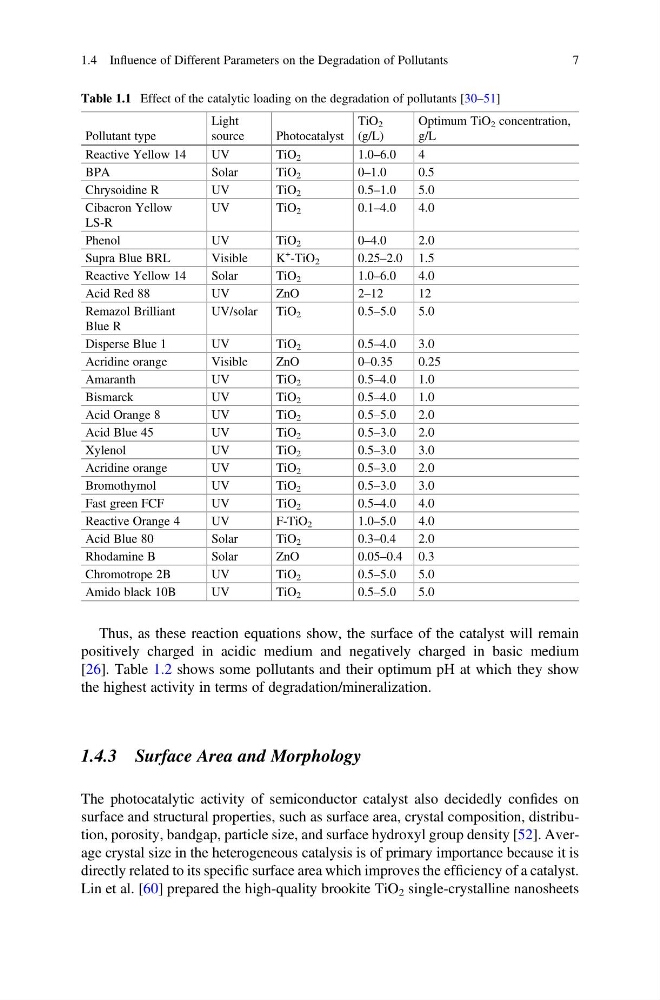
Table 1.1 Effect of the catalytic loading on the degradation of pollutants [30–51]
Pollutant type
Light
source
Photocatalyst
TiO 2
(g/L)
Optimum TiO 2 concentration,
g/L
Reactive Yellow 14
UV
TiO 2
1.0–6.0
4
BPA
Solar
TiO 2
0–1.0
0.5
Chrysoidine R
UV
TiO 2
0.5–1.0
5.0
Cibacron Yellow
LS-R
UV
TiO 2
0.1–4.0
4.0
Phenol
UV
TiO 2
0–4.0
2.0
Supra Blue BRL
Visible
K
+ -TiO 2
0.25–2.0 1.5
Reactive Yellow 14
Solar
TiO 2
1.0–6.0
4.0
Acid Red 88
UV
ZnO
2–12
12
Remazol Brilliant
Blue R
UV/solar TiO 2
0.5–5.0
5.0
Disperse Blue 1
UV
TiO 2
0.5–4.0
3.0
Acridine orange
Visible
ZnO
0–0.35
0.25
Amaranth
UV
TiO 2
0.5–4.0
1.0
Bismarck
UV
TiO 2
0.5–4.0
1.0
Acid Orange 8
UV
TiO 2
0.5–5.0
2.0
Acid Blue 45
UV
TiO 2
0.5–3.0
2.0
Xylenol
UV
TiO 2
0.5–3.0
3.0
Acridine orange
UV
TiO 2
0.5–3.0
2.0
Bromothymol
UV
TiO 2
0.5–3.0
3.0
Fast green FCF
UV
TiO 2
0.5–4.0
4.0
Reactive Orange 4
UV
F-TiO 2
1.0–5.0
4.0
Acid Blue 80
Solar
TiO 2
0.3–0.4
2.0
Rhodamine B
Solar
ZnO
0.05–0.4 0.3
Chromotrope 2B
UV
TiO 2
0.5–5.0
5.0
Amido black 10B
UV
TiO 2
0.5–5.0
5.0
1.4 Influence of Different Parameters on the Degradation of Pollutants
7
positively charged in acidic medium and negatively charged in basic medium
[26]. Table 1.2 shows some pollutants and their optimum pH at which they show
the highest activity in terms of degradation/mineralization.
1.4.3 Surface Area and Morphology
The photocatalytic activity of semiconductor catalyst also decidedly confides on
surface and structural properties, such as surface area, crystal composition, distribution, porosity, bandgap, particle size, and surface hydroxyl group density [52]. Average crystal size in the heterogeneous catalysis is of primary importance because it is
directly related to its specific surface area which improves the efficiency of a catalyst.
Lin et al. [60] prepared the high-quality brookite TiO 2 single-crystalline nanosheets
Table 1.1 Effect of the catalytic loading on the degradation of pollutants [30–51]
Pollutant type
Light
source
Photocatalyst
TiO 2
(g/L)
Optimum TiO 2 concentration,
g/L
Reactive Yellow 14
UV
TiO 2
1.0–6.0
4
BPA
Solar
TiO 2
0–1.0
0.5
Chrysoidine R
UV
TiO 2
0.5–1.0
5.0
Cibacron Yellow
LS-R
UV
TiO 2
0.1–4.0
4.0
Phenol
UV
TiO 2
0–4.0
2.0
Supra Blue BRL
Visible
K
+ -TiO 2
0.25–2.0 1.5
Reactive Yellow 14
Solar
TiO 2
1.0–6.0
4.0
Acid Red 88
UV
ZnO
2–12
12
Remazol Brilliant
Blue R
UV/solar TiO 2
0.5–5.0
5.0
Disperse Blue 1
UV
TiO 2
0.5–4.0
3.0
Acridine orange
Visible
ZnO
0–0.35
0.25
Amaranth
UV
TiO 2
0.5–4.0
1.0
Bismarck
UV
TiO 2
0.5–4.0
1.0
Acid Orange 8
UV
TiO 2
0.5–5.0
2.0
Acid Blue 45
UV
TiO 2
0.5–3.0
2.0
Xylenol
UV
TiO 2
0.5–3.0
3.0
Acridine orange
UV
TiO 2
0.5–3.0
2.0
Bromothymol
UV
TiO 2
0.5–3.0
3.0
Fast green FCF
UV
TiO 2
0.5–4.0
4.0
Reactive Orange 4
UV
F-TiO 2
1.0–5.0
4.0
Acid Blue 80
Solar
TiO 2
0.3–0.4
2.0
Rhodamine B
Solar
ZnO
0.05–0.4 0.3
Chromotrope 2B
UV
TiO 2
0.5–5.0
5.0
Amido black 10B
UV
TiO 2
0.5–5.0
5.0
1.4 Influence of Different Parameters on the Degradation of Pollutants
7