

TiO 2 . The changing in the different parameters can change the degradation results
which will be discussed one by one.
1.4.1 Catalyst Loading
The catalyst concentration for photoactivity in the sample is one of the important
parameters that control the degradation rate of the organic compounds. This is based
upon the initial concentration of the pollutant and volume of the solution being
examined. It has been generally noticed that the degradation rate of the dyes and
pollutants on the surface of the catalyst increases with an increase in the loading of
the catalyst [26]. The increased loading contributes to the high activity because of
the presence of more active catalyst sites at higher concentrations, which helps in the
formation of more hydroxyl species. Furthermore, when catalytic loading is
increased above the optimum value, there observed no substantial increase in the
degradation rate. This is due to the reason that the increased amounts of catalyst
particles in the solution make it turbid and thus block and scatter UV radiation for the
reaction to proceed, and therefore percentage degradation of the pollutant starts
decreasing [27–29]. At high concentrations of photocatalysts, the chances for particle agglomeration increase, which results in the abatement of the available surface
area for the light intake and hence reduces the generation of photoexcited electrons
and holes which affects the photoactivity and reaction rate drops significantly.
Table 1.1 shows the optimum catalyst concentration for the different dyes and
organic compound degradations with different light sources.
1.4.2 pH Effect
The pH of the reaction solution is another very important and determining factor for
the degradation of the pollutants in the presence of the catalyst. The degradation
reactions are immensely sensitive to the pH of photocatalytic reaction mixture. The
dependence of the reaction rate on pH is because of the reason that the pH controls
the adsorption of the organic compound onto the photocatalyst surface, and hence,
the degradation reactions rely on the ionization state and also on the surface charge
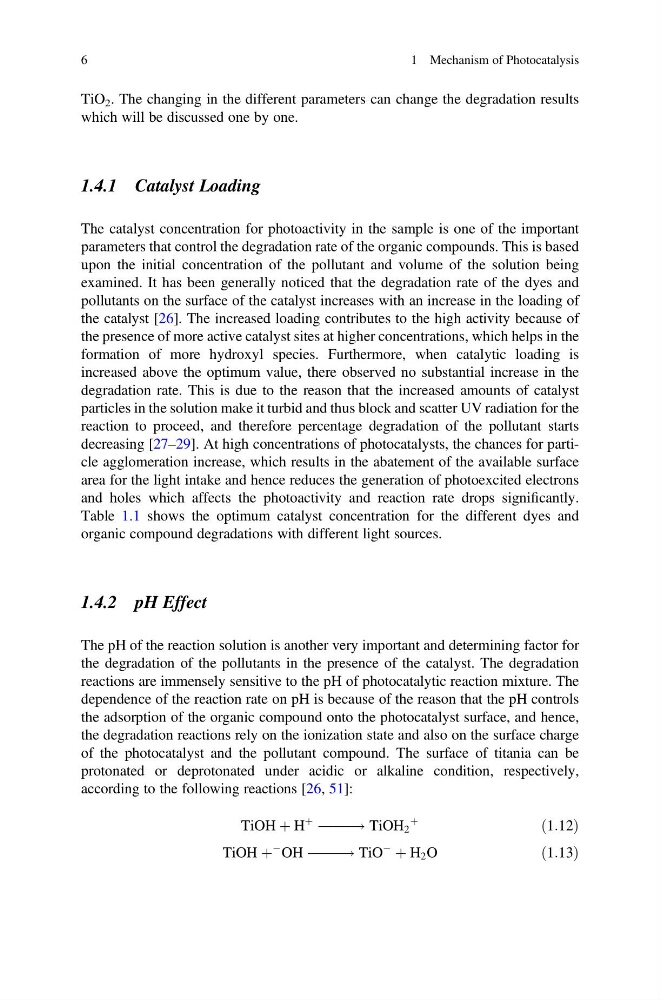
of the photocatalyst and the pollutant compound. The surface of titania can be
protonated or deprotonated under acidic or alkaline condition, respectively,
according to the following reactions [26, 51]:
TiOH þ H
þ
ÀÀÀÀ! TiOH 2
þ
ð1:12Þ
TiOH þ
À OH ÀÀÀÀ! TiO
À
þ H 2 O
ð1:13Þ
6
1 Mechanism of Photocatalysis
which will be discussed one by one.
1.4.1 Catalyst Loading
The catalyst concentration for photoactivity in the sample is one of the important
parameters that control the degradation rate of the organic compounds. This is based
upon the initial concentration of the pollutant and volume of the solution being
examined. It has been generally noticed that the degradation rate of the dyes and
pollutants on the surface of the catalyst increases with an increase in the loading of
the catalyst [26]. The increased loading contributes to the high activity because of
the presence of more active catalyst sites at higher concentrations, which helps in the
formation of more hydroxyl species. Furthermore, when catalytic loading is
increased above the optimum value, there observed no substantial increase in the
degradation rate. This is due to the reason that the increased amounts of catalyst
particles in the solution make it turbid and thus block and scatter UV radiation for the
reaction to proceed, and therefore percentage degradation of the pollutant starts
decreasing [27–29]. At high concentrations of photocatalysts, the chances for particle agglomeration increase, which results in the abatement of the available surface
area for the light intake and hence reduces the generation of photoexcited electrons
and holes which affects the photoactivity and reaction rate drops significantly.
Table 1.1 shows the optimum catalyst concentration for the different dyes and
organic compound degradations with different light sources.
1.4.2 pH Effect
The pH of the reaction solution is another very important and determining factor for
the degradation of the pollutants in the presence of the catalyst. The degradation
reactions are immensely sensitive to the pH of photocatalytic reaction mixture. The
dependence of the reaction rate on pH is because of the reason that the pH controls
the adsorption of the organic compound onto the photocatalyst surface, and hence,
the degradation reactions rely on the ionization state and also on the surface charge
of the photocatalyst and the pollutant compound. The surface of titania can be
protonated or deprotonated under acidic or alkaline condition, respectively,
according to the following reactions [26, 51]:
TiOH þ H
þ
ÀÀÀÀ! TiOH 2
þ
ð1:12Þ
TiOH þ
À OH ÀÀÀÀ! TiO
À
þ H 2 O
ð1:13Þ
6
1 Mechanism of Photocatalysis