

7.3.3 Other Applications
Apart from the above applications, other applications of the g-C 3 N 4 /TiO 2
heterojunction catalysts have also been explored, such as the photocatalytic reduction of CO 2 , treating heavy metal ion, as well as the inactivation of bacteria.
Guiyuan Jiang et al. fabricated a series of composites of g-C 3 N 4 and in situ
N-doped TiO 2 and then applied them to photocatalytic reduction of CO 2 under
simulated light irradiation with water vapor at room temperature. Their research
results showed efficient photocatalytic conversion of CO 2 to CO, and CH 4 was
achieved. In addition, the photocatalytic activity and product selectivity were easy to
adjust through simply varying the ratios of the precursor for g-C 3 N 4 to the precursor
for TiO 2 during the synthesis process of the catalyst. Moreover, as shown in
Fig. 7.18, compared with g-C 3 N 4 and commercial P25, the as-prepared g-C 3 N 4 -NTiO 2 heterojunction photocatalysts showed improved photocatalytic performance
for the reduction of CO 2 , indicating the g-C 3 N 4 /TiO 2 heterojunction catalysts have
good application prospects for mitigating the greenhouse effect and producing
hydrocarbon and chemical compounds [65].
Guangshe Li et al. synthesized br-TiO 2 /g-C 3 N 4 by a facile calcination in air of
brookite TiO 2 (br-TiO 2 ) hybridized with g-C 3 N 4 . The obtained samples were used
for oxidation of toxic As
3+ [42]. The intimately contacted hybrid br-TiO 2 /g-C 3 N 4
showed excellent photocatalytic activity in oxidation of As
3+ to As
5+ , which is less
harmful than As
3+ . Figure 7.19 indicated that the br-TiO 2 /g-C 3 N 4 catalyst with 35%
weight ratio of the g-C 3 N 4 exhibited much higher efficiency than pure br-TiO 2 and
g-C 3 N 4 for the application of As
3+ oxidization.
Additionally, Taicheng An et al. investigated effective removal of biohazards
from water using g-C 3 N 4 /TiO 2 hybrid photocatalyst [66]. The photocatalyst they
synthesized was composed of micron-sized TiO 2 spheres wrapped with lamellar
g-C 3 N 4 . A significantly improved visible light absorption and effectively reduced
recombination of photo-generated electron–hole pairs were achieved by the
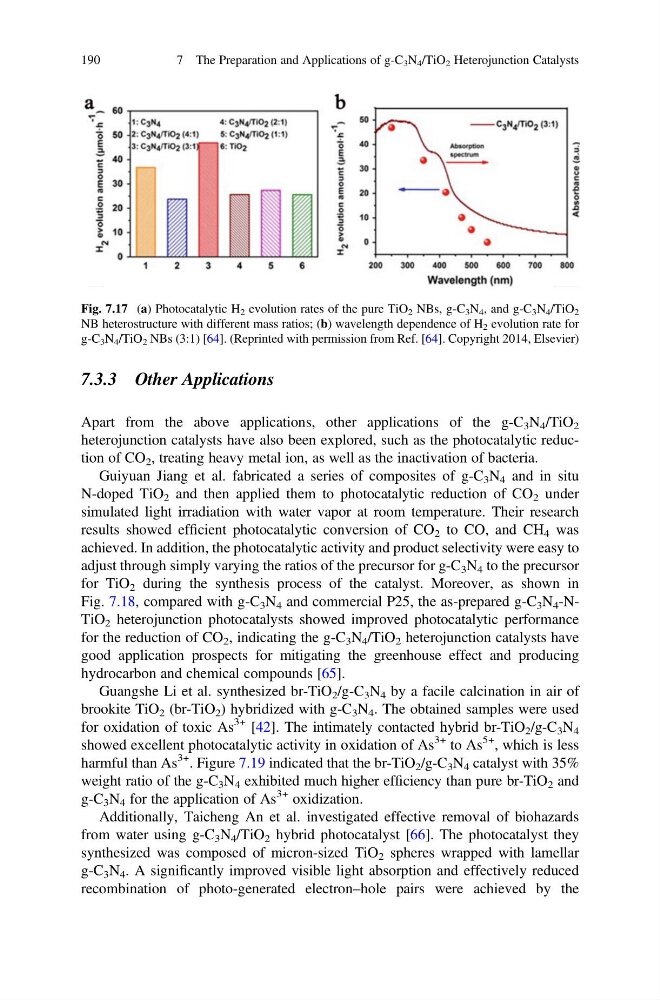
Fig. 7.17 (a) Photocatalytic H 2 evolution rates of the pure TiO 2 NBs, g-C 3 N 4 , and g-C 3 N 4 /TiO 2
NB heterostructure with different mass ratios; (b) wavelength dependence of H 2 evolution rate for
g-C 3 N 4 /TiO 2 NBs (3:1) [64]. (Reprinted with permission from Ref. [64]. Copyright 2014, Elsevier)
190
7 The Preparation and Applications of g-C 3 N 4 /TiO 2 Heterojunction Catalysts
Apart from the above applications, other applications of the g-C 3 N 4 /TiO 2
heterojunction catalysts have also been explored, such as the photocatalytic reduction of CO 2 , treating heavy metal ion, as well as the inactivation of bacteria.
Guiyuan Jiang et al. fabricated a series of composites of g-C 3 N 4 and in situ
N-doped TiO 2 and then applied them to photocatalytic reduction of CO 2 under
simulated light irradiation with water vapor at room temperature. Their research
results showed efficient photocatalytic conversion of CO 2 to CO, and CH 4 was
achieved. In addition, the photocatalytic activity and product selectivity were easy to
adjust through simply varying the ratios of the precursor for g-C 3 N 4 to the precursor
for TiO 2 during the synthesis process of the catalyst. Moreover, as shown in
Fig. 7.18, compared with g-C 3 N 4 and commercial P25, the as-prepared g-C 3 N 4 -NTiO 2 heterojunction photocatalysts showed improved photocatalytic performance
for the reduction of CO 2 , indicating the g-C 3 N 4 /TiO 2 heterojunction catalysts have
good application prospects for mitigating the greenhouse effect and producing
hydrocarbon and chemical compounds [65].
Guangshe Li et al. synthesized br-TiO 2 /g-C 3 N 4 by a facile calcination in air of
brookite TiO 2 (br-TiO 2 ) hybridized with g-C 3 N 4 . The obtained samples were used
for oxidation of toxic As
3+ [42]. The intimately contacted hybrid br-TiO 2 /g-C 3 N 4
showed excellent photocatalytic activity in oxidation of As
3+ to As
5+ , which is less
harmful than As
3+ . Figure 7.19 indicated that the br-TiO 2 /g-C 3 N 4 catalyst with 35%
weight ratio of the g-C 3 N 4 exhibited much higher efficiency than pure br-TiO 2 and
g-C 3 N 4 for the application of As
3+ oxidization.
Additionally, Taicheng An et al. investigated effective removal of biohazards
from water using g-C 3 N 4 /TiO 2 hybrid photocatalyst [66]. The photocatalyst they
synthesized was composed of micron-sized TiO 2 spheres wrapped with lamellar
g-C 3 N 4 . A significantly improved visible light absorption and effectively reduced
recombination of photo-generated electron–hole pairs were achieved by the
Fig. 7.17 (a) Photocatalytic H 2 evolution rates of the pure TiO 2 NBs, g-C 3 N 4 , and g-C 3 N 4 /TiO 2
NB heterostructure with different mass ratios; (b) wavelength dependence of H 2 evolution rate for
g-C 3 N 4 /TiO 2 NBs (3:1) [64]. (Reprinted with permission from Ref. [64]. Copyright 2014, Elsevier)
190
7 The Preparation and Applications of g-C 3 N 4 /TiO 2 Heterojunction Catalysts