

combination of these two components. Using this hybrid photocatalyst, 107 cfu mL
À1
of Escherichia coli K-12 could be completely inactivated within 180 min under
visible light irradiation. Figure 7.20 showed that bacterial cells were seriously
damaged during the photocatalytic inactivation processes, resulting in a severe
leakage of intracellular components. Their research revealed that, through this kind
of g-C 3 N 4 /TiO 2 heterojunction catalyst, bacterial cell destruction and water disinfection could be achieved easily. Besides, their results showed that substantial
interaction between TiO 2 and g-C 3 N 4 in the hybrid photocatalyst was a vital
prerequisite for the enhancement of photocatalytic activity, which subsequently
increased the trapping of the photoinduced charge carriers, benefiting for the production of reactive species. Furthermore, besides h
+ , other reactive species such as
subsequently generated ÁO 2
À and H 2 O 2 also attacked biohazards, causing efficient
photocatalytic inactivation and completely decomposition of bacteria.
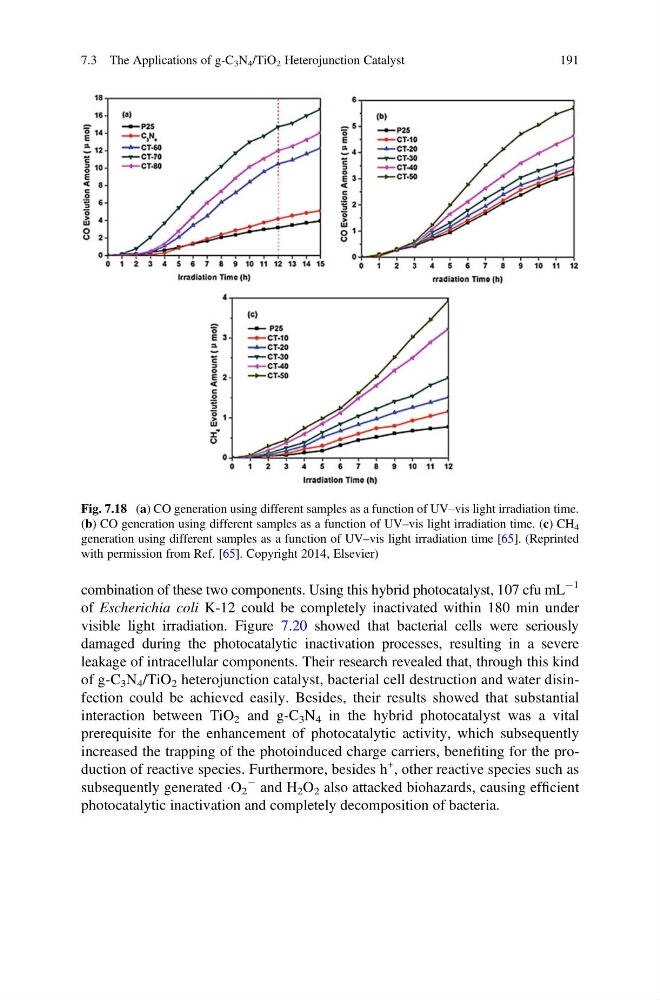
Fig. 7.18 (a) CO generation using different samples as a function of UV–vis light irradiation time.
(b) CO generation using different samples as a function of UV–vis light irradiation time. (c) CH 4
generation using different samples as a function of UV–vis light irradiation time [65]. (Reprinted
with permission from Ref. [65]. Copyright 2014, Elsevier)
7.3 The Applications of g-C 3 N 4 /TiO 2 Heterojunction Catalyst
191
À1
of Escherichia coli K-12 could be completely inactivated within 180 min under
visible light irradiation. Figure 7.20 showed that bacterial cells were seriously
damaged during the photocatalytic inactivation processes, resulting in a severe
leakage of intracellular components. Their research revealed that, through this kind
of g-C 3 N 4 /TiO 2 heterojunction catalyst, bacterial cell destruction and water disinfection could be achieved easily. Besides, their results showed that substantial
interaction between TiO 2 and g-C 3 N 4 in the hybrid photocatalyst was a vital
prerequisite for the enhancement of photocatalytic activity, which subsequently
increased the trapping of the photoinduced charge carriers, benefiting for the production of reactive species. Furthermore, besides h
+ , other reactive species such as
subsequently generated ÁO 2
À and H 2 O 2 also attacked biohazards, causing efficient
photocatalytic inactivation and completely decomposition of bacteria.
Fig. 7.18 (a) CO generation using different samples as a function of UV–vis light irradiation time.
(b) CO generation using different samples as a function of UV–vis light irradiation time. (c) CH 4
generation using different samples as a function of UV–vis light irradiation time [65]. (Reprinted
with permission from Ref. [65]. Copyright 2014, Elsevier)
7.3 The Applications of g-C 3 N 4 /TiO 2 Heterojunction Catalyst
191