

bias-free H 2 evolution of 15.62 μL h
À1 cm
À2 , which was almost a 98-fold increase in
the H 2 production rate of aligned TiO 2 nanotube layers (0.16 μL h
À1 cm
À2 ) [63].
Jian-guo Wang et al. designed and fabricated a novel g-C 3 N 4 /TiO 2 nanobelt
heterostructure material. As shown in Fig. 7.17, the g-C 3 N 4 /TiO 2 nanobelt
heterostructure with a mass ratio of 3:1 showed the highest H 2 production rate of
46.6 μmol h
À1 [64].
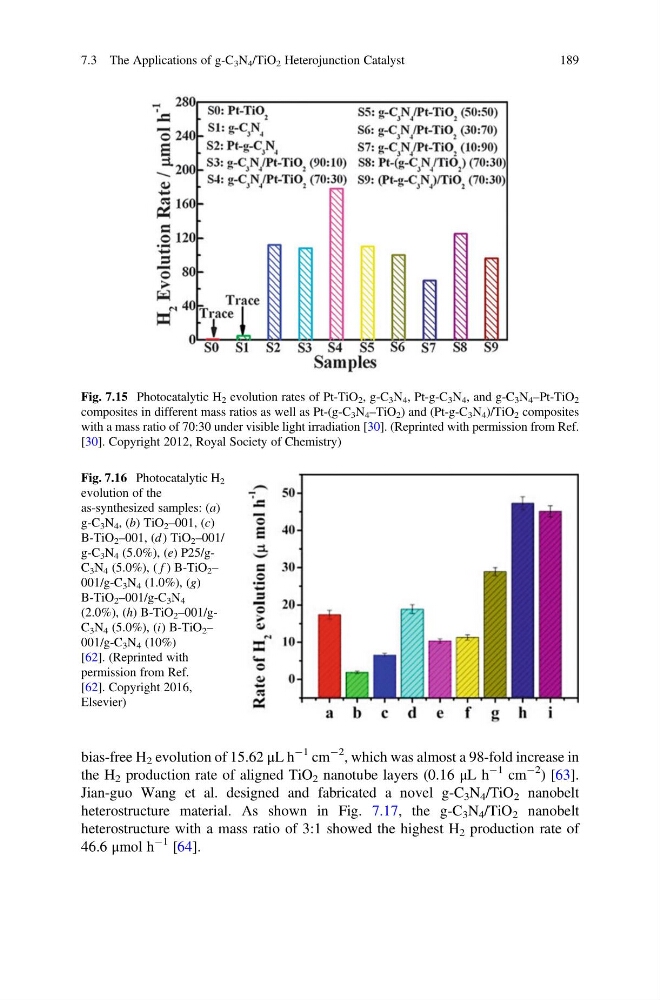
Fig. 7.15 Photocatalytic H 2 evolution rates of Pt-TiO 2 , g-C 3 N 4 , Pt-g-C 3 N 4 , and g-C 3 N 4 –Pt-TiO 2
composites in different mass ratios as well as Pt-(g-C 3 N 4 –TiO 2 ) and (Pt-g-C 3 N 4 )/TiO 2 composites
with a mass ratio of 70:30 under visible light irradiation [30]. (Reprinted with permission from Ref.
[30]. Copyright 2012, Royal Society of Chemistry)
Fig. 7.16 Photocatalytic H 2
evolution of the
as-synthesized samples: (a)
g-C 3 N 4 , (b) TiO 2 –001, (c)
B-TiO 2 –001, (d ) TiO 2 –001/
g-C 3 N 4 (5.0%), (e) P25/gC 3 N 4 (5.0%), ( f ) B-TiO 2 –
001/g-C 3 N 4 (1.0%), (g)
B-TiO 2 –001/g-C 3 N 4
(2.0%), (h) B-TiO 2 –001/gC 3 N 4 (5.0%), (i) B-TiO 2 –
001/g-C 3 N 4 (10%)
[62]. (Reprinted with
permission from Ref.
[62]. Copyright 2016,
Elsevier)
7.3 The Applications of g-C 3 N 4 /TiO 2 Heterojunction Catalyst
189
À1 cm
À2 , which was almost a 98-fold increase in
the H 2 production rate of aligned TiO 2 nanotube layers (0.16 μL h
À1 cm
À2 ) [63].
Jian-guo Wang et al. designed and fabricated a novel g-C 3 N 4 /TiO 2 nanobelt
heterostructure material. As shown in Fig. 7.17, the g-C 3 N 4 /TiO 2 nanobelt
heterostructure with a mass ratio of 3:1 showed the highest H 2 production rate of
46.6 μmol h
À1 [64].
Fig. 7.15 Photocatalytic H 2 evolution rates of Pt-TiO 2 , g-C 3 N 4 , Pt-g-C 3 N 4 , and g-C 3 N 4 –Pt-TiO 2
composites in different mass ratios as well as Pt-(g-C 3 N 4 –TiO 2 ) and (Pt-g-C 3 N 4 )/TiO 2 composites
with a mass ratio of 70:30 under visible light irradiation [30]. (Reprinted with permission from Ref.
[30]. Copyright 2012, Royal Society of Chemistry)
Fig. 7.16 Photocatalytic H 2
evolution of the
as-synthesized samples: (a)
g-C 3 N 4 , (b) TiO 2 –001, (c)
B-TiO 2 –001, (d ) TiO 2 –001/
g-C 3 N 4 (5.0%), (e) P25/gC 3 N 4 (5.0%), ( f ) B-TiO 2 –
001/g-C 3 N 4 (1.0%), (g)
B-TiO 2 –001/g-C 3 N 4
(2.0%), (h) B-TiO 2 –001/gC 3 N 4 (5.0%), (i) B-TiO 2 –
001/g-C 3 N 4 (10%)
[62]. (Reprinted with
permission from Ref.
[62]. Copyright 2016,
Elsevier)
7.3 The Applications of g-C 3 N 4 /TiO 2 Heterojunction Catalyst
189