

environmental and green energy, whose production methods have been studied and
explored a lot. Among the numerous production methods, water splitting with
g-C 3 N 4 /TiO 2 as photocatalyst has been favored by many researchers due to its
merit of environment friendly.
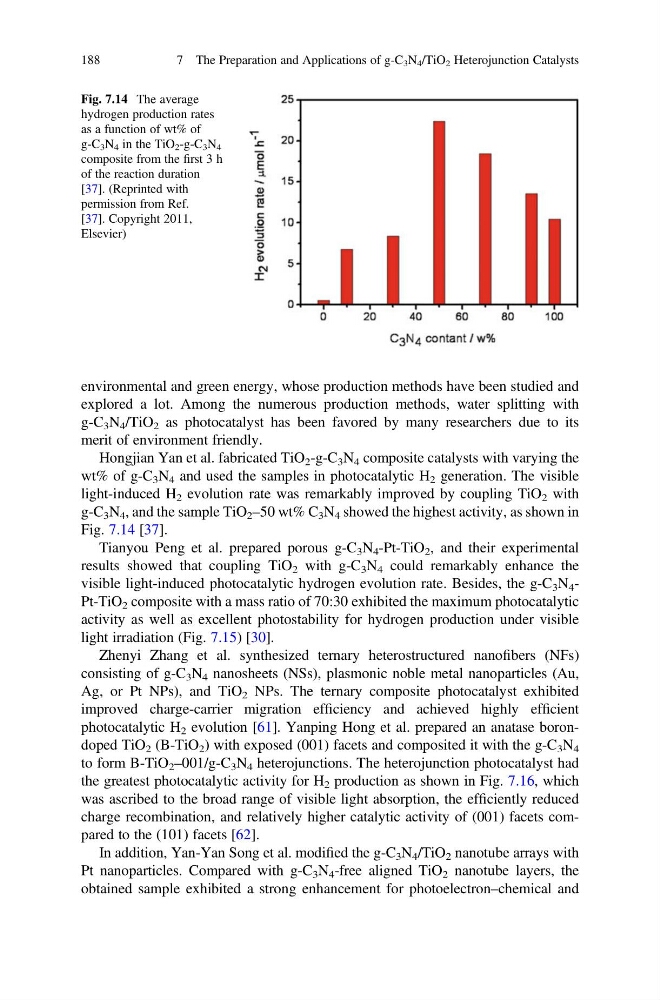
Hongjian Yan et al. fabricated TiO 2 -g-C 3 N 4 composite catalysts with varying the
wt% of g-C 3 N 4 and used the samples in photocatalytic H 2 generation. The visible
light-induced H 2 evolution rate was remarkably improved by coupling TiO 2 with
g-C 3 N 4 , and the sample TiO 2 –50 wt% C 3 N 4 showed the highest activity, as shown in
Fig. 7.14 [37].
Tianyou Peng et al. prepared porous g-C 3 N 4 -Pt-TiO 2 , and their experimental
results showed that coupling TiO 2 with g-C 3 N 4 could remarkably enhance the
visible light-induced photocatalytic hydrogen evolution rate. Besides, the g-C 3 N 4 -
Pt-TiO 2 composite with a mass ratio of 70:30 exhibited the maximum photocatalytic
activity as well as excellent photostability for hydrogen production under visible
light irradiation (Fig. 7.15) [30].
Zhenyi Zhang et al. synthesized ternary heterostructured nanofibers (NFs)
consisting of g-C 3 N 4 nanosheets (NSs), plasmonic noble metal nanoparticles (Au,
Ag, or Pt NPs), and TiO 2 NPs. The ternary composite photocatalyst exhibited
improved charge-carrier migration efficiency and achieved highly efficient
photocatalytic H 2 evolution [61]. Yanping Hong et al. prepared an anatase borondoped TiO 2 (B-TiO 2 ) with exposed (001) facets and composited it with the g-C 3 N 4
to form B-TiO 2 –001/g-C 3 N 4 heterojunctions. The heterojunction photocatalyst had
the greatest photocatalytic activity for H 2 production as shown in Fig. 7.16, which
was ascribed to the broad range of visible light absorption, the efficiently reduced
charge recombination, and relatively higher catalytic activity of (001) facets compared to the (101) facets [62].
In addition, Yan-Yan Song et al. modified the g-C 3 N 4 /TiO 2 nanotube arrays with
Pt nanoparticles. Compared with g-C 3 N 4 -free aligned TiO 2 nanotube layers, the
obtained sample exhibited a strong enhancement for photoelectron–chemical and
Fig. 7.14 The average
hydrogen production rates
as a function of wt% of
g-C 3 N 4 in the TiO 2 -g-C 3 N 4
composite from the first 3 h
of the reaction duration
[37]. (Reprinted with
permission from Ref.
[37]. Copyright 2011,
Elsevier)
188
7 The Preparation and Applications of g-C 3 N 4 /TiO 2 Heterojunction Catalysts
explored a lot. Among the numerous production methods, water splitting with
g-C 3 N 4 /TiO 2 as photocatalyst has been favored by many researchers due to its
merit of environment friendly.
Hongjian Yan et al. fabricated TiO 2 -g-C 3 N 4 composite catalysts with varying the
wt% of g-C 3 N 4 and used the samples in photocatalytic H 2 generation. The visible
light-induced H 2 evolution rate was remarkably improved by coupling TiO 2 with
g-C 3 N 4 , and the sample TiO 2 –50 wt% C 3 N 4 showed the highest activity, as shown in
Fig. 7.14 [37].
Tianyou Peng et al. prepared porous g-C 3 N 4 -Pt-TiO 2 , and their experimental
results showed that coupling TiO 2 with g-C 3 N 4 could remarkably enhance the
visible light-induced photocatalytic hydrogen evolution rate. Besides, the g-C 3 N 4 -
Pt-TiO 2 composite with a mass ratio of 70:30 exhibited the maximum photocatalytic
activity as well as excellent photostability for hydrogen production under visible
light irradiation (Fig. 7.15) [30].
Zhenyi Zhang et al. synthesized ternary heterostructured nanofibers (NFs)
consisting of g-C 3 N 4 nanosheets (NSs), plasmonic noble metal nanoparticles (Au,
Ag, or Pt NPs), and TiO 2 NPs. The ternary composite photocatalyst exhibited
improved charge-carrier migration efficiency and achieved highly efficient
photocatalytic H 2 evolution [61]. Yanping Hong et al. prepared an anatase borondoped TiO 2 (B-TiO 2 ) with exposed (001) facets and composited it with the g-C 3 N 4
to form B-TiO 2 –001/g-C 3 N 4 heterojunctions. The heterojunction photocatalyst had
the greatest photocatalytic activity for H 2 production as shown in Fig. 7.16, which
was ascribed to the broad range of visible light absorption, the efficiently reduced
charge recombination, and relatively higher catalytic activity of (001) facets compared to the (101) facets [62].
In addition, Yan-Yan Song et al. modified the g-C 3 N 4 /TiO 2 nanotube arrays with
Pt nanoparticles. Compared with g-C 3 N 4 -free aligned TiO 2 nanotube layers, the
obtained sample exhibited a strong enhancement for photoelectron–chemical and
Fig. 7.14 The average
hydrogen production rates
as a function of wt% of
g-C 3 N 4 in the TiO 2 -g-C 3 N 4
composite from the first 3 h
of the reaction duration
[37]. (Reprinted with
permission from Ref.
[37]. Copyright 2011,
Elsevier)
188
7 The Preparation and Applications of g-C 3 N 4 /TiO 2 Heterojunction Catalysts