

and its value was equal to 0, 20, 100, 200, and 500, respectively. Their experimental
results showed that the pure g-C 3 N 4 exhibited very low photocatalytic activity for
HCHO oxidation decomposition, while pure TiO 2 was active for decomposition of
HCHO, and the photocatalytic activity of g-C 3 N 4 -TiO 2 was highly dependent on the
amount of incorporated g-C 3 N 4 . The U100 sample with g-C 3 N 4 content of 94%
exhibited the highest photocatalytic activity for HCHO decomposition [5].
In addition to formaldehyde, gaseous acetone has also been degraded by the
g-C 3 N 4 /TiO 2 photocatalyst. Xiangli Li fabricated microspherical g-C 3 N 4 /TiO 2 with
high percentage of TiO 2 (001) facets through a solvothermal method and evaluated
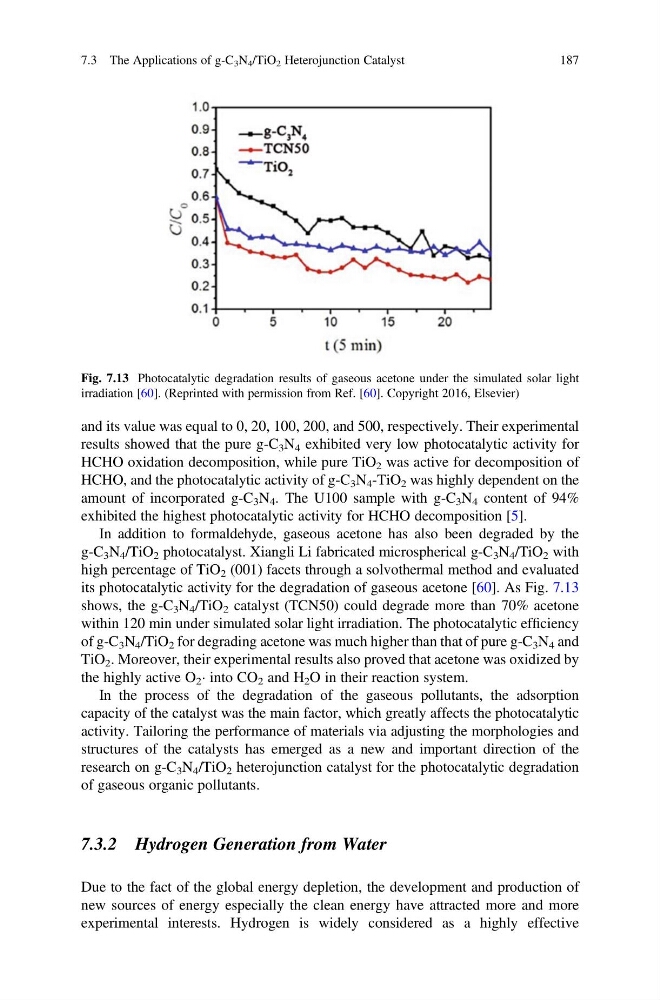
its photocatalytic activity for the degradation of gaseous acetone [60]. As Fig. 7.13
shows, the g-C 3 N 4 /TiO 2 catalyst (TCN50) could degrade more than 70% acetone
within 120 min under simulated solar light irradiation. The photocatalytic efficiency
of g-C 3 N 4 /TiO 2 for degrading acetone was much higher than that of pure g-C 3 N 4 and
TiO 2 . Moreover, their experimental results also proved that acetone was oxidized by
the highly active O 2 Á into CO 2 and H 2 O in their reaction system.
In the process of the degradation of the gaseous pollutants, the adsorption
capacity of the catalyst was the main factor, which greatly affects the photocatalytic
activity. Tailoring the performance of materials via adjusting the morphologies and
structures of the catalysts has emerged as a new and important direction of the
research on g-C 3 N 4 /TiO 2 heterojunction catalyst for the photocatalytic degradation
of gaseous organic pollutants.
7.3.2 Hydrogen Generation from Water
Due to the fact of the global energy depletion, the development and production of
new sources of energy especially the clean energy have attracted more and more
experimental interests. Hydrogen is widely considered as a highly effective
Fig. 7.13 Photocatalytic degradation results of gaseous acetone under the simulated solar light
irradiation [60]. (Reprinted with permission from Ref. [60]. Copyright 2016, Elsevier)
7.3 The Applications of g-C 3 N 4 /TiO 2 Heterojunction Catalyst
187
results showed that the pure g-C 3 N 4 exhibited very low photocatalytic activity for
HCHO oxidation decomposition, while pure TiO 2 was active for decomposition of
HCHO, and the photocatalytic activity of g-C 3 N 4 -TiO 2 was highly dependent on the
amount of incorporated g-C 3 N 4 . The U100 sample with g-C 3 N 4 content of 94%
exhibited the highest photocatalytic activity for HCHO decomposition [5].
In addition to formaldehyde, gaseous acetone has also been degraded by the
g-C 3 N 4 /TiO 2 photocatalyst. Xiangli Li fabricated microspherical g-C 3 N 4 /TiO 2 with
high percentage of TiO 2 (001) facets through a solvothermal method and evaluated
its photocatalytic activity for the degradation of gaseous acetone [60]. As Fig. 7.13
shows, the g-C 3 N 4 /TiO 2 catalyst (TCN50) could degrade more than 70% acetone
within 120 min under simulated solar light irradiation. The photocatalytic efficiency
of g-C 3 N 4 /TiO 2 for degrading acetone was much higher than that of pure g-C 3 N 4 and
TiO 2 . Moreover, their experimental results also proved that acetone was oxidized by
the highly active O 2 Á into CO 2 and H 2 O in their reaction system.
In the process of the degradation of the gaseous pollutants, the adsorption
capacity of the catalyst was the main factor, which greatly affects the photocatalytic
activity. Tailoring the performance of materials via adjusting the morphologies and
structures of the catalysts has emerged as a new and important direction of the
research on g-C 3 N 4 /TiO 2 heterojunction catalyst for the photocatalytic degradation
of gaseous organic pollutants.
7.3.2 Hydrogen Generation from Water
Due to the fact of the global energy depletion, the development and production of
new sources of energy especially the clean energy have attracted more and more
experimental interests. Hydrogen is widely considered as a highly effective
Fig. 7.13 Photocatalytic degradation results of gaseous acetone under the simulated solar light
irradiation [60]. (Reprinted with permission from Ref. [60]. Copyright 2016, Elsevier)
7.3 The Applications of g-C 3 N 4 /TiO 2 Heterojunction Catalyst
187