

and (020). The g-C 3 N 4 /TiO 2 (B) system showed better photocatalytic degradation
ability than the g-C 3 N 4 /anatase system, although the photocatalytic activity of the
anatase nanofibers was much better than that of the TiO 2 (B) nanofibers [40].
In addition to dyes, some other organic compounds such as phenol have also been
served as the target pollutants in the g-C 3 N 4 /TiO 2 photocatalysis system. For
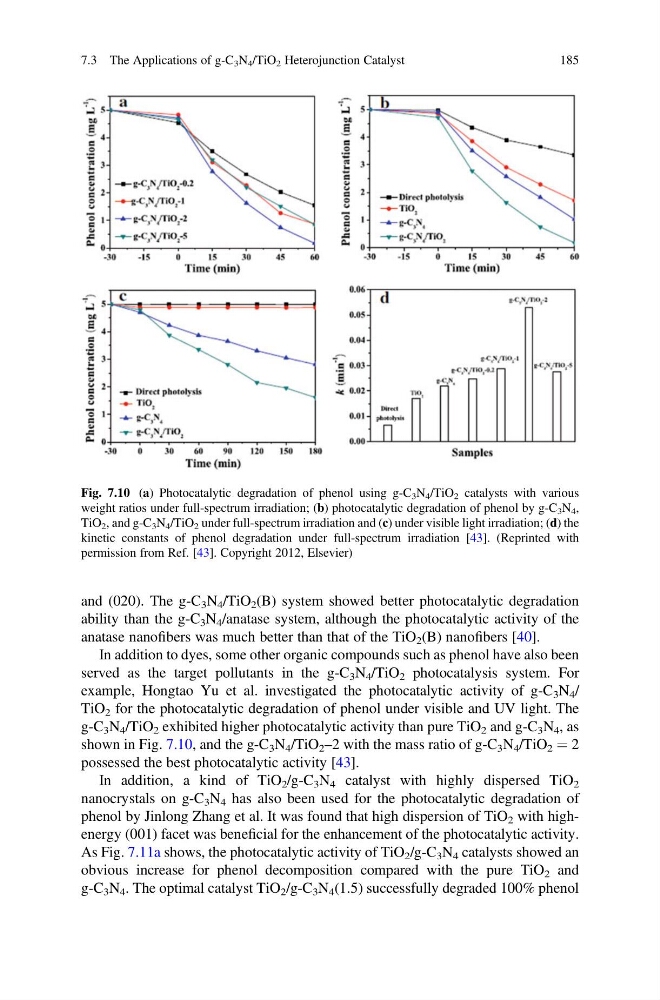
example, Hongtao Yu et al. investigated the photocatalytic activity of g-C 3 N 4 /
TiO 2 for the photocatalytic degradation of phenol under visible and UV light. The
g-C 3 N 4 /TiO 2 exhibited higher photocatalytic activity than pure TiO 2 and g-C 3 N 4 , as
shown in Fig. 7.10, and the g-C 3 N 4 /TiO 2 –2 with the mass ratio of g-C 3 N 4 /TiO 2 ¼ 2
possessed the best photocatalytic activity [43].
In addition, a kind of TiO 2 /g-C 3 N 4 catalyst with highly dispersed TiO 2
nanocrystals on g-C 3 N 4 has also been used for the photocatalytic degradation of
phenol by Jinlong Zhang et al. It was found that high dispersion of TiO 2 with highenergy (001) facet was beneficial for the enhancement of the photocatalytic activity.
As Fig. 7.11a shows, the photocatalytic activity of TiO 2 /g-C 3 N 4 catalysts showed an
obvious increase for phenol decomposition compared with the pure TiO 2 and
g-C 3 N 4 . The optimal catalyst TiO 2 /g-C 3 N 4 (1.5) successfully degraded 100% phenol
Fig. 7.10 (a) Photocatalytic degradation of phenol using g-C 3 N 4 /TiO 2 catalysts with various
weight ratios under full-spectrum irradiation; (b) photocatalytic degradation of phenol by g-C 3 N 4 ,
TiO 2 , and g-C 3 N 4 /TiO 2 under full-spectrum irradiation and (c) under visible light irradiation; (d) the
kinetic constants of phenol degradation under full-spectrum irradiation [43]. (Reprinted with
permission from Ref. [43]. Copyright 2012, Elsevier)
7.3 The Applications of g-C 3 N 4 /TiO 2 Heterojunction Catalyst
185
ability than the g-C 3 N 4 /anatase system, although the photocatalytic activity of the
anatase nanofibers was much better than that of the TiO 2 (B) nanofibers [40].
In addition to dyes, some other organic compounds such as phenol have also been
served as the target pollutants in the g-C 3 N 4 /TiO 2 photocatalysis system. For
example, Hongtao Yu et al. investigated the photocatalytic activity of g-C 3 N 4 /
TiO 2 for the photocatalytic degradation of phenol under visible and UV light. The
g-C 3 N 4 /TiO 2 exhibited higher photocatalytic activity than pure TiO 2 and g-C 3 N 4 , as
shown in Fig. 7.10, and the g-C 3 N 4 /TiO 2 –2 with the mass ratio of g-C 3 N 4 /TiO 2 ¼ 2
possessed the best photocatalytic activity [43].
In addition, a kind of TiO 2 /g-C 3 N 4 catalyst with highly dispersed TiO 2
nanocrystals on g-C 3 N 4 has also been used for the photocatalytic degradation of
phenol by Jinlong Zhang et al. It was found that high dispersion of TiO 2 with highenergy (001) facet was beneficial for the enhancement of the photocatalytic activity.
As Fig. 7.11a shows, the photocatalytic activity of TiO 2 /g-C 3 N 4 catalysts showed an
obvious increase for phenol decomposition compared with the pure TiO 2 and
g-C 3 N 4 . The optimal catalyst TiO 2 /g-C 3 N 4 (1.5) successfully degraded 100% phenol
Fig. 7.10 (a) Photocatalytic degradation of phenol using g-C 3 N 4 /TiO 2 catalysts with various
weight ratios under full-spectrum irradiation; (b) photocatalytic degradation of phenol by g-C 3 N 4 ,
TiO 2 , and g-C 3 N 4 /TiO 2 under full-spectrum irradiation and (c) under visible light irradiation; (d) the
kinetic constants of phenol degradation under full-spectrum irradiation [43]. (Reprinted with
permission from Ref. [43]. Copyright 2012, Elsevier)
7.3 The Applications of g-C 3 N 4 /TiO 2 Heterojunction Catalyst
185