

7.2.3 Loading g-C 3 N 4 on TiO 2
In this synthesis method, TiO 2 is firstly obtained by hydrolysis, hydrothermal,
microwave method, or directly using the commercial P25, and then TiO 2 is impregnated in the precursor solution of g-C 3 N 4 to obtain the g-C 3 N 4 /TiO 2 heterojunction
catalyst after drying and calcination. Weide Zhang et al. modified TiO 2 nanorod
arrays with g-C 3 N 4 via chemical vapor deposition using melamine as a precursor.
The rutile TiO 2 nanorod arrays were firstly synthesized by hydrothermal process,
and then the TiO 2 /FTO was loaded with melamine and followed by heating process
in a muffle furnace to obtain g-C 3 N 4 /TiO 2 /FTO. The g-C 3 N 4 /TiO 2 /FTO electrode
exhibited high photoelectrocatalytic activity for degradation of RhB. Under visible
light irradiation, the photocurrent response of the g-C 3 N 4 /TiO 2 /FTO electrode is
about 10 times as that of the TiO 2 /FTO electrode, making it a promising
nanomaterial for future applications in solar cells, water treatment, as well as
photoelectric devices [51]. Min Fu et al. prepared a kind of novel visible light
photocatalyst g-C 3 N 4 /TiO 2 composite by calcinating the mixtures of melamine and
commercial TiO 2 at different weight ratios. In their work, the samples at the
optimized precursor weight ratio (M melamine : M titania ¼ 2.5) exhibited highest adsorption ability and visible light photocatalytic activity, evaluated by photocatalytic
degradation of methylene blue (MB) [52]. Furthermore, Min Fu et al. also synthesized novel g-C 3 N 4 -coated TiO 2 nanocomposites by a facile and cost-effective solidstate method through thermal treatment of the mixture of urea and commercial TiO 2 .
The as-prepared g-C 3 N 4 -coated TiO 2 nanocomposites showed efficient visible light
photocatalytic activity for degradation of aqueous MB owing to the increased visible
light absorption and enhanced MB adsorption [31]. Burapat Inceesungvorn et al.
fabricated g-C 3 N 4 /TiO 2 films by directly heating the mixture of melamine and
pre-synthesized TiO 2 nanoparticles at the atmosphere of Ar. The TiO 2 was prepared
by hydrolysis of titanium tetraisopropoxide (TTIP) and calcination. The obtained
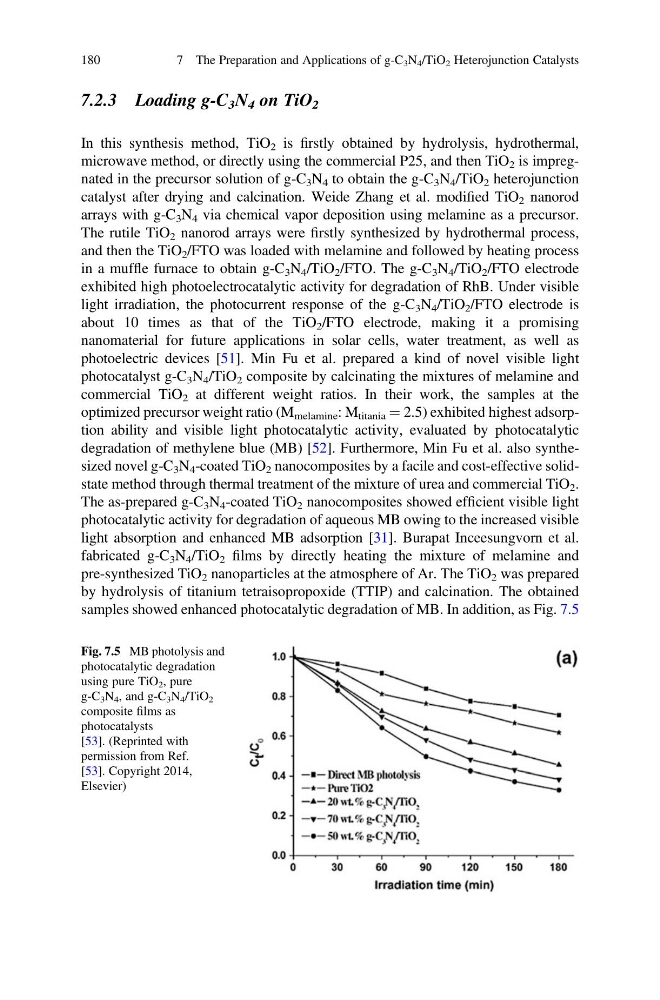
samples showed enhanced photocatalytic degradation of MB. In addition, as Fig. 7.5
Fig. 7.5 MB photolysis and
photocatalytic degradation
using pure TiO 2 , pure
g-C 3 N 4 , and g-C 3 N 4 /TiO 2
composite films as
photocatalysts
[53]. (Reprinted with
permission from Ref.
[53]. Copyright 2014,
Elsevier)
180
7 The Preparation and Applications of g-C 3 N 4 /TiO 2 Heterojunction Catalysts
In this synthesis method, TiO 2 is firstly obtained by hydrolysis, hydrothermal,
microwave method, or directly using the commercial P25, and then TiO 2 is impregnated in the precursor solution of g-C 3 N 4 to obtain the g-C 3 N 4 /TiO 2 heterojunction
catalyst after drying and calcination. Weide Zhang et al. modified TiO 2 nanorod
arrays with g-C 3 N 4 via chemical vapor deposition using melamine as a precursor.
The rutile TiO 2 nanorod arrays were firstly synthesized by hydrothermal process,
and then the TiO 2 /FTO was loaded with melamine and followed by heating process
in a muffle furnace to obtain g-C 3 N 4 /TiO 2 /FTO. The g-C 3 N 4 /TiO 2 /FTO electrode
exhibited high photoelectrocatalytic activity for degradation of RhB. Under visible
light irradiation, the photocurrent response of the g-C 3 N 4 /TiO 2 /FTO electrode is
about 10 times as that of the TiO 2 /FTO electrode, making it a promising
nanomaterial for future applications in solar cells, water treatment, as well as
photoelectric devices [51]. Min Fu et al. prepared a kind of novel visible light
photocatalyst g-C 3 N 4 /TiO 2 composite by calcinating the mixtures of melamine and
commercial TiO 2 at different weight ratios. In their work, the samples at the
optimized precursor weight ratio (M melamine : M titania ¼ 2.5) exhibited highest adsorption ability and visible light photocatalytic activity, evaluated by photocatalytic
degradation of methylene blue (MB) [52]. Furthermore, Min Fu et al. also synthesized novel g-C 3 N 4 -coated TiO 2 nanocomposites by a facile and cost-effective solidstate method through thermal treatment of the mixture of urea and commercial TiO 2 .
The as-prepared g-C 3 N 4 -coated TiO 2 nanocomposites showed efficient visible light
photocatalytic activity for degradation of aqueous MB owing to the increased visible
light absorption and enhanced MB adsorption [31]. Burapat Inceesungvorn et al.
fabricated g-C 3 N 4 /TiO 2 films by directly heating the mixture of melamine and
pre-synthesized TiO 2 nanoparticles at the atmosphere of Ar. The TiO 2 was prepared
by hydrolysis of titanium tetraisopropoxide (TTIP) and calcination. The obtained
samples showed enhanced photocatalytic degradation of MB. In addition, as Fig. 7.5
Fig. 7.5 MB photolysis and
photocatalytic degradation
using pure TiO 2 , pure
g-C 3 N 4 , and g-C 3 N 4 /TiO 2
composite films as
photocatalysts
[53]. (Reprinted with
permission from Ref.
[53]. Copyright 2014,
Elsevier)
180
7 The Preparation and Applications of g-C 3 N 4 /TiO 2 Heterojunction Catalysts