

shows, the 50 wt% g-C 3 N 4 /TiO 2 composite with the best loading content exhibited
the best performance [53].
Honglei Zhu et al. synthesized a series of g-C 3 N 4 -P25 composite photocatalysts
with different mass ratios using an in situ preparation method. In the method,
g-C 3 N 4 -P25 nanocomposites were obtained by calcinating mixtures of the P25 and
dicyandiamide. The optimal g-C 3 N 4 content was determined to be 84%. The sample
in the optimal weight ratio exhibited almost 3.3 times higher photocatalytic activity
than that of individual g-C 3 N 4 under visible light irradiation [54]. Our group also
prepared g-C 3 N 4 -modified TiO 2 composites through a simple calcination process of
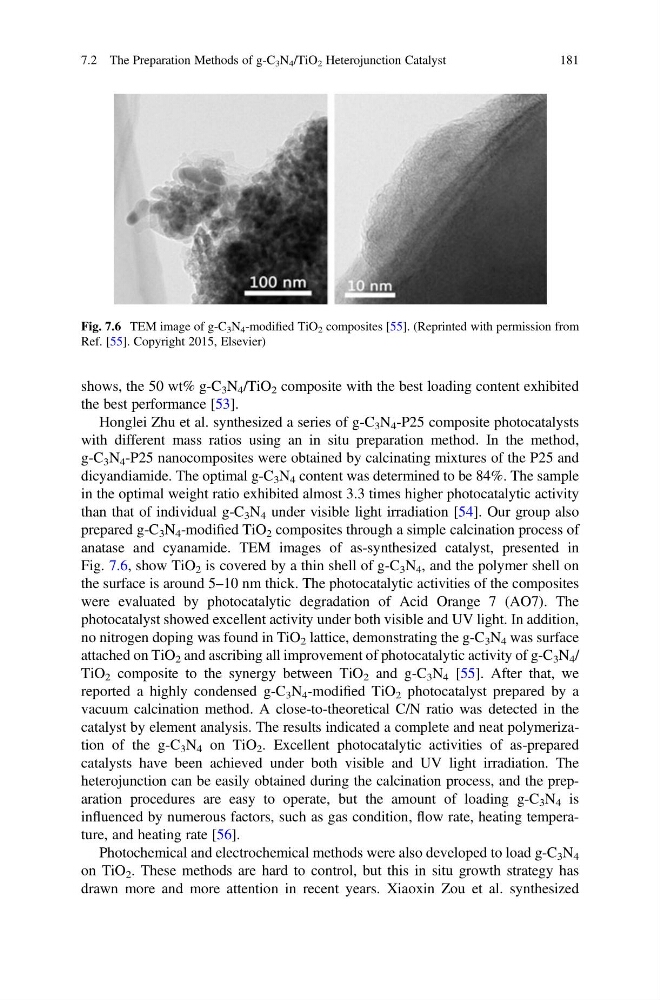
anatase and cyanamide. TEM images of as-synthesized catalyst, presented in
Fig. 7.6, show TiO 2 is covered by a thin shell of g-C 3 N 4 , and the polymer shell on
the surface is around 5–10 nm thick. The photocatalytic activities of the composites
were evaluated by photocatalytic degradation of Acid Orange 7 (AO7). The
photocatalyst showed excellent activity under both visible and UV light. In addition,
no nitrogen doping was found in TiO 2 lattice, demonstrating the g-C 3 N 4 was surface
attached on TiO 2 and ascribing all improvement of photocatalytic activity of g-C 3 N 4 /
TiO 2 composite to the synergy between TiO 2 and g-C 3 N 4 [55]. After that, we
reported a highly condensed g-C 3 N 4 -modified TiO 2 photocatalyst prepared by a
vacuum calcination method. A close-to-theoretical C/N ratio was detected in the
catalyst by element analysis. The results indicated a complete and neat polymerization of the g-C 3 N 4 on TiO 2 . Excellent photocatalytic activities of as-prepared
catalysts have been achieved under both visible and UV light irradiation. The
heterojunction can be easily obtained during the calcination process, and the preparation procedures are easy to operate, but the amount of loading g-C 3 N 4 is
influenced by numerous factors, such as gas condition, flow rate, heating temperature, and heating rate [56].
Photochemical and electrochemical methods were also developed to load g-C 3 N 4
on TiO 2 . These methods are hard to control, but this in situ growth strategy has
drawn more and more attention in recent years. Xiaoxin Zou et al. synthesized
Fig. 7.6 TEM image of g-C 3 N 4 -modified TiO 2 composites [55]. (Reprinted with permission from
Ref. [55]. Copyright 2015, Elsevier)
7.2 The Preparation Methods of g-C 3 N 4 /TiO 2 Heterojunction Catalyst
181
the best performance [53].
Honglei Zhu et al. synthesized a series of g-C 3 N 4 -P25 composite photocatalysts
with different mass ratios using an in situ preparation method. In the method,
g-C 3 N 4 -P25 nanocomposites were obtained by calcinating mixtures of the P25 and
dicyandiamide. The optimal g-C 3 N 4 content was determined to be 84%. The sample
in the optimal weight ratio exhibited almost 3.3 times higher photocatalytic activity
than that of individual g-C 3 N 4 under visible light irradiation [54]. Our group also
prepared g-C 3 N 4 -modified TiO 2 composites through a simple calcination process of
anatase and cyanamide. TEM images of as-synthesized catalyst, presented in
Fig. 7.6, show TiO 2 is covered by a thin shell of g-C 3 N 4 , and the polymer shell on
the surface is around 5–10 nm thick. The photocatalytic activities of the composites
were evaluated by photocatalytic degradation of Acid Orange 7 (AO7). The
photocatalyst showed excellent activity under both visible and UV light. In addition,
no nitrogen doping was found in TiO 2 lattice, demonstrating the g-C 3 N 4 was surface
attached on TiO 2 and ascribing all improvement of photocatalytic activity of g-C 3 N 4 /
TiO 2 composite to the synergy between TiO 2 and g-C 3 N 4 [55]. After that, we
reported a highly condensed g-C 3 N 4 -modified TiO 2 photocatalyst prepared by a
vacuum calcination method. A close-to-theoretical C/N ratio was detected in the
catalyst by element analysis. The results indicated a complete and neat polymerization of the g-C 3 N 4 on TiO 2 . Excellent photocatalytic activities of as-prepared
catalysts have been achieved under both visible and UV light irradiation. The
heterojunction can be easily obtained during the calcination process, and the preparation procedures are easy to operate, but the amount of loading g-C 3 N 4 is
influenced by numerous factors, such as gas condition, flow rate, heating temperature, and heating rate [56].
Photochemical and electrochemical methods were also developed to load g-C 3 N 4
on TiO 2 . These methods are hard to control, but this in situ growth strategy has
drawn more and more attention in recent years. Xiaoxin Zou et al. synthesized
Fig. 7.6 TEM image of g-C 3 N 4 -modified TiO 2 composites [55]. (Reprinted with permission from
Ref. [55]. Copyright 2015, Elsevier)
7.2 The Preparation Methods of g-C 3 N 4 /TiO 2 Heterojunction Catalyst
181