

The strategy of growing TiO 2 on g-C 3 N 4 is very effective to form the
heterojunction structure. The heterojunction which formed in the growing process
possesses chemical stability during the multiple cycle experiments. However, due to
the rapid hydrolysis process of the titanium precursor, it is difficult to achieve
ultradispersed TiO 2 nanocrystals on the surface of g-C 3 N 4 by this method
[50]. Besides, a great challenge for controlling the microstructures of coupled
TiO 2 with desired size distribution and dispersity still retains.
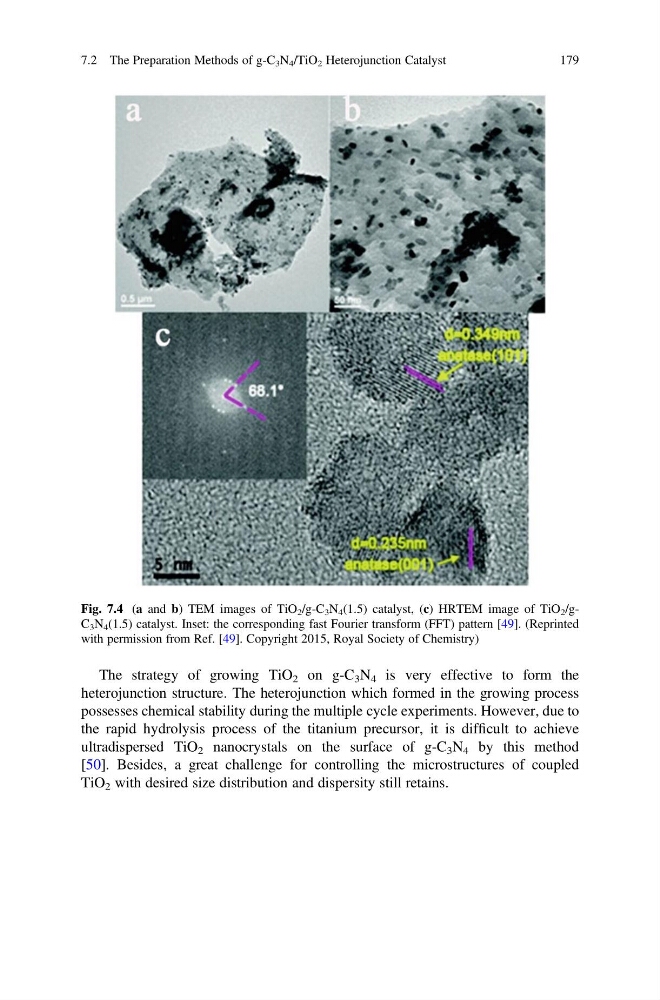
Fig. 7.4 (a and b) TEM images of TiO 2 /g-C 3 N 4 (1.5) catalyst, (c) HRTEM image of TiO 2 /gC 3 N 4 (1.5) catalyst. Inset: the corresponding fast Fourier transform (FFT) pattern [49]. (Reprinted
with permission from Ref. [49]. Copyright 2015, Royal Society of Chemistry)
7.2 The Preparation Methods of g-C 3 N 4 /TiO 2 Heterojunction Catalyst
179
heterojunction structure. The heterojunction which formed in the growing process
possesses chemical stability during the multiple cycle experiments. However, due to
the rapid hydrolysis process of the titanium precursor, it is difficult to achieve
ultradispersed TiO 2 nanocrystals on the surface of g-C 3 N 4 by this method
[50]. Besides, a great challenge for controlling the microstructures of coupled
TiO 2 with desired size distribution and dispersity still retains.
Fig. 7.4 (a and b) TEM images of TiO 2 /g-C 3 N 4 (1.5) catalyst, (c) HRTEM image of TiO 2 /gC 3 N 4 (1.5) catalyst. Inset: the corresponding fast Fourier transform (FFT) pattern [49]. (Reprinted
with permission from Ref. [49]. Copyright 2015, Royal Society of Chemistry)
7.2 The Preparation Methods of g-C 3 N 4 /TiO 2 Heterojunction Catalyst
179