

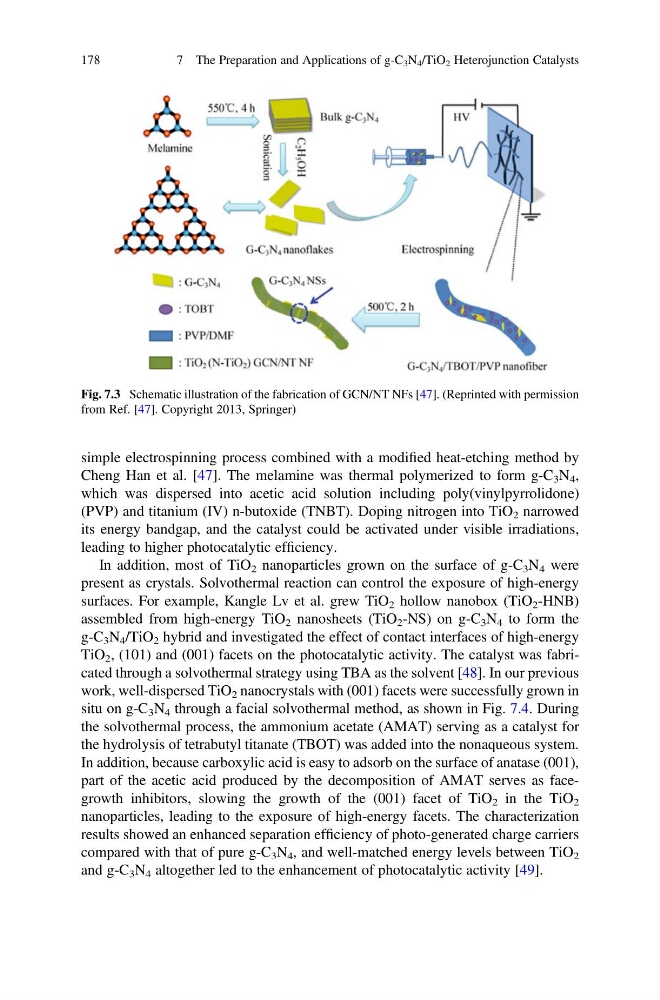
simple electrospinning process combined with a modified heat-etching method by
Cheng Han et al. [47]. The melamine was thermal polymerized to form g-C 3 N 4 ,
which was dispersed into acetic acid solution including poly(vinylpyrrolidone)
(PVP) and titanium (IV) n-butoxide (TNBT). Doping nitrogen into TiO 2 narrowed
its energy bandgap, and the catalyst could be activated under visible irradiations,
leading to higher photocatalytic efficiency.
In addition, most of TiO 2 nanoparticles grown on the surface of g-C 3 N 4 were
present as crystals. Solvothermal reaction can control the exposure of high-energy
surfaces. For example, Kangle Lv et al. grew TiO 2 hollow nanobox (TiO 2 -HNB)
assembled from high-energy TiO 2 nanosheets (TiO 2 -NS) on g-C 3 N 4 to form the
g-C 3 N 4 /TiO 2 hybrid and investigated the effect of contact interfaces of high-energy
TiO 2 , (101) and (001) facets on the photocatalytic activity. The catalyst was fabricated through a solvothermal strategy using TBA as the solvent [48]. In our previous
work, well-dispersed TiO 2 nanocrystals with (001) facets were successfully grown in
situ on g-C 3 N 4 through a facial solvothermal method, as shown in Fig. 7.4. During
the solvothermal process, the ammonium acetate (AMAT) serving as a catalyst for
the hydrolysis of tetrabutyl titanate (TBOT) was added into the nonaqueous system.
In addition, because carboxylic acid is easy to adsorb on the surface of anatase (001),
part of the acetic acid produced by the decomposition of AMAT serves as facegrowth inhibitors, slowing the growth of the (001) facet of TiO 2 in the TiO 2
nanoparticles, leading to the exposure of high-energy facets. The characterization
results showed an enhanced separation efficiency of photo-generated charge carriers
compared with that of pure g-C 3 N 4 , and well-matched energy levels between TiO 2
and g-C 3 N 4 altogether led to the enhancement of photocatalytic activity [49].
Fig. 7.3 Schematic illustration of the fabrication of GCN/NT NFs [47]. (Reprinted with permission
from Ref. [47]. Copyright 2013, Springer)
178
7 The Preparation and Applications of g-C 3 N 4 /TiO 2 Heterojunction Catalysts
Cheng Han et al. [47]. The melamine was thermal polymerized to form g-C 3 N 4 ,
which was dispersed into acetic acid solution including poly(vinylpyrrolidone)
(PVP) and titanium (IV) n-butoxide (TNBT). Doping nitrogen into TiO 2 narrowed
its energy bandgap, and the catalyst could be activated under visible irradiations,
leading to higher photocatalytic efficiency.
In addition, most of TiO 2 nanoparticles grown on the surface of g-C 3 N 4 were
present as crystals. Solvothermal reaction can control the exposure of high-energy
surfaces. For example, Kangle Lv et al. grew TiO 2 hollow nanobox (TiO 2 -HNB)
assembled from high-energy TiO 2 nanosheets (TiO 2 -NS) on g-C 3 N 4 to form the
g-C 3 N 4 /TiO 2 hybrid and investigated the effect of contact interfaces of high-energy
TiO 2 , (101) and (001) facets on the photocatalytic activity. The catalyst was fabricated through a solvothermal strategy using TBA as the solvent [48]. In our previous
work, well-dispersed TiO 2 nanocrystals with (001) facets were successfully grown in
situ on g-C 3 N 4 through a facial solvothermal method, as shown in Fig. 7.4. During
the solvothermal process, the ammonium acetate (AMAT) serving as a catalyst for
the hydrolysis of tetrabutyl titanate (TBOT) was added into the nonaqueous system.
In addition, because carboxylic acid is easy to adsorb on the surface of anatase (001),
part of the acetic acid produced by the decomposition of AMAT serves as facegrowth inhibitors, slowing the growth of the (001) facet of TiO 2 in the TiO 2
nanoparticles, leading to the exposure of high-energy facets. The characterization
results showed an enhanced separation efficiency of photo-generated charge carriers
compared with that of pure g-C 3 N 4 , and well-matched energy levels between TiO 2
and g-C 3 N 4 altogether led to the enhancement of photocatalytic activity [49].
Fig. 7.3 Schematic illustration of the fabrication of GCN/NT NFs [47]. (Reprinted with permission
from Ref. [47]. Copyright 2013, Springer)
178
7 The Preparation and Applications of g-C 3 N 4 /TiO 2 Heterojunction Catalysts