

obtained, which showed better photocatalytic activity than hybrid composite of
g-C 3 N 4 /TiO 2 and the pure TiO 2 for degradation of rhodamine B (RhB) under the
UV and visible light irradiation [28]. Similarly, Hongtao Yu et al. prepared g-C 3 N 4 /
TiO 2 hybrid photocatalyst with wide absorption wavelength range from 300 nm to
450 nm by taking g-C 3 N 4 into the hydrolysis reaction of TiCl 4 . TEM images showed
that TiO 2 nanoparticles were dispersed well on the surface of g-C 3 N 4 sheet, and the
average size of particles was much smaller than that of TiO 2 samples without g-C 3 N 4
sheet. The synthesized g-C 3 N 4 /TiO 2 exhibited much better photocatalytic activity
for the degradation of phenol than pristine g-C 3 N 4 and TiO 2 [43]. Qianhong Shen
et al. developed a novel and facile template-free method to synthesize a network
structure of mesoporous g-C 3 N 4 /TiO 2 nanocomposite with enhanced visible light
photocatalytic activity. Firstly, they synthesized g-C 3 N 4 by directly heating melamine, and then g-C 3 N 4 /TiO 2 was obtained by adding g-C 3 N 4 into the solution of
titanium sulfate Ti(SO 4 ) 2 and followed by hydrothermal reaction [44].
In recent years, more and more attention has been paid in the research on
nitrogen-doped titanium dioxide (N-TiO 2 ), due to its promising extension for environmental application [2, 45]. Many groups grew the N-TiO 2 on the surface of
g-C 3 N 4 to form heterojunction. Fatang Li et al. reported an in situ microwaveassisted synthesis method to fabricate N-TiO 2 /g-C 3 N 4 composites by using
H 2 TiO 3 as the reactant and NH 3 ÁH 2 O as the N-doping source. In their experiments,
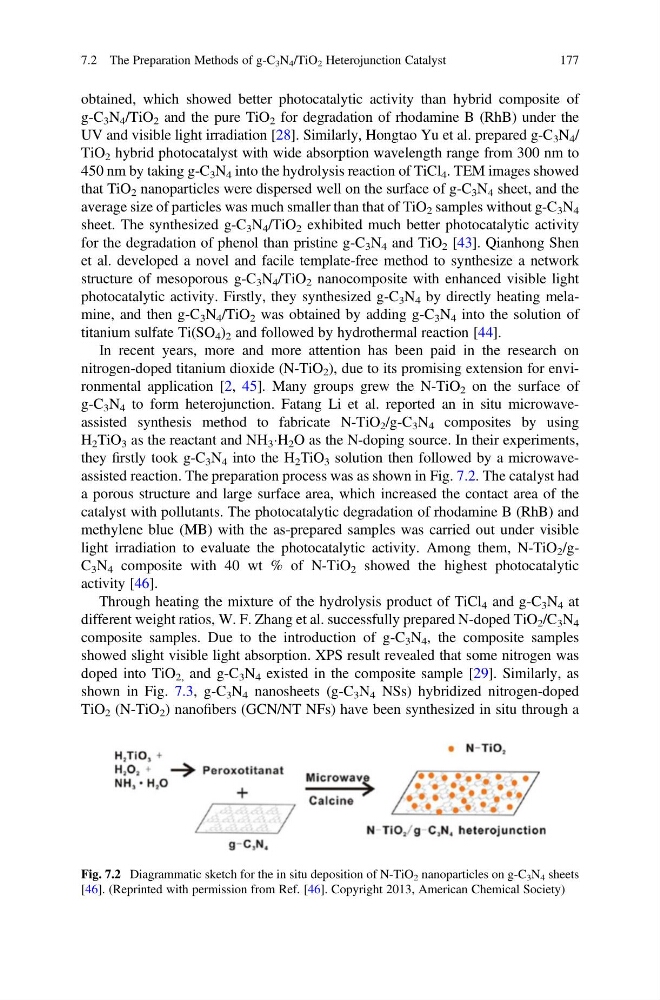
they firstly took g-C 3 N 4 into the H 2 TiO 3 solution then followed by a microwaveassisted reaction. The preparation process was as shown in Fig. 7.2. The catalyst had
a porous structure and large surface area, which increased the contact area of the
catalyst with pollutants. The photocatalytic degradation of rhodamine B (RhB) and
methylene blue (MB) with the as-prepared samples was carried out under visible
light irradiation to evaluate the photocatalytic activity. Among them, N-TiO 2 /gC 3 N 4 composite with 40 wt % of N-TiO 2 showed the highest photocatalytic
activity [46].
Through heating the mixture of the hydrolysis product of TiCl 4 and g-C 3 N 4 at
different weight ratios, W. F. Zhang et al. successfully prepared N-doped TiO 2 /C 3 N 4
composite samples. Due to the introduction of g-C 3 N 4 , the composite samples
showed slight visible light absorption. XPS result revealed that some nitrogen was
doped into TiO 2, and g-C 3 N 4 existed in the composite sample [29]. Similarly, as
shown in Fig. 7.3, g-C 3 N 4 nanosheets (g-C 3 N 4 NSs) hybridized nitrogen-doped
TiO 2 (N-TiO 2 ) nanofibers (GCN/NT NFs) have been synthesized in situ through a
Fig. 7.2 Diagrammatic sketch for the in situ deposition of N-TiO 2 nanoparticles on g-C 3 N 4 sheets
[46]. (Reprinted with permission from Ref. [46]. Copyright 2013, American Chemical Society)
7.2 The Preparation Methods of g-C 3 N 4 /TiO 2 Heterojunction Catalyst
177
g-C 3 N 4 /TiO 2 and the pure TiO 2 for degradation of rhodamine B (RhB) under the
UV and visible light irradiation [28]. Similarly, Hongtao Yu et al. prepared g-C 3 N 4 /
TiO 2 hybrid photocatalyst with wide absorption wavelength range from 300 nm to
450 nm by taking g-C 3 N 4 into the hydrolysis reaction of TiCl 4 . TEM images showed
that TiO 2 nanoparticles were dispersed well on the surface of g-C 3 N 4 sheet, and the
average size of particles was much smaller than that of TiO 2 samples without g-C 3 N 4
sheet. The synthesized g-C 3 N 4 /TiO 2 exhibited much better photocatalytic activity
for the degradation of phenol than pristine g-C 3 N 4 and TiO 2 [43]. Qianhong Shen
et al. developed a novel and facile template-free method to synthesize a network
structure of mesoporous g-C 3 N 4 /TiO 2 nanocomposite with enhanced visible light
photocatalytic activity. Firstly, they synthesized g-C 3 N 4 by directly heating melamine, and then g-C 3 N 4 /TiO 2 was obtained by adding g-C 3 N 4 into the solution of
titanium sulfate Ti(SO 4 ) 2 and followed by hydrothermal reaction [44].
In recent years, more and more attention has been paid in the research on
nitrogen-doped titanium dioxide (N-TiO 2 ), due to its promising extension for environmental application [2, 45]. Many groups grew the N-TiO 2 on the surface of
g-C 3 N 4 to form heterojunction. Fatang Li et al. reported an in situ microwaveassisted synthesis method to fabricate N-TiO 2 /g-C 3 N 4 composites by using
H 2 TiO 3 as the reactant and NH 3 ÁH 2 O as the N-doping source. In their experiments,
they firstly took g-C 3 N 4 into the H 2 TiO 3 solution then followed by a microwaveassisted reaction. The preparation process was as shown in Fig. 7.2. The catalyst had
a porous structure and large surface area, which increased the contact area of the
catalyst with pollutants. The photocatalytic degradation of rhodamine B (RhB) and
methylene blue (MB) with the as-prepared samples was carried out under visible
light irradiation to evaluate the photocatalytic activity. Among them, N-TiO 2 /gC 3 N 4 composite with 40 wt % of N-TiO 2 showed the highest photocatalytic
activity [46].
Through heating the mixture of the hydrolysis product of TiCl 4 and g-C 3 N 4 at
different weight ratios, W. F. Zhang et al. successfully prepared N-doped TiO 2 /C 3 N 4
composite samples. Due to the introduction of g-C 3 N 4 , the composite samples
showed slight visible light absorption. XPS result revealed that some nitrogen was
doped into TiO 2, and g-C 3 N 4 existed in the composite sample [29]. Similarly, as
shown in Fig. 7.3, g-C 3 N 4 nanosheets (g-C 3 N 4 NSs) hybridized nitrogen-doped
TiO 2 (N-TiO 2 ) nanofibers (GCN/NT NFs) have been synthesized in situ through a
Fig. 7.2 Diagrammatic sketch for the in situ deposition of N-TiO 2 nanoparticles on g-C 3 N 4 sheets
[46]. (Reprinted with permission from Ref. [46]. Copyright 2013, American Chemical Society)
7.2 The Preparation Methods of g-C 3 N 4 /TiO 2 Heterojunction Catalyst
177