

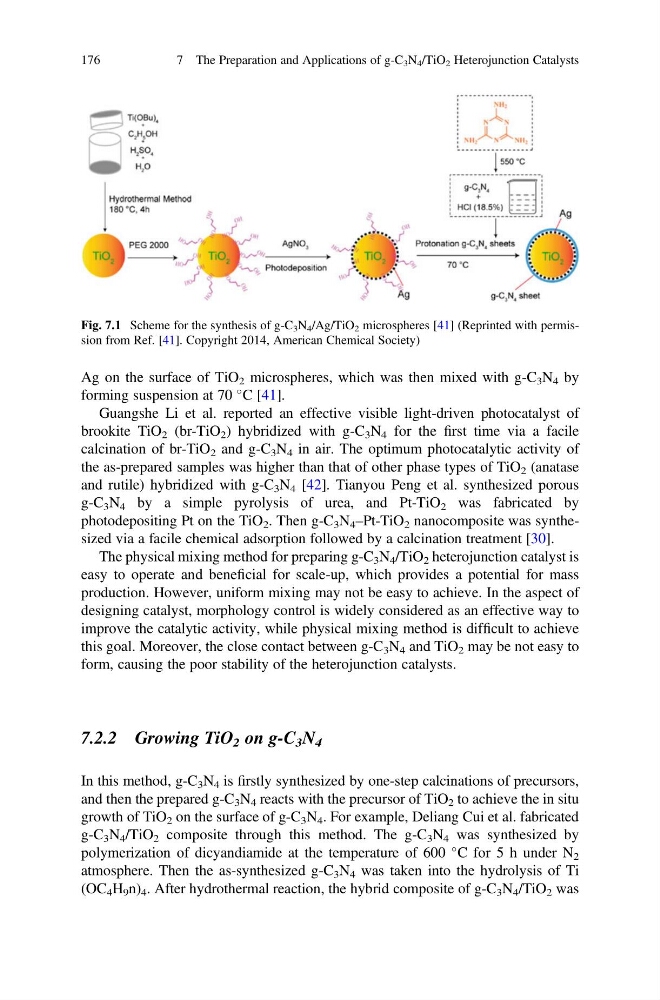
Ag on the surface of TiO 2 microspheres, which was then mixed with g-C 3 N 4 by
forming suspension at 70
C [41].
Guangshe Li et al. reported an effective visible light-driven photocatalyst of
brookite TiO 2 (br-TiO 2 ) hybridized with g-C 3 N 4 for the first time via a facile
calcination of br-TiO 2 and g-C 3 N 4 in air. The optimum photocatalytic activity of
the as-prepared samples was higher than that of other phase types of TiO 2 (anatase
and rutile) hybridized with g-C 3 N 4 [42]. Tianyou Peng et al. synthesized porous
g-C 3 N 4 by a simple pyrolysis of urea, and Pt-TiO 2 was fabricated by
photodepositing Pt on the TiO 2 . Then g-C 3 N 4 –Pt-TiO 2 nanocomposite was synthesized via a facile chemical adsorption followed by a calcination treatment [30].
The physical mixing method for preparing g-C 3 N 4 /TiO 2 heterojunction catalyst is
easy to operate and beneficial for scale-up, which provides a potential for mass
production. However, uniform mixing may not be easy to achieve. In the aspect of
designing catalyst, morphology control is widely considered as an effective way to
improve the catalytic activity, while physical mixing method is difficult to achieve
this goal. Moreover, the close contact between g-C 3 N 4 and TiO 2 may be not easy to
form, causing the poor stability of the heterojunction catalysts.
7.2.2 Growing TiO 2 on g-C 3 N 4
In this method, g-C 3 N 4 is firstly synthesized by one-step calcinations of precursors,
and then the prepared g-C 3 N 4 reacts with the precursor of TiO 2 to achieve the in situ
growth of TiO 2 on the surface of g-C 3 N 4 . For example, Deliang Cui et al. fabricated
g-C 3 N 4 /TiO 2 composite through this method. The g-C 3 N 4 was synthesized by
polymerization of dicyandiamide at the temperature of 600
C for 5 h under N 2
atmosphere. Then the as-synthesized g-C 3 N 4 was taken into the hydrolysis of Ti
(OC 4 H 9 n) 4 . After hydrothermal reaction, the hybrid composite of g-C 3 N 4 /TiO 2 was
Fig. 7.1 Scheme for the synthesis of g-C 3 N 4 /Ag/TiO 2 microspheres [41] (Reprinted with permission from Ref. [41]. Copyright 2014, American Chemical Society)
176
7 The Preparation and Applications of g-C 3 N 4 /TiO 2 Heterojunction Catalysts
forming suspension at 70
C [41].
Guangshe Li et al. reported an effective visible light-driven photocatalyst of
brookite TiO 2 (br-TiO 2 ) hybridized with g-C 3 N 4 for the first time via a facile
calcination of br-TiO 2 and g-C 3 N 4 in air. The optimum photocatalytic activity of
the as-prepared samples was higher than that of other phase types of TiO 2 (anatase
and rutile) hybridized with g-C 3 N 4 [42]. Tianyou Peng et al. synthesized porous
g-C 3 N 4 by a simple pyrolysis of urea, and Pt-TiO 2 was fabricated by
photodepositing Pt on the TiO 2 . Then g-C 3 N 4 –Pt-TiO 2 nanocomposite was synthesized via a facile chemical adsorption followed by a calcination treatment [30].
The physical mixing method for preparing g-C 3 N 4 /TiO 2 heterojunction catalyst is
easy to operate and beneficial for scale-up, which provides a potential for mass
production. However, uniform mixing may not be easy to achieve. In the aspect of
designing catalyst, morphology control is widely considered as an effective way to
improve the catalytic activity, while physical mixing method is difficult to achieve
this goal. Moreover, the close contact between g-C 3 N 4 and TiO 2 may be not easy to
form, causing the poor stability of the heterojunction catalysts.
7.2.2 Growing TiO 2 on g-C 3 N 4
In this method, g-C 3 N 4 is firstly synthesized by one-step calcinations of precursors,
and then the prepared g-C 3 N 4 reacts with the precursor of TiO 2 to achieve the in situ
growth of TiO 2 on the surface of g-C 3 N 4 . For example, Deliang Cui et al. fabricated
g-C 3 N 4 /TiO 2 composite through this method. The g-C 3 N 4 was synthesized by
polymerization of dicyandiamide at the temperature of 600
C for 5 h under N 2
atmosphere. Then the as-synthesized g-C 3 N 4 was taken into the hydrolysis of Ti
(OC 4 H 9 n) 4 . After hydrothermal reaction, the hybrid composite of g-C 3 N 4 /TiO 2 was
Fig. 7.1 Scheme for the synthesis of g-C 3 N 4 /Ag/TiO 2 microspheres [41] (Reprinted with permission from Ref. [41]. Copyright 2014, American Chemical Society)
176
7 The Preparation and Applications of g-C 3 N 4 /TiO 2 Heterojunction Catalysts