

mechanism for P25 that the contact of the two phases led to the bending of the
conduction band, resulting in the holes in anatase transferring to rutile, while the
electrons in anatase not transferring to rutile, further causing the results that holes
were concentrated in rutile and electrons stayed in the anatase particles. It was to say
that the oxidation reaction mostly happened on rutile and the reduction reactions
mostly took place on anatase; thus the Pt deposition on anatase was not able to
increase the photocatalytic efficiency for phenol oxidation in water.
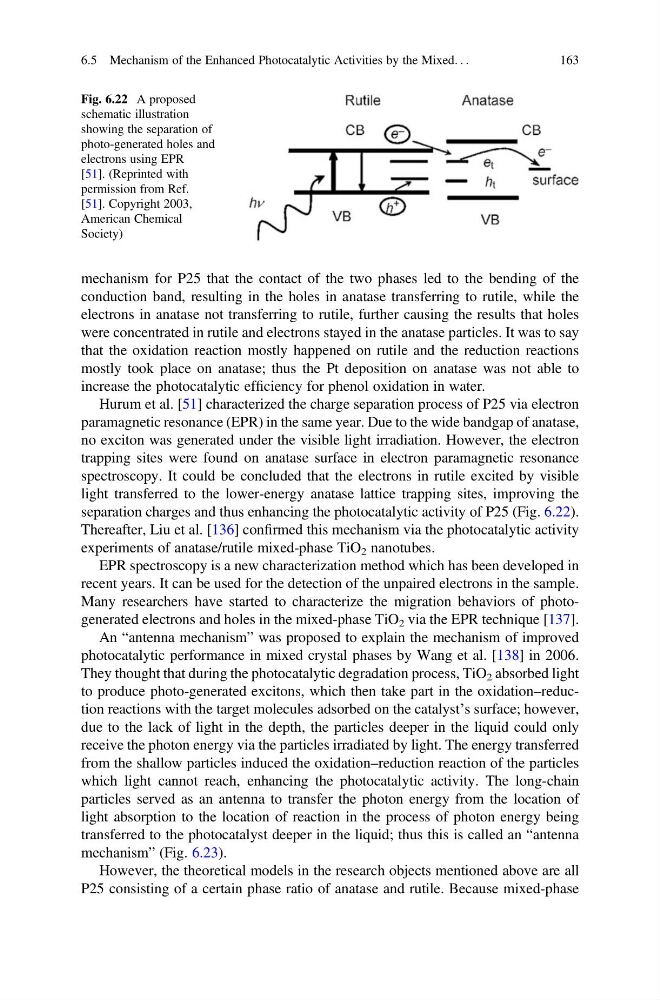
Hurum et al. [51] characterized the charge separation process of P25 via electron
paramagnetic resonance (EPR) in the same year. Due to the wide bandgap of anatase,
no exciton was generated under the visible light irradiation. However, the electron
trapping sites were found on anatase surface in electron paramagnetic resonance
spectroscopy. It could be concluded that the electrons in rutile excited by visible
light transferred to the lower-energy anatase lattice trapping sites, improving the
separation charges and thus enhancing the photocatalytic activity of P25 (Fig. 6.22).
Thereafter, Liu et al. [136] confirmed this mechanism via the photocatalytic activity
experiments of anatase/rutile mixed-phase TiO 2 nanotubes.
EPR spectroscopy is a new characterization method which has been developed in
recent years. It can be used for the detection of the unpaired electrons in the sample.
Many researchers have started to characterize the migration behaviors of photogenerated electrons and holes in the mixed-phase TiO 2 via the EPR technique [137].
An “antenna mechanism” was proposed to explain the mechanism of improved
photocatalytic performance in mixed crystal phases by Wang et al. [138] in 2006.
They thought that during the photocatalytic degradation process, TiO 2 absorbed light
to produce photo-generated excitons, which then take part in the oxidation–reduction reactions with the target molecules adsorbed on the catalyst’s surface; however,
due to the lack of light in the depth, the particles deeper in the liquid could only
receive the photon energy via the particles irradiated by light. The energy transferred
from the shallow particles induced the oxidation–reduction reaction of the particles
which light cannot reach, enhancing the photocatalytic activity. The long-chain
particles served as an antenna to transfer the photon energy from the location of
light absorption to the location of reaction in the process of photon energy being
transferred to the photocatalyst deeper in the liquid; thus this is called an “antenna
mechanism” (Fig. 6.23).
However, the theoretical models in the research objects mentioned above are all
P25 consisting of a certain phase ratio of anatase and rutile. Because mixed-phase
Fig. 6.22 A proposed
schematic illustration
showing the separation of
photo-generated holes and
electrons using EPR
[51]. (Reprinted with
permission from Ref.
[51]. Copyright 2003,
American Chemical
Society)
6.5 Mechanism of the Enhanced Photocatalytic Activities by the Mixed. . .
163
conduction band, resulting in the holes in anatase transferring to rutile, while the
electrons in anatase not transferring to rutile, further causing the results that holes
were concentrated in rutile and electrons stayed in the anatase particles. It was to say
that the oxidation reaction mostly happened on rutile and the reduction reactions
mostly took place on anatase; thus the Pt deposition on anatase was not able to
increase the photocatalytic efficiency for phenol oxidation in water.
Hurum et al. [51] characterized the charge separation process of P25 via electron
paramagnetic resonance (EPR) in the same year. Due to the wide bandgap of anatase,
no exciton was generated under the visible light irradiation. However, the electron
trapping sites were found on anatase surface in electron paramagnetic resonance
spectroscopy. It could be concluded that the electrons in rutile excited by visible
light transferred to the lower-energy anatase lattice trapping sites, improving the
separation charges and thus enhancing the photocatalytic activity of P25 (Fig. 6.22).
Thereafter, Liu et al. [136] confirmed this mechanism via the photocatalytic activity
experiments of anatase/rutile mixed-phase TiO 2 nanotubes.
EPR spectroscopy is a new characterization method which has been developed in
recent years. It can be used for the detection of the unpaired electrons in the sample.
Many researchers have started to characterize the migration behaviors of photogenerated electrons and holes in the mixed-phase TiO 2 via the EPR technique [137].
An “antenna mechanism” was proposed to explain the mechanism of improved
photocatalytic performance in mixed crystal phases by Wang et al. [138] in 2006.
They thought that during the photocatalytic degradation process, TiO 2 absorbed light
to produce photo-generated excitons, which then take part in the oxidation–reduction reactions with the target molecules adsorbed on the catalyst’s surface; however,
due to the lack of light in the depth, the particles deeper in the liquid could only
receive the photon energy via the particles irradiated by light. The energy transferred
from the shallow particles induced the oxidation–reduction reaction of the particles
which light cannot reach, enhancing the photocatalytic activity. The long-chain
particles served as an antenna to transfer the photon energy from the location of
light absorption to the location of reaction in the process of photon energy being
transferred to the photocatalyst deeper in the liquid; thus this is called an “antenna
mechanism” (Fig. 6.23).
However, the theoretical models in the research objects mentioned above are all
P25 consisting of a certain phase ratio of anatase and rutile. Because mixed-phase
Fig. 6.22 A proposed
schematic illustration
showing the separation of
photo-generated holes and
electrons using EPR
[51]. (Reprinted with
permission from Ref.
[51]. Copyright 2003,
American Chemical
Society)
6.5 Mechanism of the Enhanced Photocatalytic Activities by the Mixed. . .
163