

6.5 Mechanism of the Enhanced Photocatalytic Activities
by the Mixed-Phase TiO 2 Photocatalysis
Generally, most of the photo-generated electrons and holes in the single-phase TiO 2
will recombine, and only a small amount of the excitons can migrate to the surface to
participate in the oxidation–reduction reactions with absorbed molecules, causing
relatively low photocatalytic efficiency. In 1991, Bickley et al. [76] first put forward
the mechanism of enhanced photocatalytic activity of P25 consisting of 80% anatase
and 20% rutile. They demonstrated that the mixed-phase structure of P25 is an
anatase nanostructure coated with a layer of rutile film via TEM. Compared with any
other single-phase TiO 2 photocatalyst, the evaluation results showed that the
photocatalytic activity of the mixed-phase TiO 2 was significantly improved. Because
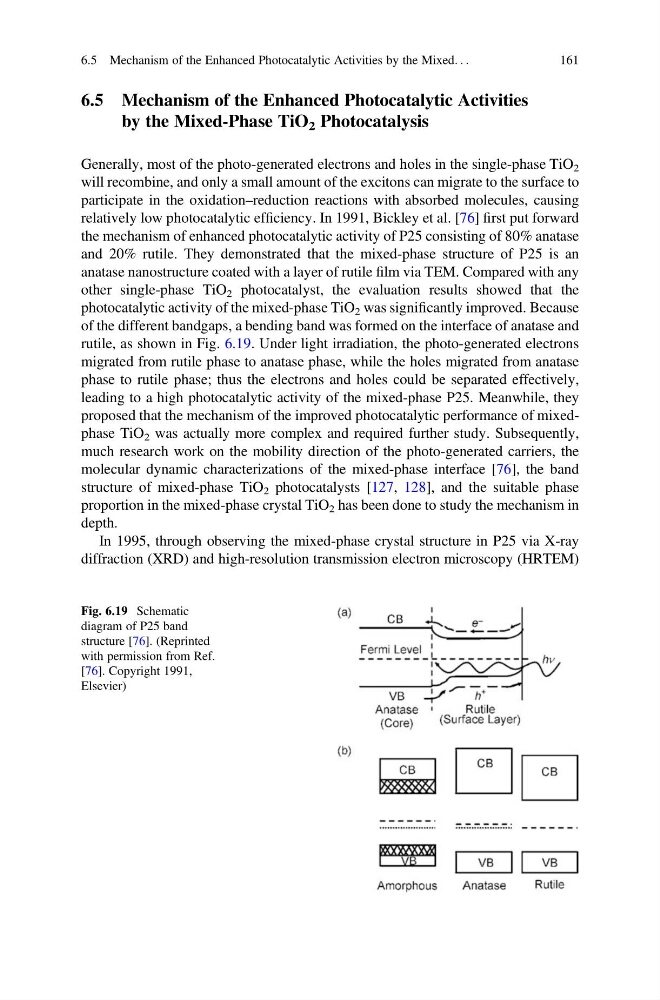
of the different bandgaps, a bending band was formed on the interface of anatase and
rutile, as shown in Fig. 6.19. Under light irradiation, the photo-generated electrons
migrated from rutile phase to anatase phase, while the holes migrated from anatase
phase to rutile phase; thus the electrons and holes could be separated effectively,
leading to a high photocatalytic activity of the mixed-phase P25. Meanwhile, they
proposed that the mechanism of the improved photocatalytic performance of mixedphase TiO 2 was actually more complex and required further study. Subsequently,
much research work on the mobility direction of the photo-generated carriers, the
molecular dynamic characterizations of the mixed-phase interface [76], the band
structure of mixed-phase TiO 2 photocatalysts [127, 128], and the suitable phase
proportion in the mixed-phase crystal TiO 2 has been done to study the mechanism in
depth.
In 1995, through observing the mixed-phase crystal structure in P25 via X-ray
diffraction (XRD) and high-resolution transmission electron microscopy (HRTEM)
Fig. 6.19 Schematic
diagram of P25 band
structure [76]. (Reprinted
with permission from Ref.
[76]. Copyright 1991,
Elsevier)
6.5 Mechanism of the Enhanced Photocatalytic Activities by the Mixed. . .
161
by the Mixed-Phase TiO 2 Photocatalysis
Generally, most of the photo-generated electrons and holes in the single-phase TiO 2
will recombine, and only a small amount of the excitons can migrate to the surface to
participate in the oxidation–reduction reactions with absorbed molecules, causing
relatively low photocatalytic efficiency. In 1991, Bickley et al. [76] first put forward
the mechanism of enhanced photocatalytic activity of P25 consisting of 80% anatase
and 20% rutile. They demonstrated that the mixed-phase structure of P25 is an
anatase nanostructure coated with a layer of rutile film via TEM. Compared with any
other single-phase TiO 2 photocatalyst, the evaluation results showed that the
photocatalytic activity of the mixed-phase TiO 2 was significantly improved. Because
of the different bandgaps, a bending band was formed on the interface of anatase and
rutile, as shown in Fig. 6.19. Under light irradiation, the photo-generated electrons
migrated from rutile phase to anatase phase, while the holes migrated from anatase
phase to rutile phase; thus the electrons and holes could be separated effectively,
leading to a high photocatalytic activity of the mixed-phase P25. Meanwhile, they
proposed that the mechanism of the improved photocatalytic performance of mixedphase TiO 2 was actually more complex and required further study. Subsequently,
much research work on the mobility direction of the photo-generated carriers, the
molecular dynamic characterizations of the mixed-phase interface [76], the band
structure of mixed-phase TiO 2 photocatalysts [127, 128], and the suitable phase
proportion in the mixed-phase crystal TiO 2 has been done to study the mechanism in
depth.
In 1995, through observing the mixed-phase crystal structure in P25 via X-ray
diffraction (XRD) and high-resolution transmission electron microscopy (HRTEM)
Fig. 6.19 Schematic
diagram of P25 band
structure [76]. (Reprinted
with permission from Ref.
[76]. Copyright 1991,
Elsevier)
6.5 Mechanism of the Enhanced Photocatalytic Activities by the Mixed. . .
161