

(k ¼ 0.05397 min
À1 ). In addition, as shown in Fig. 6.17c, the photocatalytic activity
of the best photocatalyst T2 showed only a slight loss after five recycles, indicating a
good stability of the triphasic TiO 2 photocatalyst in the degradation process. Similarly, Shao et al. also developed brookite/anatase/rutile coexisting TiO 2 , and the
as-prepared photocatalyst was demonstrated to show excellent photocatalytic performance for the degradation of methylene blue solutions.
Apart from dyes, some other organic compounds such as phenol and benzyl
alcohol have also been used as the target pollutants in the mixed-phase TiO 2
photocatalysis system. Because phenol as well as its derivatives, as one type of
primary pollutants, is able to do harm to organisms at low concentrations, many
studies on the photodegradation of phenol have been widely carried out [124]. Lu
et al. [125] synthesized a series of mixed-phase TiO 2 samples with different anataseto-rutile ratios and studied the effects of crystal phase in photocatalytic oxidation of
phenol aqueous solution. They found that the photocatalysts with higher anatase-torutile ratios showed higher photocatalytic activities for phenol degradation. Tian
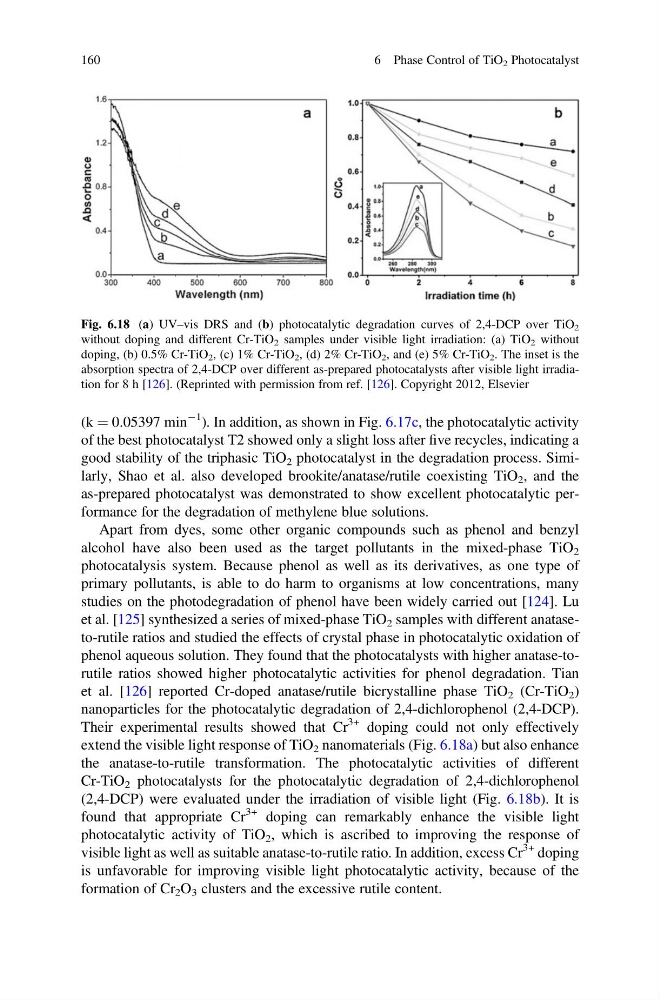
et al. [126] reported Cr-doped anatase/rutile bicrystalline phase TiO 2 (Cr-TiO 2 )
nanoparticles for the photocatalytic degradation of 2,4-dichlorophenol (2,4-DCP).
Their experimental results showed that Cr
3+ doping could not only effectively
extend the visible light response of TiO 2 nanomaterials (Fig. 6.18a) but also enhance
the anatase-to-rutile transformation. The photocatalytic activities of different
Cr-TiO 2 photocatalysts for the photocatalytic degradation of 2,4-dichlorophenol
(2,4-DCP) were evaluated under the irradiation of visible light (Fig. 6.18b). It is
found that appropriate Cr
3+ doping can remarkably enhance the visible light
photocatalytic activity of TiO 2 , which is ascribed to improving the response of
visible light as well as suitable anatase-to-rutile ratio. In addition, excess Cr
3+ doping
is unfavorable for improving visible light photocatalytic activity, because of the
formation of Cr 2 O 3 clusters and the excessive rutile content.
Fig. 6.18 (a) UV–vis DRS and (b) photocatalytic degradation curves of 2,4-DCP over TiO 2
without doping and different Cr-TiO 2 samples under visible light irradiation: (a) TiO 2 without
doping, (b) 0.5% Cr-TiO 2 , (c) 1% Cr-TiO 2 , (d) 2% Cr-TiO 2 , and (e) 5% Cr-TiO 2 . The inset is the
absorption spectra of 2,4-DCP over different as-prepared photocatalysts after visible light irradiation for 8 h [126]. (Reprinted with permission from ref. [126]. Copyright 2012, Elsevier
160
6 Phase Control of TiO 2 Photocatalyst
À1 ). In addition, as shown in Fig. 6.17c, the photocatalytic activity
of the best photocatalyst T2 showed only a slight loss after five recycles, indicating a
good stability of the triphasic TiO 2 photocatalyst in the degradation process. Similarly, Shao et al. also developed brookite/anatase/rutile coexisting TiO 2 , and the
as-prepared photocatalyst was demonstrated to show excellent photocatalytic performance for the degradation of methylene blue solutions.
Apart from dyes, some other organic compounds such as phenol and benzyl
alcohol have also been used as the target pollutants in the mixed-phase TiO 2
photocatalysis system. Because phenol as well as its derivatives, as one type of
primary pollutants, is able to do harm to organisms at low concentrations, many
studies on the photodegradation of phenol have been widely carried out [124]. Lu
et al. [125] synthesized a series of mixed-phase TiO 2 samples with different anataseto-rutile ratios and studied the effects of crystal phase in photocatalytic oxidation of
phenol aqueous solution. They found that the photocatalysts with higher anatase-torutile ratios showed higher photocatalytic activities for phenol degradation. Tian
et al. [126] reported Cr-doped anatase/rutile bicrystalline phase TiO 2 (Cr-TiO 2 )
nanoparticles for the photocatalytic degradation of 2,4-dichlorophenol (2,4-DCP).
Their experimental results showed that Cr
3+ doping could not only effectively
extend the visible light response of TiO 2 nanomaterials (Fig. 6.18a) but also enhance
the anatase-to-rutile transformation. The photocatalytic activities of different
Cr-TiO 2 photocatalysts for the photocatalytic degradation of 2,4-dichlorophenol
(2,4-DCP) were evaluated under the irradiation of visible light (Fig. 6.18b). It is
found that appropriate Cr
3+ doping can remarkably enhance the visible light
photocatalytic activity of TiO 2 , which is ascribed to improving the response of
visible light as well as suitable anatase-to-rutile ratio. In addition, excess Cr
3+ doping
is unfavorable for improving visible light photocatalytic activity, because of the
formation of Cr 2 O 3 clusters and the excessive rutile content.
Fig. 6.18 (a) UV–vis DRS and (b) photocatalytic degradation curves of 2,4-DCP over TiO 2
without doping and different Cr-TiO 2 samples under visible light irradiation: (a) TiO 2 without
doping, (b) 0.5% Cr-TiO 2 , (c) 1% Cr-TiO 2 , (d) 2% Cr-TiO 2 , and (e) 5% Cr-TiO 2 . The inset is the
absorption spectra of 2,4-DCP over different as-prepared photocatalysts after visible light irradiation for 8 h [126]. (Reprinted with permission from ref. [126]. Copyright 2012, Elsevier
160
6 Phase Control of TiO 2 Photocatalyst