

separation of the photo-generated electrons and holes, which was caused by two
aspects: (1) synergistic effect of anatase and brookite in the composite and (2) the
Schottky barrier at the interface of TiO 2 and Ag
0 .
While most research focused on photocatalytic degradation properties of biphasic
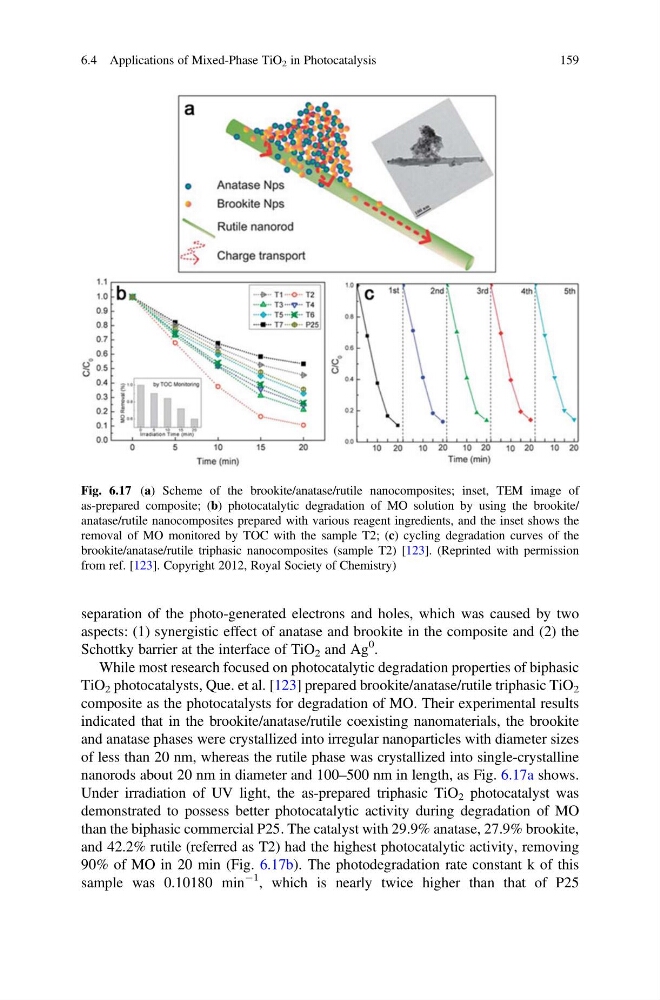
TiO 2 photocatalysts, Que. et al. [123] prepared brookite/anatase/rutile triphasic TiO 2
composite as the photocatalysts for degradation of MO. Their experimental results
indicated that in the brookite/anatase/rutile coexisting nanomaterials, the brookite
and anatase phases were crystallized into irregular nanoparticles with diameter sizes
of less than 20 nm, whereas the rutile phase was crystallized into single-crystalline
nanorods about 20 nm in diameter and 100–500 nm in length, as Fig. 6.17a shows.
Under irradiation of UV light, the as-prepared triphasic TiO 2 photocatalyst was
demonstrated to possess better photocatalytic activity during degradation of MO
than the biphasic commercial P25. The catalyst with 29.9% anatase, 27.9% brookite,
and 42.2% rutile (referred as T2) had the highest photocatalytic activity, removing
90% of MO in 20 min (Fig. 6.17b). The photodegradation rate constant k of this
sample was 0.10180 min
À1 , which is nearly twice higher than that of P25
Fig. 6.17 (a) Scheme of the brookite/anatase/rutile nanocomposites; inset, TEM image of
as-prepared composite; (b) photocatalytic degradation of MO solution by using the brookite/
anatase/rutile nanocomposites prepared with various reagent ingredients, and the inset shows the
removal of MO monitored by TOC with the sample T2; (c) cycling degradation curves of the
brookite/anatase/rutile triphasic nanocomposites (sample T2) [123]. (Reprinted with permission
from ref. [123]. Copyright 2012, Royal Society of Chemistry)
6.4 Applications of Mixed-Phase TiO 2 in Photocatalysis
159
aspects: (1) synergistic effect of anatase and brookite in the composite and (2) the
Schottky barrier at the interface of TiO 2 and Ag
0 .
While most research focused on photocatalytic degradation properties of biphasic
TiO 2 photocatalysts, Que. et al. [123] prepared brookite/anatase/rutile triphasic TiO 2
composite as the photocatalysts for degradation of MO. Their experimental results
indicated that in the brookite/anatase/rutile coexisting nanomaterials, the brookite
and anatase phases were crystallized into irregular nanoparticles with diameter sizes
of less than 20 nm, whereas the rutile phase was crystallized into single-crystalline
nanorods about 20 nm in diameter and 100–500 nm in length, as Fig. 6.17a shows.
Under irradiation of UV light, the as-prepared triphasic TiO 2 photocatalyst was
demonstrated to possess better photocatalytic activity during degradation of MO
than the biphasic commercial P25. The catalyst with 29.9% anatase, 27.9% brookite,
and 42.2% rutile (referred as T2) had the highest photocatalytic activity, removing
90% of MO in 20 min (Fig. 6.17b). The photodegradation rate constant k of this
sample was 0.10180 min
À1 , which is nearly twice higher than that of P25
Fig. 6.17 (a) Scheme of the brookite/anatase/rutile nanocomposites; inset, TEM image of
as-prepared composite; (b) photocatalytic degradation of MO solution by using the brookite/
anatase/rutile nanocomposites prepared with various reagent ingredients, and the inset shows the
removal of MO monitored by TOC with the sample T2; (c) cycling degradation curves of the
brookite/anatase/rutile triphasic nanocomposites (sample T2) [123]. (Reprinted with permission
from ref. [123]. Copyright 2012, Royal Society of Chemistry)
6.4 Applications of Mixed-Phase TiO 2 in Photocatalysis
159