

62% rutile showed the highest photocatalytic activity, which was about six times that
of the commercial P25 catalysts. Recently, Chen et al. [55] grew anatase grains on
the surface of brookite petals to form a brookite/anatase TiO 2 hybrid, which
appeared to have superior photocatalytic activity to the single-phase TiO 2 during
the degradation of methyl orange (MO) as well as 2,4-dichlorophenol (2,4-DCP).
The hybrid consisting of 60% brookite and 40% anatase exhibited the highest
activity, whose degradation rate constants are 2.27 and 1.80 times higher than that
of the corresponding physically mixed brookite/anatase TiO 2 for the
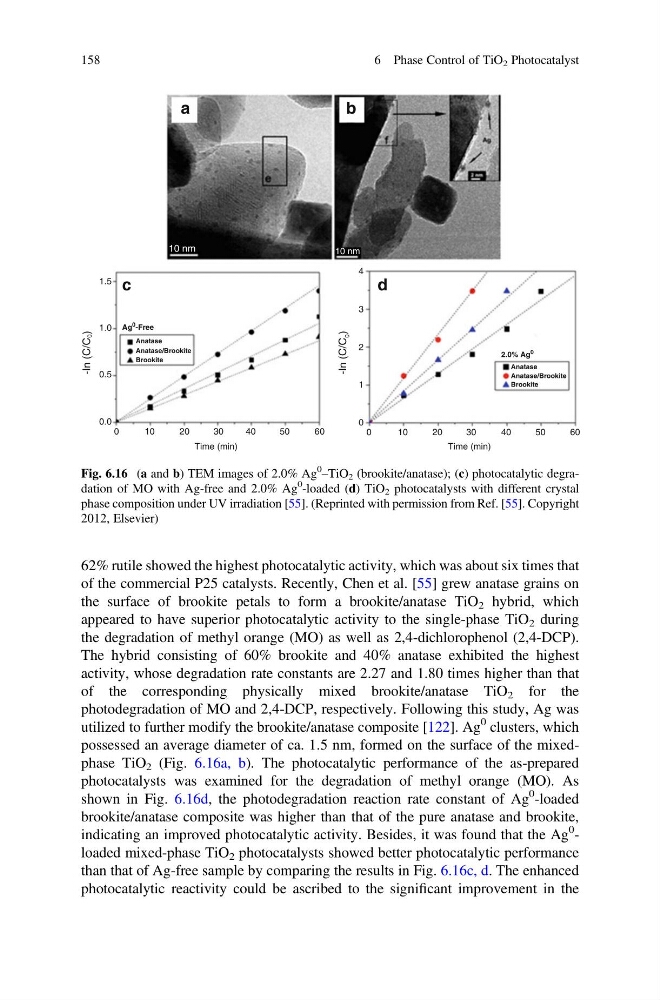
photodegradation of MO and 2,4-DCP, respectively. Following this study, Ag was
utilized to further modify the brookite/anatase composite [122]. Ag
0 clusters, which
possessed an average diameter of ca. 1.5 nm, formed on the surface of the mixedphase TiO 2 (Fig. 6.16a, b). The photocatalytic performance of the as-prepared
photocatalysts was examined for the degradation of methyl orange (MO). As
shown in Fig. 6.16d, the photodegradation reaction rate constant of Ag
0 -loaded
brookite/anatase composite was higher than that of the pure anatase and brookite,
indicating an improved photocatalytic activity. Besides, it was found that the Ag
0 -
loaded mixed-phase TiO 2 photocatalysts showed better photocatalytic performance
than that of Ag-free sample by comparing the results in Fig. 6.16c, d. The enhanced
photocatalytic reactivity could be ascribed to the significant improvement in the
1.5
4
3
10 nm
10 nm
2
1
0
0
1 0
2 0
3 0
4 0
5 0
6 0
Time (min)
1.0
0.5
0.0
0
1 0
Anatase
Ag
0 -Free
2.0% Ag
0
-In (C/C0)
-In (C/C
0
)
Anatase/Brookite
Brookite
Anatase
Anatase/Brookite
Brookite
20
30
40
50
60
Time (min)
a
b
c
d
Fig. 6.16 (a and b) TEM images of 2.0% Ag
0
–TiO 2 (brookite/anatase); (c) photocatalytic degradation of MO with Ag-free and 2.0% Ag
0
-loaded (d) TiO 2 photocatalysts with different crystal
phase composition under UV irradiation [55]. (Reprinted with permission from Ref. [55]. Copyright
2012, Elsevier)
158
6 Phase Control of TiO 2 Photocatalyst
of the commercial P25 catalysts. Recently, Chen et al. [55] grew anatase grains on
the surface of brookite petals to form a brookite/anatase TiO 2 hybrid, which
appeared to have superior photocatalytic activity to the single-phase TiO 2 during
the degradation of methyl orange (MO) as well as 2,4-dichlorophenol (2,4-DCP).
The hybrid consisting of 60% brookite and 40% anatase exhibited the highest
activity, whose degradation rate constants are 2.27 and 1.80 times higher than that
of the corresponding physically mixed brookite/anatase TiO 2 for the
photodegradation of MO and 2,4-DCP, respectively. Following this study, Ag was
utilized to further modify the brookite/anatase composite [122]. Ag
0 clusters, which
possessed an average diameter of ca. 1.5 nm, formed on the surface of the mixedphase TiO 2 (Fig. 6.16a, b). The photocatalytic performance of the as-prepared
photocatalysts was examined for the degradation of methyl orange (MO). As
shown in Fig. 6.16d, the photodegradation reaction rate constant of Ag
0 -loaded
brookite/anatase composite was higher than that of the pure anatase and brookite,
indicating an improved photocatalytic activity. Besides, it was found that the Ag
0 -
loaded mixed-phase TiO 2 photocatalysts showed better photocatalytic performance
than that of Ag-free sample by comparing the results in Fig. 6.16c, d. The enhanced
photocatalytic reactivity could be ascribed to the significant improvement in the
1.5
4
3
10 nm
10 nm
2
1
0
0
1 0
2 0
3 0
4 0
5 0
6 0
Time (min)
1.0
0.5
0.0
0
1 0
Anatase
Ag
0 -Free
2.0% Ag
0
-In (C/C0)
-In (C/C
0
)
Anatase/Brookite
Brookite
Anatase
Anatase/Brookite
Brookite
20
30
40
50
60
Time (min)
a
b
c
d
Fig. 6.16 (a and b) TEM images of 2.0% Ag
0
–TiO 2 (brookite/anatase); (c) photocatalytic degradation of MO with Ag-free and 2.0% Ag
0
-loaded (d) TiO 2 photocatalysts with different crystal
phase composition under UV irradiation [55]. (Reprinted with permission from Ref. [55]. Copyright
2012, Elsevier)
158
6 Phase Control of TiO 2 Photocatalyst