

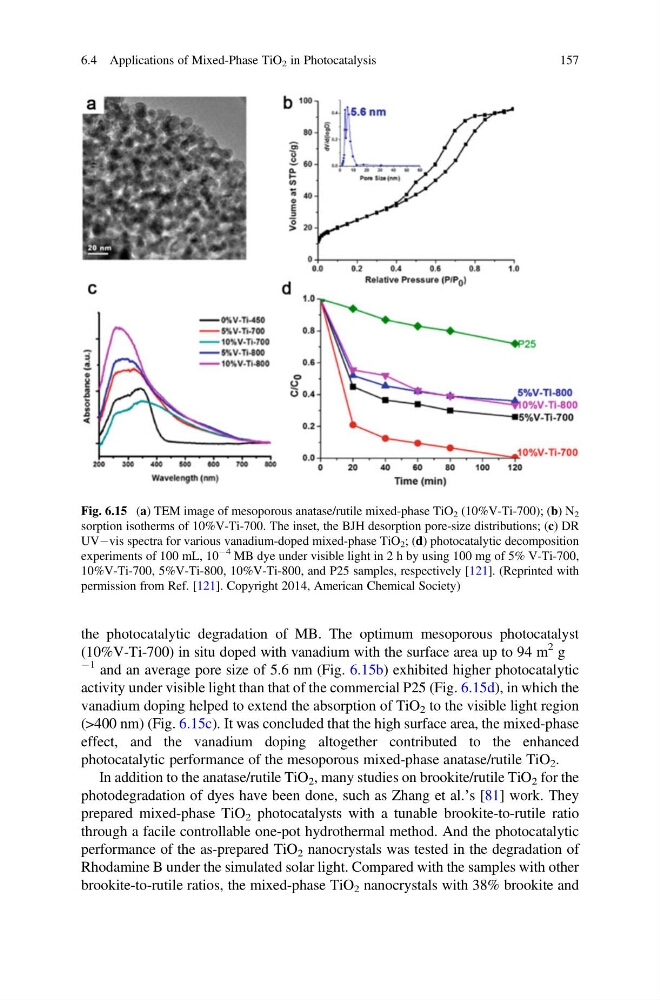
the photocatalytic degradation of MB. The optimum mesoporous photocatalyst
(10%V-Ti-700) in situ doped with vanadium with the surface area up to 94 m
2 g
À1 and an average pore size of 5.6 nm (Fig. 6.15b) exhibited higher photocatalytic
activity under visible light than that of the commercial P25 (Fig. 6.15d), in which the
vanadium doping helped to extend the absorption of TiO 2 to the visible light region
(>400 nm) (Fig. 6.15c). It was concluded that the high surface area, the mixed-phase
effect, and the vanadium doping altogether contributed to the enhanced
photocatalytic performance of the mesoporous mixed-phase anatase/rutile TiO 2 .
In addition to the anatase/rutile TiO 2 , many studies on brookite/rutile TiO 2 for the
photodegradation of dyes have been done, such as Zhang et al.’s [81] work. They
prepared mixed-phase TiO 2 photocatalysts with a tunable brookite-to-rutile ratio
through a facile controllable one-pot hydrothermal method. And the photocatalytic
performance of the as-prepared TiO 2 nanocrystals was tested in the degradation of
Rhodamine B under the simulated solar light. Compared with the samples with other
brookite-to-rutile ratios, the mixed-phase TiO 2 nanocrystals with 38% brookite and
Fig. 6.15 (a) TEM image of mesoporous anatase/rutile mixed-phase TiO 2 (10%V-Ti-700); (b) N 2
sorption isotherms of 10%V-Ti-700. The inset, the BJH desorption pore-size distributions; (c) DR
UVÀvis spectra for various vanadium-doped mixed-phase TiO 2 ; (d) photocatalytic decomposition
experiments of 100 mL, 10
À4 MB dye under visible light in 2 h by using 100 mg of 5% V-Ti-700,
10%V-Ti-700, 5%V-Ti-800, 10%V-Ti-800, and P25 samples, respectively [121]. (Reprinted with
permission from Ref. [121]. Copyright 2014, American Chemical Society)
6.4 Applications of Mixed-Phase TiO 2 in Photocatalysis
157
(10%V-Ti-700) in situ doped with vanadium with the surface area up to 94 m
2 g
À1 and an average pore size of 5.6 nm (Fig. 6.15b) exhibited higher photocatalytic
activity under visible light than that of the commercial P25 (Fig. 6.15d), in which the
vanadium doping helped to extend the absorption of TiO 2 to the visible light region
(>400 nm) (Fig. 6.15c). It was concluded that the high surface area, the mixed-phase
effect, and the vanadium doping altogether contributed to the enhanced
photocatalytic performance of the mesoporous mixed-phase anatase/rutile TiO 2 .
In addition to the anatase/rutile TiO 2 , many studies on brookite/rutile TiO 2 for the
photodegradation of dyes have been done, such as Zhang et al.’s [81] work. They
prepared mixed-phase TiO 2 photocatalysts with a tunable brookite-to-rutile ratio
through a facile controllable one-pot hydrothermal method. And the photocatalytic
performance of the as-prepared TiO 2 nanocrystals was tested in the degradation of
Rhodamine B under the simulated solar light. Compared with the samples with other
brookite-to-rutile ratios, the mixed-phase TiO 2 nanocrystals with 38% brookite and
Fig. 6.15 (a) TEM image of mesoporous anatase/rutile mixed-phase TiO 2 (10%V-Ti-700); (b) N 2
sorption isotherms of 10%V-Ti-700. The inset, the BJH desorption pore-size distributions; (c) DR
UVÀvis spectra for various vanadium-doped mixed-phase TiO 2 ; (d) photocatalytic decomposition
experiments of 100 mL, 10
À4 MB dye under visible light in 2 h by using 100 mg of 5% V-Ti-700,
10%V-Ti-700, 5%V-Ti-800, 10%V-Ti-800, and P25 samples, respectively [121]. (Reprinted with
permission from Ref. [121]. Copyright 2014, American Chemical Society)
6.4 Applications of Mixed-Phase TiO 2 in Photocatalysis
157