

6.4.2 Photocatalytic Reduction of CO 2 with Water on MixedPhase TiO 2
As we know, CO 2 is the main cause of the greenhouse effect, which leads to global
warming. Meanwhile, based on the fact that CO 2 can be converted into various
useful chemical compounds and fuels such as CH 4 , CH 3 OH, and HCOOH, it is also
a promising carbon resource. Therefore, in order to reduce the emissions of CO 2 and
to obtain a sustainable energy, many kinds of novel materials and new technologies
have been developed to convert CO 2 . Besides the methods of solar thermochemical
conversion as well as electrochemical reduction of CO 2 , solar-activated
photocatalytic reduction of CO 2 with water by TiO 2 at atmospheric pressure and
room temperature has attracted much attention due to its “green chemistry” and
relatively low cost.
a
b
c
d
2.5
2.0
1.5
1.0
0.5
0.0
200
300
400
500
600
700
800
200
0.0
0.5
1.0
1.5
Absorbance (u.a.)
2.0
5 nm
20 nm
300
400
500
600
700
800
Wavelength (nm)
Wavelength (nm)
Absorbance (a.u.)
P25
Brij 56
CTAB
PVA
PEG
TiO2-B rij 56
2% Au/TiO2-B rij 56
1.4% Au/TiO
0.3% Au/TiO2-B rij 56
1.4% Au/P25
2% Au/P25
P25
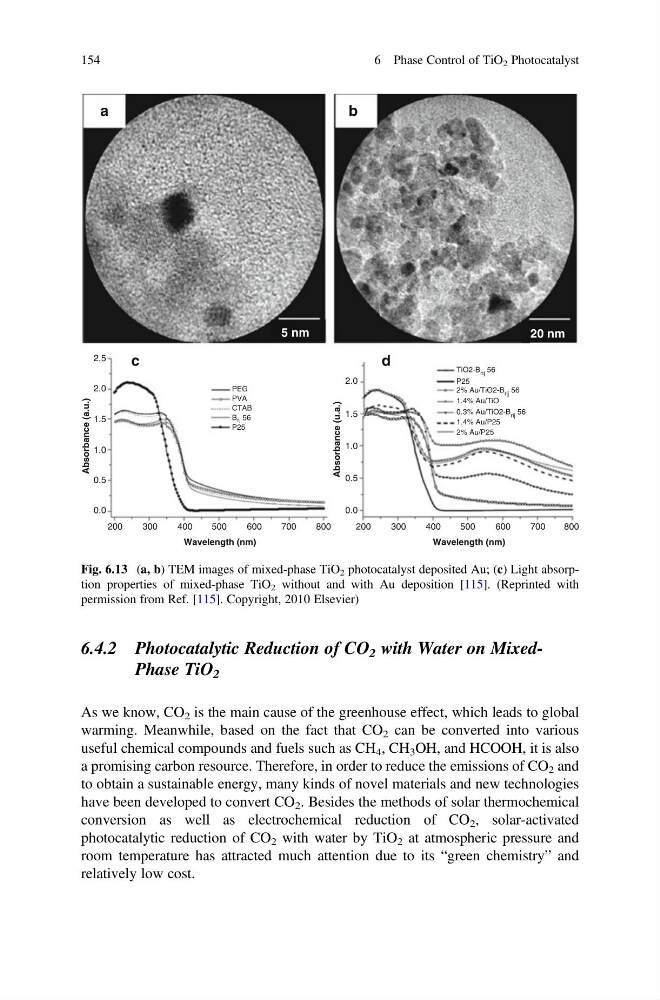
Fig. 6.13 (a, b) TEM images of mixed-phase TiO 2 photocatalyst deposited Au; (c) Light absorption properties of mixed-phase TiO 2 without and with Au deposition [115]. (Reprinted with
permission from Ref. [115]. Copyright, 2010 Elsevier)
154
6 Phase Control of TiO 2 Photocatalyst
As we know, CO 2 is the main cause of the greenhouse effect, which leads to global
warming. Meanwhile, based on the fact that CO 2 can be converted into various
useful chemical compounds and fuels such as CH 4 , CH 3 OH, and HCOOH, it is also
a promising carbon resource. Therefore, in order to reduce the emissions of CO 2 and
to obtain a sustainable energy, many kinds of novel materials and new technologies
have been developed to convert CO 2 . Besides the methods of solar thermochemical
conversion as well as electrochemical reduction of CO 2 , solar-activated
photocatalytic reduction of CO 2 with water by TiO 2 at atmospheric pressure and
room temperature has attracted much attention due to its “green chemistry” and
relatively low cost.
a
b
c
d
2.5
2.0
1.5
1.0
0.5
0.0
200
300
400
500
600
700
800
200
0.0
0.5
1.0
1.5
Absorbance (u.a.)
2.0
5 nm
20 nm
300
400
500
600
700
800
Wavelength (nm)
Wavelength (nm)
Absorbance (a.u.)
P25
Brij 56
CTAB
PVA
PEG
TiO2-B rij 56
2% Au/TiO2-B rij 56
1.4% Au/TiO
0.3% Au/TiO2-B rij 56
1.4% Au/P25
2% Au/P25
P25
Fig. 6.13 (a, b) TEM images of mixed-phase TiO 2 photocatalyst deposited Au; (c) Light absorption properties of mixed-phase TiO 2 without and with Au deposition [115]. (Reprinted with
permission from Ref. [115]. Copyright, 2010 Elsevier)
154
6 Phase Control of TiO 2 Photocatalyst