

During the process of CO 2 photocatalytic reduction with H 2 O by TiO 2 , the
irradiation of solar light activates the generation of electron–hole pairs in TiO 2
nanomaterials. The excited electrons in the conduction band (CB) of TiO 2
photocatalyst migrate to the surface to reduce CO 2 . Meanwhile, the holes left in
the valence band (VB) of TiO 2 can oxidize H 2 O into O 2 .
It has been proved that the above photocatalytic process had a close relation with
the phase type of TiO 2 . Li et al. [117] investigated the CO 2 photoreduction with
water vapor on three types of TiO 2 nanocrystal polymorphs (anatase, rutile, and
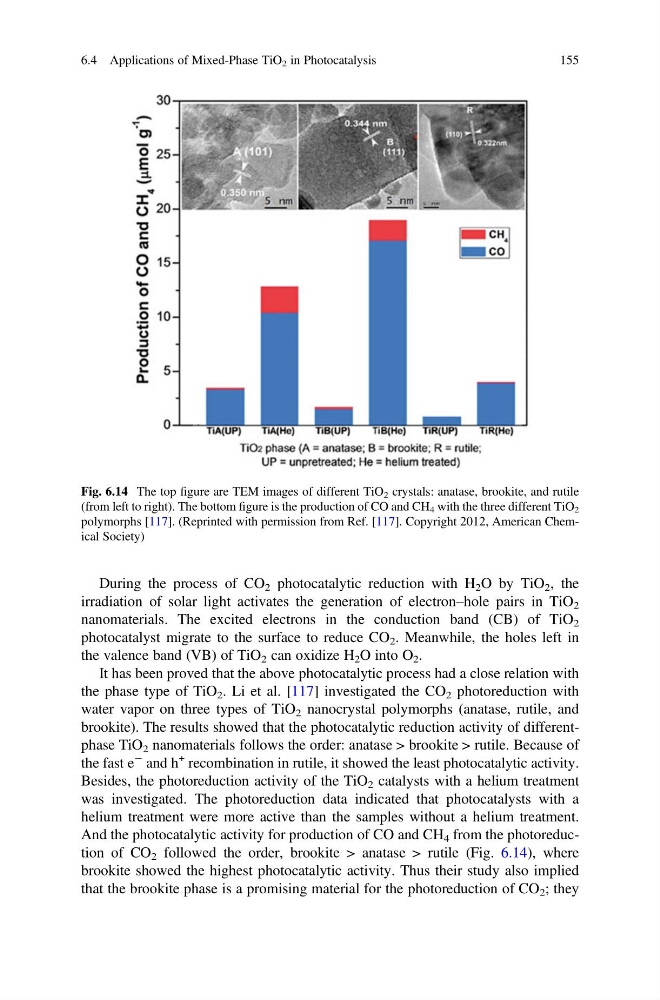
brookite). The results showed that the photocatalytic reduction activity of differentphase TiO 2 nanomaterials follows the order: anatase > brookite > rutile. Because of
the fast e
À and h
+ recombination in rutile, it showed the least photocatalytic activity.
Besides, the photoreduction activity of the TiO 2 catalysts with a helium treatment
was investigated. The photoreduction data indicated that photocatalysts with a
helium treatment were more active than the samples without a helium treatment.
And the photocatalytic activity for production of CO and CH 4 from the photoreduction of CO 2 followed the order, brookite > anatase > rutile (Fig. 6.14), where
brookite showed the highest photocatalytic activity. Thus their study also implied
that the brookite phase is a promising material for the photoreduction of CO 2 ; they
Fig. 6.14 The top figure are TEM images of different TiO 2 crystals: anatase, brookite, and rutile
(from left to right). The bottom figure is the production of CO and CH 4 with the three different TiO 2
polymorphs [117]. (Reprinted with permission from Ref. [117]. Copyright 2012, American Chemical Society)
6.4 Applications of Mixed-Phase TiO 2 in Photocatalysis
155
irradiation of solar light activates the generation of electron–hole pairs in TiO 2
nanomaterials. The excited electrons in the conduction band (CB) of TiO 2
photocatalyst migrate to the surface to reduce CO 2 . Meanwhile, the holes left in
the valence band (VB) of TiO 2 can oxidize H 2 O into O 2 .
It has been proved that the above photocatalytic process had a close relation with
the phase type of TiO 2 . Li et al. [117] investigated the CO 2 photoreduction with
water vapor on three types of TiO 2 nanocrystal polymorphs (anatase, rutile, and
brookite). The results showed that the photocatalytic reduction activity of differentphase TiO 2 nanomaterials follows the order: anatase > brookite > rutile. Because of
the fast e
À and h
+ recombination in rutile, it showed the least photocatalytic activity.
Besides, the photoreduction activity of the TiO 2 catalysts with a helium treatment
was investigated. The photoreduction data indicated that photocatalysts with a
helium treatment were more active than the samples without a helium treatment.
And the photocatalytic activity for production of CO and CH 4 from the photoreduction of CO 2 followed the order, brookite > anatase > rutile (Fig. 6.14), where
brookite showed the highest photocatalytic activity. Thus their study also implied
that the brookite phase is a promising material for the photoreduction of CO 2 ; they
Fig. 6.14 The top figure are TEM images of different TiO 2 crystals: anatase, brookite, and rutile
(from left to right). The bottom figure is the production of CO and CH 4 with the three different TiO 2
polymorphs [117]. (Reprinted with permission from Ref. [117]. Copyright 2012, American Chemical Society)
6.4 Applications of Mixed-Phase TiO 2 in Photocatalysis
155