

modification of the light absorption properties, yielding an additional absorption
band around 550 nm. It could be attributed to a plasmon resonance phenomenon
[116] owing to collective oscillations of the conduction electrons located on the 6s
orbital of Au and induced by the incident electromagnetic wave. In addition to this
plasmon absorption, Au deposition also benefited to shift the absorption spectrum of
TiO 2 photocatalysts deeper into the visible light range of 380–450 nm. This
enhanced light absorption in the visible region was demonstrated to contribute to
the improved photocatalytic performance of TiO 2 for the hydrogen production under
the irradiation of simulated solar light. Furthermore, they pointed out that there were
various factors which were crucial to improve H 2 evolution efficiency: (i) the surface
and the crystallographic porosity properties of the TiO 2 anatase/rutile photocatalyst,
(ii) the anatase/rutile ratio, (iii) the amount and nature of the metallic cocatalyst,
(iv) the metal–support interactions, and (v) the relative content of sacrificial reagent.
After studying the influence of these different factors in depth, they optimized the
experimental conditions, obtaining the important H 2 production efficiency up to120
μmol min
À1 over days without deactivation and with very low amounts of sacrificial
reagent.
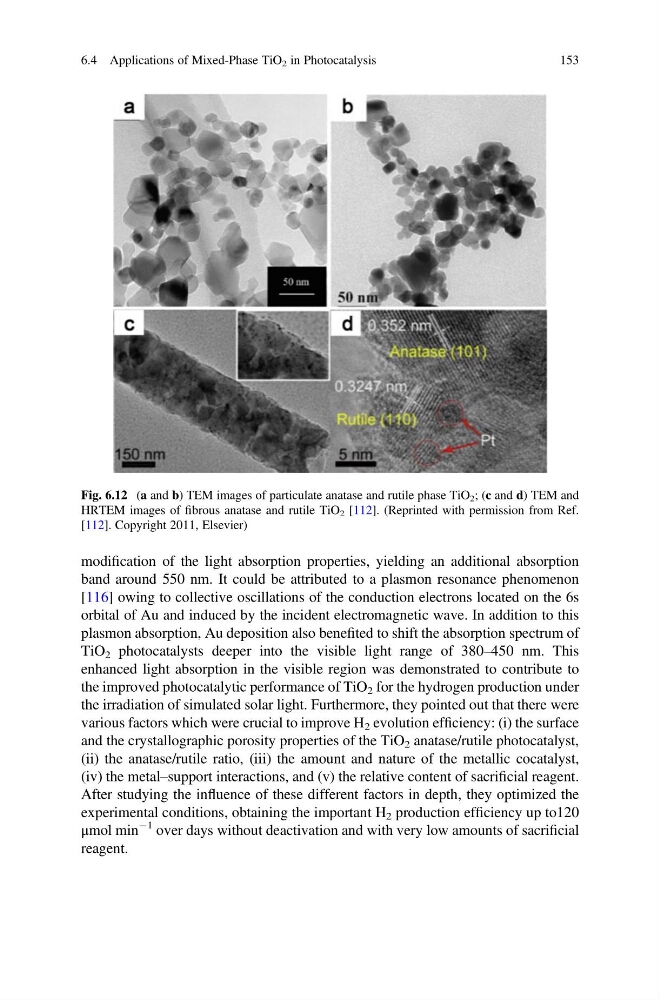
Fig. 6.12 (a and b) TEM images of particulate anatase and rutile phase TiO 2 ; (c and d) TEM and
HRTEM images of fibrous anatase and rutile TiO 2 [112]. (Reprinted with permission from Ref.
[112]. Copyright 2011, Elsevier)
6.4 Applications of Mixed-Phase TiO 2 in Photocatalysis
153
band around 550 nm. It could be attributed to a plasmon resonance phenomenon
[116] owing to collective oscillations of the conduction electrons located on the 6s
orbital of Au and induced by the incident electromagnetic wave. In addition to this
plasmon absorption, Au deposition also benefited to shift the absorption spectrum of
TiO 2 photocatalysts deeper into the visible light range of 380–450 nm. This
enhanced light absorption in the visible region was demonstrated to contribute to
the improved photocatalytic performance of TiO 2 for the hydrogen production under
the irradiation of simulated solar light. Furthermore, they pointed out that there were
various factors which were crucial to improve H 2 evolution efficiency: (i) the surface
and the crystallographic porosity properties of the TiO 2 anatase/rutile photocatalyst,
(ii) the anatase/rutile ratio, (iii) the amount and nature of the metallic cocatalyst,
(iv) the metal–support interactions, and (v) the relative content of sacrificial reagent.
After studying the influence of these different factors in depth, they optimized the
experimental conditions, obtaining the important H 2 production efficiency up to120
μmol min
À1 over days without deactivation and with very low amounts of sacrificial
reagent.
Fig. 6.12 (a and b) TEM images of particulate anatase and rutile phase TiO 2 ; (c and d) TEM and
HRTEM images of fibrous anatase and rutile TiO 2 [112]. (Reprinted with permission from Ref.
[112]. Copyright 2011, Elsevier)
6.4 Applications of Mixed-Phase TiO 2 in Photocatalysis
153