

Besides, the agglomeration of TiO 2 product is also serious. All of the before
mentioned can easily decrease the photocatalytic activity of mixed-phase TiO 2 .
Therefore, in recent years, these methods are used less and less.
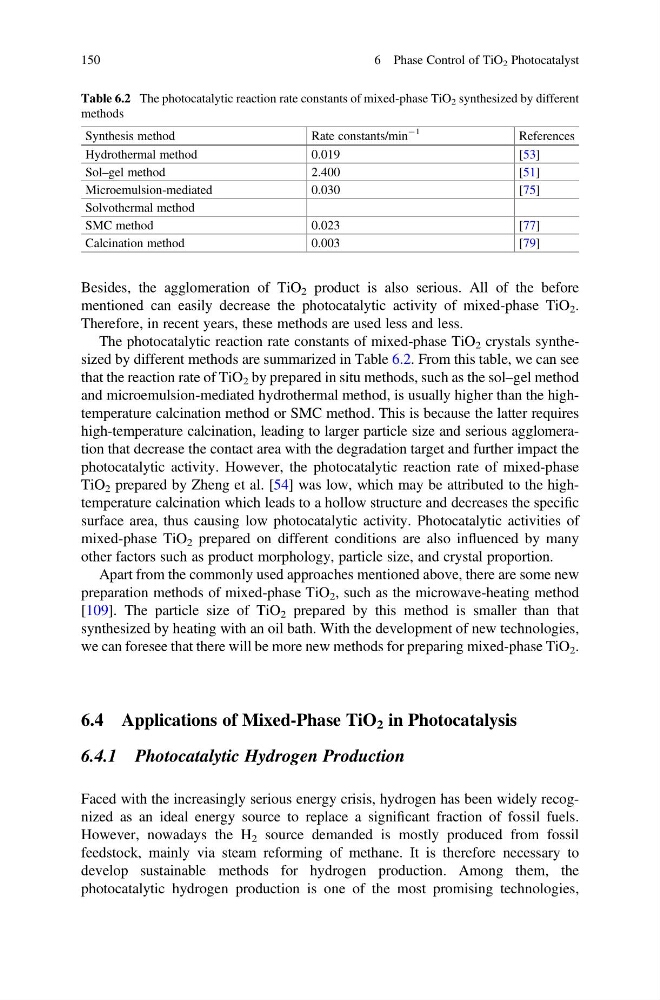
The photocatalytic reaction rate constants of mixed-phase TiO 2 crystals synthesized by different methods are summarized in Table 6.2. From this table, we can see
that the reaction rate of TiO 2 by prepared in situ methods, such as the sol–gel method
and microemulsion-mediated hydrothermal method, is usually higher than the hightemperature calcination method or SMC method. This is because the latter requires
high-temperature calcination, leading to larger particle size and serious agglomeration that decrease the contact area with the degradation target and further impact the
photocatalytic activity. However, the photocatalytic reaction rate of mixed-phase
TiO 2 prepared by Zheng et al. [54] was low, which may be attributed to the hightemperature calcination which leads to a hollow structure and decreases the specific
surface area, thus causing low photocatalytic activity. Photocatalytic activities of
mixed-phase TiO 2 prepared on different conditions are also influenced by many
other factors such as product morphology, particle size, and crystal proportion.
Apart from the commonly used approaches mentioned above, there are some new
preparation methods of mixed-phase TiO 2 , such as the microwave-heating method
[109]. The particle size of TiO 2 prepared by this method is smaller than that
synthesized by heating with an oil bath. With the development of new technologies,
we can foresee that there will be more new methods for preparing mixed-phase TiO 2 .
6.4 Applications of Mixed-Phase TiO 2 in Photocatalysis
6.4.1 Photocatalytic Hydrogen Production
Faced with the increasingly serious energy crisis, hydrogen has been widely recognized as an ideal energy source to replace a significant fraction of fossil fuels.
However, nowadays the H 2 source demanded is mostly produced from fossil
feedstock, mainly via steam reforming of methane. It is therefore necessary to
develop sustainable methods for hydrogen production. Among them, the
photocatalytic hydrogen production is one of the most promising technologies,
Table 6.2 The photocatalytic reaction rate constants of mixed-phase TiO 2 synthesized by different
methods
Synthesis method
Rate constants/min
À1
References
Hydrothermal method
0.019
[53]
Sol–gel method
2.400
[51]
Microemulsion-mediated
0.030
[75]
Solvothermal method
SMC method
0.023
[77]
Calcination method
0.003
[79]
150
6 Phase Control of TiO 2 Photocatalyst
mentioned can easily decrease the photocatalytic activity of mixed-phase TiO 2 .
Therefore, in recent years, these methods are used less and less.
The photocatalytic reaction rate constants of mixed-phase TiO 2 crystals synthesized by different methods are summarized in Table 6.2. From this table, we can see
that the reaction rate of TiO 2 by prepared in situ methods, such as the sol–gel method
and microemulsion-mediated hydrothermal method, is usually higher than the hightemperature calcination method or SMC method. This is because the latter requires
high-temperature calcination, leading to larger particle size and serious agglomeration that decrease the contact area with the degradation target and further impact the
photocatalytic activity. However, the photocatalytic reaction rate of mixed-phase
TiO 2 prepared by Zheng et al. [54] was low, which may be attributed to the hightemperature calcination which leads to a hollow structure and decreases the specific
surface area, thus causing low photocatalytic activity. Photocatalytic activities of
mixed-phase TiO 2 prepared on different conditions are also influenced by many
other factors such as product morphology, particle size, and crystal proportion.
Apart from the commonly used approaches mentioned above, there are some new
preparation methods of mixed-phase TiO 2 , such as the microwave-heating method
[109]. The particle size of TiO 2 prepared by this method is smaller than that
synthesized by heating with an oil bath. With the development of new technologies,
we can foresee that there will be more new methods for preparing mixed-phase TiO 2 .
6.4 Applications of Mixed-Phase TiO 2 in Photocatalysis
6.4.1 Photocatalytic Hydrogen Production
Faced with the increasingly serious energy crisis, hydrogen has been widely recognized as an ideal energy source to replace a significant fraction of fossil fuels.
However, nowadays the H 2 source demanded is mostly produced from fossil
feedstock, mainly via steam reforming of methane. It is therefore necessary to
develop sustainable methods for hydrogen production. Among them, the
photocatalytic hydrogen production is one of the most promising technologies,
Table 6.2 The photocatalytic reaction rate constants of mixed-phase TiO 2 synthesized by different
methods
Synthesis method
Rate constants/min
À1
References
Hydrothermal method
0.019
[53]
Sol–gel method
2.400
[51]
Microemulsion-mediated
0.030
[75]
Solvothermal method
SMC method
0.023
[77]
Calcination method
0.003
[79]
150
6 Phase Control of TiO 2 Photocatalyst