

which possesses various advantages, such as sustainability of the primary energy
source (the solar light), the renewability of the starting feedstock, as well as the
possible production of by-products with a high added value [110]. Due to the merits
of TiO 2 such as nontoxicity, relatively cheap cost, easy to prepare, and excellent
stability under the reaction conditions, it is the most investigated photocatalyst for
H 2 production. However, the present solar-to-hydrogen energy conversion efficiency of TiO 2 is not high enough for the applications in commercial production.
The rapid recombination of photo-generated electron–hole pairs of the materials,
backward reaction, and the poor utilization of visible light hinder the practical
applications. In order to solve the problems mentioned above, many researchers
have been conducting studies concentrated on an emphasis to develop effective
remediation methods like modification of TiO 2 by noble metal loading, metal ion
doping, anion doping, dye sensitization, composite semiconductor, and metal ion
implantation. In addition, mixed-phase TiO 2 has also been investigated for hydrogen
production [91, 110–114], since mixed-phase TiO 2 nanomaterials demonstrated
higher performances than the correspondent monophasic systems in many
photocatalytic processes.
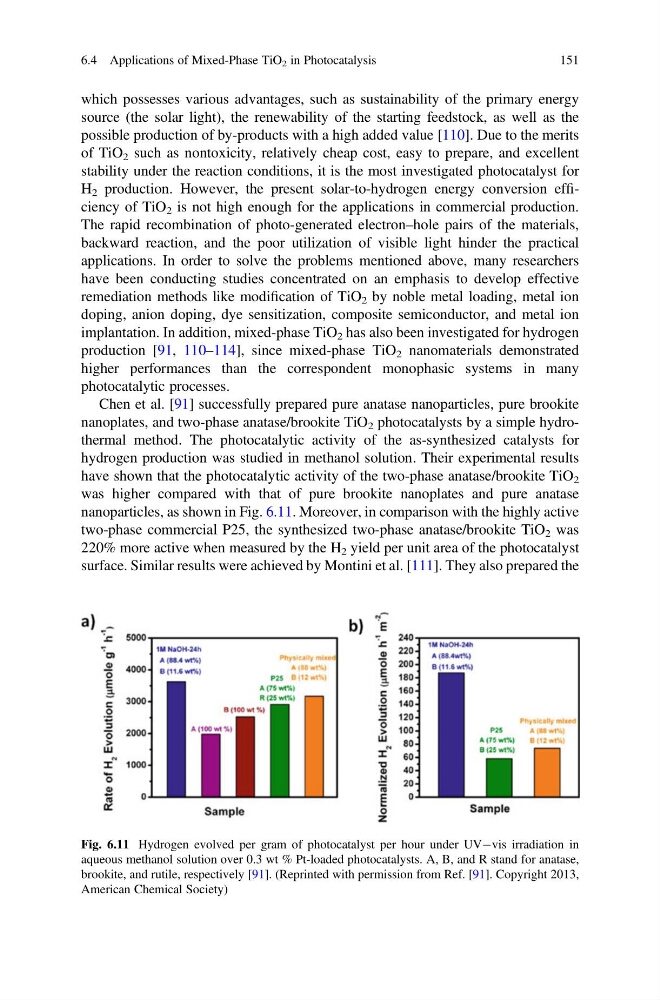
Chen et al. [91] successfully prepared pure anatase nanoparticles, pure brookite
nanoplates, and two-phase anatase/brookite TiO 2 photocatalysts by a simple hydrothermal method. The photocatalytic activity of the as-synthesized catalysts for
hydrogen production was studied in methanol solution. Their experimental results
have shown that the photocatalytic activity of the two-phase anatase/brookite TiO 2
was higher compared with that of pure brookite nanoplates and pure anatase
nanoparticles, as shown in Fig. 6.11. Moreover, in comparison with the highly active
two-phase commercial P25, the synthesized two-phase anatase/brookite TiO 2 was
220% more active when measured by the H 2 yield per unit area of the photocatalyst
surface. Similar results were achieved by Montini et al. [111]. They also prepared the
Fig. 6.11 Hydrogen evolved per gram of photocatalyst per hour under UVÀvis irradiation in
aqueous methanol solution over 0.3 wt % Pt-loaded photocatalysts. A, B, and R stand for anatase,
brookite, and rutile, respectively [91]. (Reprinted with permission from Ref. [91]. Copyright 2013,
American Chemical Society)
6.4 Applications of Mixed-Phase TiO 2 in Photocatalysis
151
source (the solar light), the renewability of the starting feedstock, as well as the
possible production of by-products with a high added value [110]. Due to the merits
of TiO 2 such as nontoxicity, relatively cheap cost, easy to prepare, and excellent
stability under the reaction conditions, it is the most investigated photocatalyst for
H 2 production. However, the present solar-to-hydrogen energy conversion efficiency of TiO 2 is not high enough for the applications in commercial production.
The rapid recombination of photo-generated electron–hole pairs of the materials,
backward reaction, and the poor utilization of visible light hinder the practical
applications. In order to solve the problems mentioned above, many researchers
have been conducting studies concentrated on an emphasis to develop effective
remediation methods like modification of TiO 2 by noble metal loading, metal ion
doping, anion doping, dye sensitization, composite semiconductor, and metal ion
implantation. In addition, mixed-phase TiO 2 has also been investigated for hydrogen
production [91, 110–114], since mixed-phase TiO 2 nanomaterials demonstrated
higher performances than the correspondent monophasic systems in many
photocatalytic processes.
Chen et al. [91] successfully prepared pure anatase nanoparticles, pure brookite
nanoplates, and two-phase anatase/brookite TiO 2 photocatalysts by a simple hydrothermal method. The photocatalytic activity of the as-synthesized catalysts for
hydrogen production was studied in methanol solution. Their experimental results
have shown that the photocatalytic activity of the two-phase anatase/brookite TiO 2
was higher compared with that of pure brookite nanoplates and pure anatase
nanoparticles, as shown in Fig. 6.11. Moreover, in comparison with the highly active
two-phase commercial P25, the synthesized two-phase anatase/brookite TiO 2 was
220% more active when measured by the H 2 yield per unit area of the photocatalyst
surface. Similar results were achieved by Montini et al. [111]. They also prepared the
Fig. 6.11 Hydrogen evolved per gram of photocatalyst per hour under UVÀvis irradiation in
aqueous methanol solution over 0.3 wt % Pt-loaded photocatalysts. A, B, and R stand for anatase,
brookite, and rutile, respectively [91]. (Reprinted with permission from Ref. [91]. Copyright 2013,
American Chemical Society)
6.4 Applications of Mixed-Phase TiO 2 in Photocatalysis
151