

However, it is easy to agglomerate in the process of calcination, and the particles size
of product is large, resulting in the decrease of the photocatalytic activity.
Generally speaking, both the SMC method and the high-temperature calcination
method require a high temperature to form the mixed-phase TiO 2 or close contact
between different crystalline forms. The electron micrographs and XRD results
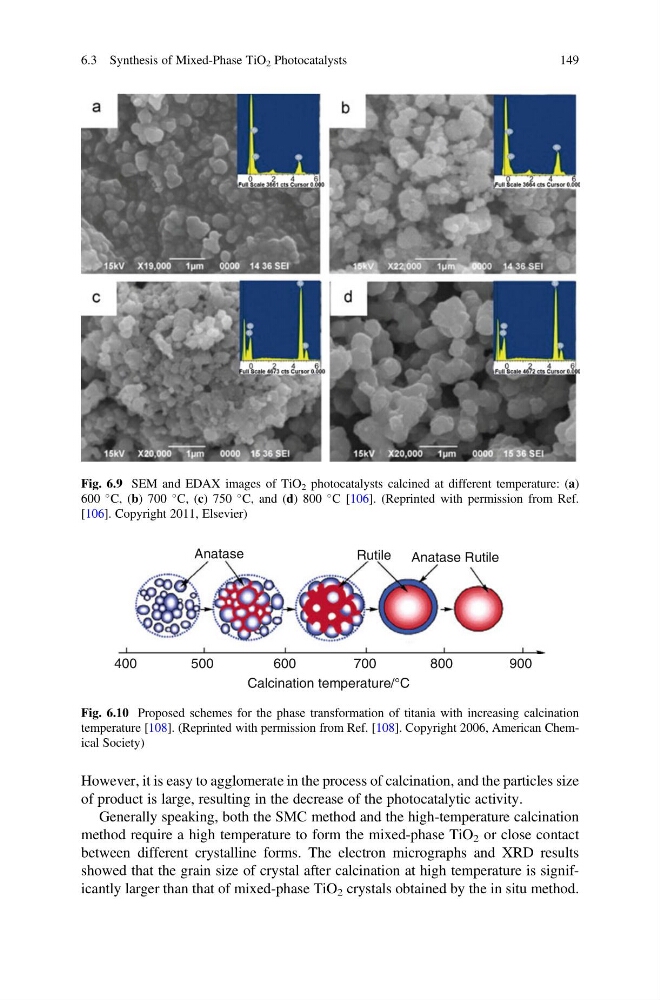
showed that the grain size of crystal after calcination at high temperature is significantly larger than that of mixed-phase TiO 2 crystals obtained by the in situ method.
Fig. 6.9 SEM and EDAX images of TiO 2 photocatalysts calcined at different temperature: (a)
600
C, (b) 700
C, (c) 750
C, and (d) 800
C [106]. (Reprinted with permission from Ref.
[106]. Copyright 2011, Elsevier)
Anatase
Rutile Anatase Rutile
500
400
600
700
800
900
Calcination temperature/°C
Fig. 6.10 Proposed schemes for the phase transformation of titania with increasing calcination
temperature [108]. (Reprinted with permission from Ref. [108]. Copyright 2006, American Chemical Society)
6.3 Synthesis of Mixed-Phase TiO 2 Photocatalysts
149
of product is large, resulting in the decrease of the photocatalytic activity.
Generally speaking, both the SMC method and the high-temperature calcination
method require a high temperature to form the mixed-phase TiO 2 or close contact
between different crystalline forms. The electron micrographs and XRD results
showed that the grain size of crystal after calcination at high temperature is significantly larger than that of mixed-phase TiO 2 crystals obtained by the in situ method.
Fig. 6.9 SEM and EDAX images of TiO 2 photocatalysts calcined at different temperature: (a)
600
C, (b) 700
C, (c) 750
C, and (d) 800
C [106]. (Reprinted with permission from Ref.
[106]. Copyright 2011, Elsevier)
Anatase
Rutile Anatase Rutile
500
400
600
700
800
900
Calcination temperature/°C
Fig. 6.10 Proposed schemes for the phase transformation of titania with increasing calcination
temperature [108]. (Reprinted with permission from Ref. [108]. Copyright 2006, American Chemical Society)
6.3 Synthesis of Mixed-Phase TiO 2 Photocatalysts
149