

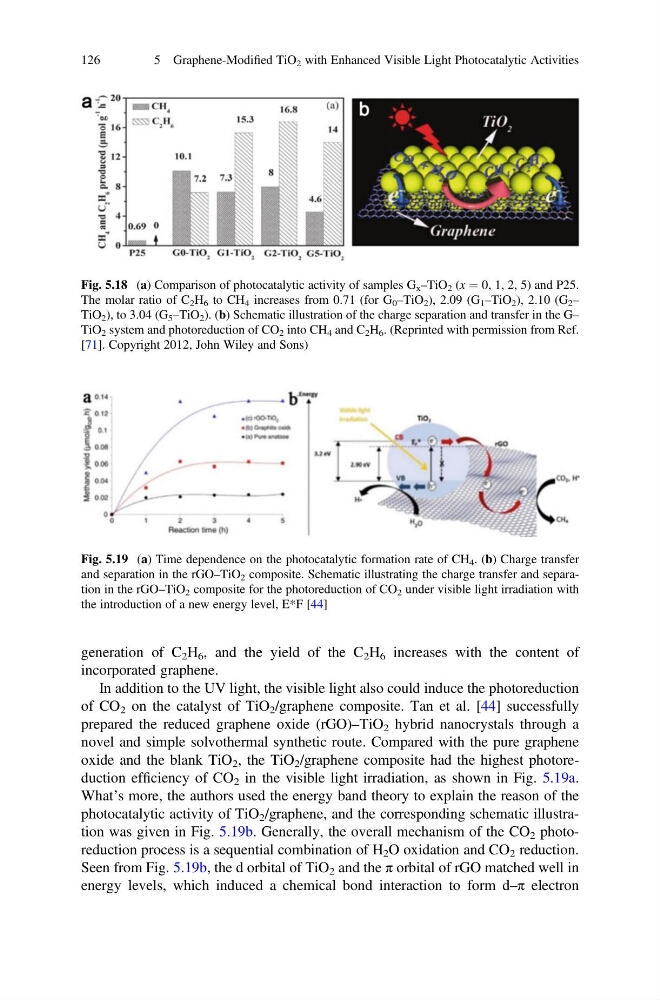
generation of C 2 H 6 , and the yield of the C 2 H 6 increases with the content of
incorporated graphene.
In addition to the UV light, the visible light also could induce the photoreduction
of CO 2 on the catalyst of TiO 2 /graphene composite. Tan et al. [44] successfully
prepared the reduced graphene oxide (rGO)–TiO 2 hybrid nanocrystals through a
novel and simple solvothermal synthetic route. Compared with the pure graphene
oxide and the blank TiO 2 , the TiO 2 /graphene composite had the highest photoreduction efficiency of CO 2 in the visible light irradiation, as shown in Fig. 5.19a.
What’s more, the authors used the energy band theory to explain the reason of the
photocatalytic activity of TiO 2 /graphene, and the corresponding schematic illustration was given in Fig. 5.19b. Generally, the overall mechanism of the CO 2 photoreduction process is a sequential combination of H 2 O oxidation and CO 2 reduction.
Seen from Fig. 5.19b, the d orbital of TiO 2 and the π orbital of rGO matched well in
energy levels, which induced a chemical bond interaction to form d–π electron
Fig. 5.18 (a) Comparison of photocatalytic activity of samples G x –TiO 2 (x ¼ 0, 1, 2, 5) and P25.
The molar ratio of C 2 H 6 to CH 4 increases from 0.71 (for G 0 –TiO 2 ), 2.09 (G 1 –TiO 2 ), 2.10 (G 2 –
TiO 2 ), to 3.04 (G 5 –TiO 2 ). (b) Schematic illustration of the charge separation and transfer in the G–
TiO 2 system and photoreduction of CO 2 into CH 4 and C 2 H 6 . (Reprinted with permission from Ref.
[71]. Copyright 2012, John Wiley and Sons)
Fig. 5.19 (a) Time dependence on the photocatalytic formation rate of CH 4 . (b) Charge transfer
and separation in the rGO–TiO 2 composite. Schematic illustrating the charge transfer and separation in the rGO–TiO 2 composite for the photoreduction of CO 2 under visible light irradiation with
the introduction of a new energy level, E*F [44]
126
5 Graphene-Modified TiO 2 with Enhanced Visible Light Photocatalytic Activities
incorporated graphene.
In addition to the UV light, the visible light also could induce the photoreduction
of CO 2 on the catalyst of TiO 2 /graphene composite. Tan et al. [44] successfully
prepared the reduced graphene oxide (rGO)–TiO 2 hybrid nanocrystals through a
novel and simple solvothermal synthetic route. Compared with the pure graphene
oxide and the blank TiO 2 , the TiO 2 /graphene composite had the highest photoreduction efficiency of CO 2 in the visible light irradiation, as shown in Fig. 5.19a.
What’s more, the authors used the energy band theory to explain the reason of the
photocatalytic activity of TiO 2 /graphene, and the corresponding schematic illustration was given in Fig. 5.19b. Generally, the overall mechanism of the CO 2 photoreduction process is a sequential combination of H 2 O oxidation and CO 2 reduction.
Seen from Fig. 5.19b, the d orbital of TiO 2 and the π orbital of rGO matched well in
energy levels, which induced a chemical bond interaction to form d–π electron
Fig. 5.18 (a) Comparison of photocatalytic activity of samples G x –TiO 2 (x ¼ 0, 1, 2, 5) and P25.
The molar ratio of C 2 H 6 to CH 4 increases from 0.71 (for G 0 –TiO 2 ), 2.09 (G 1 –TiO 2 ), 2.10 (G 2 –
TiO 2 ), to 3.04 (G 5 –TiO 2 ). (b) Schematic illustration of the charge separation and transfer in the G–
TiO 2 system and photoreduction of CO 2 into CH 4 and C 2 H 6 . (Reprinted with permission from Ref.
[71]. Copyright 2012, John Wiley and Sons)
Fig. 5.19 (a) Time dependence on the photocatalytic formation rate of CH 4 . (b) Charge transfer
and separation in the rGO–TiO 2 composite. Schematic illustrating the charge transfer and separation in the rGO–TiO 2 composite for the photoreduction of CO 2 under visible light irradiation with
the introduction of a new energy level, E*F [44]
126
5 Graphene-Modified TiO 2 with Enhanced Visible Light Photocatalytic Activities